
Use of Vectors in Problems Involving Points, Lines and Planes
Vectors provide a powerful and compact way to describe lines, planes, and distances in three-dimensional space.
1. Equation of a Line
A line passing through a point with position vector \( \mathbf{a} \) and having direction vector \( \mathbf{b} \) can be written as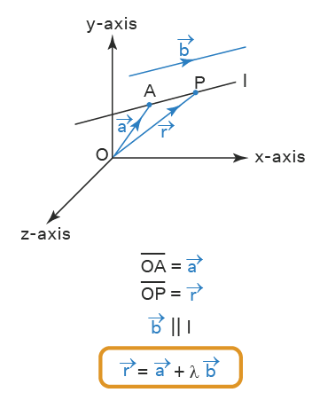
\( \mathbf{r} = \mathbf{a} + \lambda \mathbf{b} \), \( \lambda \in \mathbb{R} \)
An equivalent form using the vector product is
\( (\mathbf{r} – \mathbf{a}) \times \mathbf{b} = \mathbf{0} \)
This states that the vector joining any point on the line to the fixed point \( \mathbf{a} \) is parallel to \( \mathbf{b} \).
2. Equation of a Plane
A plane with normal vector \( \mathbf{n} \) passing through a point with position vector \( \mathbf{a} \) is given by

\( (\mathbf{r} – \mathbf{a}) \cdot \mathbf{n} = 0 \)
In cartesian form, if \( \mathbf{n} = \langle A, B, C \rangle \), the plane can be written as

\( Ax + By + Cz + D = 0 \)
Applications
(i) Distance from a Point to a Plane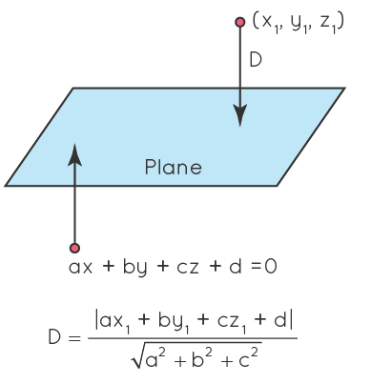
For a plane
\( Ax + By + Cz + D = 0 \)
and a point \( (x_1, y_1, z_1) \), the perpendicular distance is
\( \displaystyle d = \dfrac{|Ax_1 + By_1 + Cz_1 + D|}{\sqrt{A^2 + B^2 + C^2}} \)
(ii) Line of Intersection of Two Planes
If two planes intersect, their line of intersection:
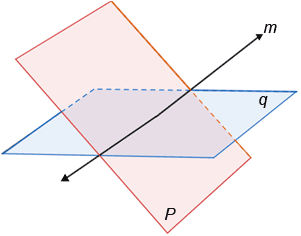
- lies in both planes
- has direction vector equal to the cross product of the two normal vectors
That is, if the planes have normals \( \mathbf{n}_1 \) and \( \mathbf{n}_2 \), then the direction of the line is
\( \mathbf{n}_1 \times \mathbf{n}_2 \)
(iii) Shortest Distance Between Two Skew Lines
Two lines are skew if they do not intersect and are not parallel.
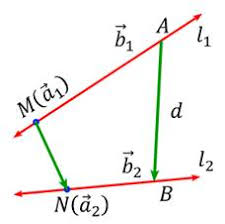
For lines
\( \mathbf{r} = \mathbf{a}_1 + \lambda \mathbf{b}_1 \), \( \mathbf{r} = \mathbf{a}_2 + \mu \mathbf{b}_2 \)
the shortest distance is
\( \displaystyle d = \dfrac{|(\mathbf{a}_2 – \mathbf{a}_1)\cdot(\mathbf{b}_1 \times \mathbf{b}_2)|}{|\mathbf{b}_1 \times \mathbf{b}_2|} \)
Example
Find the distance from the point \( (1,2,3) \) to the plane
\( 2x – y + 2z – 4 = 0 \).
▶️ Answer/Explanation
\( d = \dfrac{|2(1) – 2 + 2(3) – 4|}{\sqrt{2^2 + (-1)^2 + 2^2}} \)
\( = \dfrac{|2 – 2 + 6 – 4|}{3} = \dfrac{2}{3} \)
Conclusion: The distance is \( \dfrac{2}{3} \).
Example
Find a vector equation for the line of intersection of the planes
\( x + y + z = 1 \) \( 2x – y + z = 0 \)
▶️ Answer/Explanation
Normal vectors:
\( \mathbf{n}_1 = \langle 1,1,1 \rangle \), \( \mathbf{n}_2 = \langle 2,-1,1 \rangle \)
Direction vector:
\( \mathbf{n}_1 \times \mathbf{n}_2 = \langle 2,1,-3 \rangle \)
A point on the line is \( (0,1,0) \).
\( \mathbf{r} = \langle 0,1,0 \rangle + \lambda \langle 2,1,-3 \rangle \)
Conclusion: This is the required line of intersection.
Example
Find the shortest distance between the lines
\( \mathbf{r} = \langle 1,0,0 \rangle + \lambda \langle 1,1,0 \rangle \) \( \mathbf{r} = \langle 0,1,1 \rangle + \mu \langle 1,-1,1 \rangle \)
▶️ Answer/Explanation
Direction vectors:
\( \mathbf{b}_1 = \langle 1,1,0 \rangle \), \( \mathbf{b}_2 = \langle 1,-1,1 \rangle \)
Using the formula:
\( d = \dfrac{|(\langle -1,1,1 \rangle)\cdot(\mathbf{b}_1 \times \mathbf{b}_2)|}{|\mathbf{b}_1 \times \mathbf{b}_2|} \)
Evaluating gives
\( d = \dfrac{2}{\sqrt{3}} \)
Conclusion: The shortest distance is \( \dfrac{2}{\sqrt{3}} \).