
Equation of a Plane
In three-dimensional geometry, a plane can be described using vectors in several equivalent forms.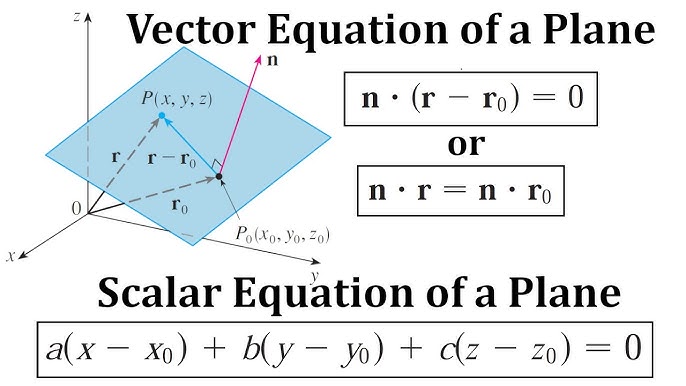
\( \mathbf{r} \cdot \mathbf{n} = p \)
\( \mathbf{r} = \mathbf{a} + s\mathbf{b} + t\mathbf{c} \)
and to convert these into cartesian equations where required.
1. Plane in the Form \( \mathbf{r} \cdot \mathbf{n} = p \)
Let
\( \mathbf{r} = x\mathbf{i} + y\mathbf{j} + z\mathbf{k} \)
\( \mathbf{n} = A\mathbf{i} + B\mathbf{j} + C\mathbf{k} \)
Then the plane
\( \mathbf{r} \cdot \mathbf{n} = p \)
represents a plane whose normal vector is \( \mathbf{n} \). Expanding gives the cartesian equation
\( Ax + By + Cz = p \)
This form is especially useful when the normal vector is known directly.
2. Plane in the Form \( \mathbf{r} = \mathbf{a} + s\mathbf{b} + t\mathbf{c} \)
This is the parametric (vector) equation of a plane.
Here:
- \( \mathbf{a} \) is the position vector of a fixed point on the plane
- \( \mathbf{b} \) and \( \mathbf{c} \) are two non-parallel direction vectors lying in the plane
\( s, t \in \mathbb{R} \)
A normal vector to the plane is
\( \mathbf{n} = \mathbf{b} \times \mathbf{c} \)
This allows conversion to the form \( \mathbf{r} \cdot \mathbf{n} = p \).
3. Conversion to Cartesian Form
From a normal vector \( \mathbf{n} = \langle A, B, C \rangle \) and a point \( (x_0, y_0, z_0) \) on the plane, the cartesian equation is
\( A(x – x_0) + B(y – y_0) + C(z – z_0) = 0 \)
which may be written as
\( Ax + By + Cz + D = 0 \)
Example
Find the cartesian equation of the plane
\( \mathbf{r} \cdot (2\mathbf{i} – \mathbf{j} + 3\mathbf{k}) = 6 \).
▶️ Answer / Explanation
Let \( \mathbf{r} = x\mathbf{i} + y\mathbf{j} + z\mathbf{k} \).
\( (x, y, z)\cdot(2, -1, 3) = 6 \)
\( 2x – y + 3z = 6 \)
Conclusion: The cartesian equation is \( 2x – y + 3z = 6 \).
Example
Find a vector equation of the plane passing through the point
\( (1,0,2) \)
and parallel to the vectors
\( \mathbf{b} = \mathbf{i} + \mathbf{j} \), \( \mathbf{c} = \mathbf{j} + \mathbf{k} \).
▶️ Answer / Explanation
Position vector of the point:
\( \mathbf{a} = \mathbf{i} + 2\mathbf{k} \)
Hence the plane is
\( \mathbf{r} = \mathbf{a} + s\mathbf{b} + t\mathbf{c} \)
\( \mathbf{r} = (\mathbf{i} + 2\mathbf{k}) + s(\mathbf{i} + \mathbf{j}) + t(\mathbf{j} + \mathbf{k}) \)
Conclusion: This is the required vector equation of the plane.
Example
Convert the plane
\( \mathbf{r} = (1,2,1) + s(1,0,1) + t(0,1,1) \)
into cartesian form.
▶️ Answer / Explanation
Direction vectors:
\( \mathbf{b} = (1,0,1) \), \( \mathbf{c} = (0,1,1) \)
Normal vector:
\( \mathbf{n} = \mathbf{b} \times \mathbf{c} = (-1,-1,1) \)
Using \( \mathbf{r}\cdot\mathbf{n} = \mathbf{a}\cdot\mathbf{n} \):
\( -x – y + z = -2 \)
Conclusion: The cartesian equation is \( x + y – z = 2 \).