
Linear Transformations and Matrix Representation (2D and 3D)
A linear transformation is a mapping that sends vectors to vectors in a way that preserves vector addition and scalar multiplication.
1. Column Vectors and Linear Transformations
A vector in two dimensions is written as
\( \begin{pmatrix} x \\ y \end{pmatrix} \)
and in three dimensions as
\( \begin{pmatrix} x \\ y \\ z \end{pmatrix} \)
A linear transformation \( T \) maps vectors to vectors:
\( T(\mathbf{u} + \mathbf{v}) = T(\mathbf{u}) + T(\mathbf{v}) \)
\( T(k\mathbf{u}) = kT(\mathbf{u}) \)
2. Matrix Representation of a Linear Transformation
Every linear transformation can be represented by a matrix.
In two dimensions:
\( T\!\left(\begin{pmatrix} x \\ y \end{pmatrix}\right) = \begin{pmatrix} a & b \\ c & d \end{pmatrix} \begin{pmatrix} x \\ y \end{pmatrix} \)
In three dimensions:
\( T\!\left(\begin{pmatrix} x \\ y \\ z \end{pmatrix}\right) = \begin{pmatrix} a & b & c \\ d & e & f \\ g & h & i \end{pmatrix} \begin{pmatrix} x \\ y \\ z \end{pmatrix} \)
The columns of the matrix are obtained by finding the images of the basis vectors.
3. Finding the Transformation Matrix
In 2D, the standard basis vectors are
\( \mathbf{e}_1 = \begin{pmatrix}1\\0\end{pmatrix}, \quad \mathbf{e}_2 = \begin{pmatrix}0\\1\end{pmatrix} \) 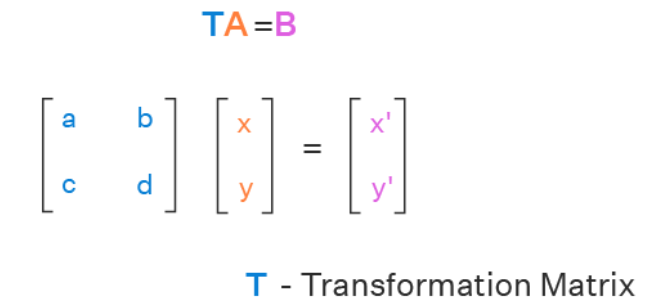
In 3D, they are
\( \mathbf{e}_1 = \begin{pmatrix}1\\0\\0\end{pmatrix},\; \mathbf{e}_2 = \begin{pmatrix}0\\1\\0\end{pmatrix},\; \mathbf{e}_3 = \begin{pmatrix}0\\0\\1\end{pmatrix} \)
The transformation matrix is formed by placing
\( T(\mathbf{e}_1), T(\mathbf{e}_2) \) (and \( T(\mathbf{e}_3) \)) as columns.
4. Common Linear Transformations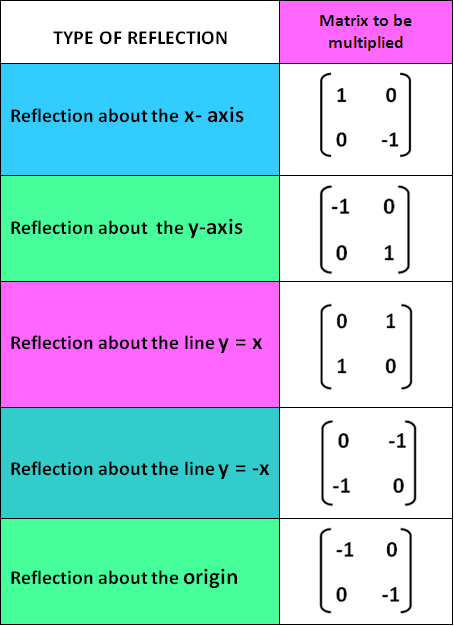
Scaling
2D: \( \begin{pmatrix} k & 0 \\ 0 & k \end{pmatrix} \)
3D: \( \begin{pmatrix} k & 0 & 0 \\ 0 & k & 0 \\ 0 & 0 & k \end{pmatrix} \)
Reflection in the x-axis (2D)
\( \begin{pmatrix} 1 & 0 \\ 0 & -1 \end{pmatrix} \)
Rotation about the z-axis (3D)
\( \begin{pmatrix} \cos\theta & -\sin\theta & 0 \\ \sin\theta & \cos\theta & 0 \\ 0 & 0 & 1 \end{pmatrix} \)
Example
A linear transformation maps
\( \begin{pmatrix}1\\0\end{pmatrix} \mapsto \begin{pmatrix}2\\1\end{pmatrix}, \quad \begin{pmatrix}0\\1\end{pmatrix} \mapsto \begin{pmatrix}-1\\3\end{pmatrix} \).
Find the transformation matrix.
▶️ Answer / Explanation
The images of the basis vectors form the columns:
\( A = \begin{pmatrix} 2 & -1 \\ 1 & 3 \end{pmatrix} \)
Conclusion: This matrix represents the transformation.
Example
A transformation in three dimensions is represented by
\( A = \begin{pmatrix} 1 & 2 & 0 \\ 0 & 1 & 1 \\ 1 & 0 & 1 \end{pmatrix} \).
Find the image of the vector \( \begin{pmatrix}2\\-1\\1\end{pmatrix} \).
▶️ Answer / Explanation
\( A\begin{pmatrix}2\\-1\\1\end{pmatrix} = \begin{pmatrix}0\\0\\3\end{pmatrix} \)
Conclusion: The image vector is \( \begin{pmatrix}0\\0\\3\end{pmatrix} \).
Example
A transformation scales vectors by factor 2 in the x-direction, leaves the y-direction unchanged, and reflects the z-direction.
Find the transformation matrix.
▶️ Answer / Explanation
The images of the basis vectors are:
\( \mathbf{e}_1 \mapsto \begin{pmatrix}2\\0\\0\end{pmatrix}, \; \mathbf{e}_2 \mapsto \begin{pmatrix}0\\1\\0\end{pmatrix}, \; \mathbf{e}_3 \mapsto \begin{pmatrix}0\\0\\-1\end{pmatrix} \)
\( A = \begin{pmatrix} 2 & 0 & 0 \\ 0 & 1 & 0 \\ 0 & 0 & -1 \end{pmatrix} \)
Conclusion: This matrix represents the required transformation.