
Combination of Transformations and Products of Matrices
Linear transformations can be combined by performing one transformation after another. In matrix terms, this corresponds to matrix multiplication.
1. Combining Linear Transformations
Suppose two linear transformations are represented by matrices:
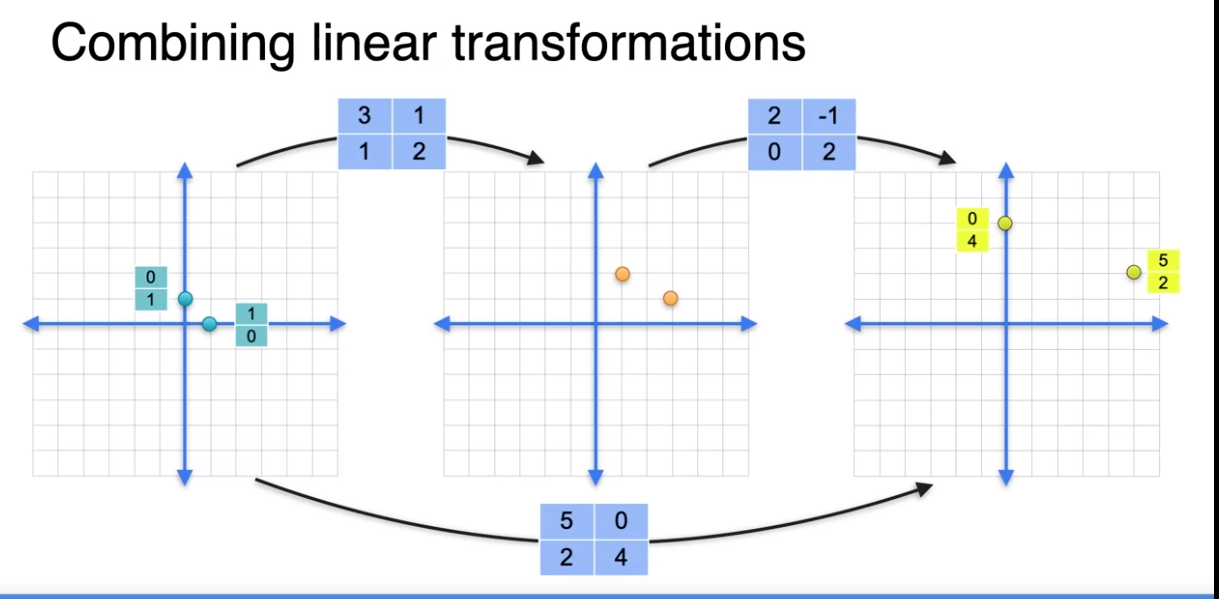
- Transformation \( T_1 \) represented by matrix \( A \)
- Transformation \( T_2 \) represented by matrix \( B \)
If a vector \( \mathbf{x} \) is first transformed by \( B \), and then by \( A \), the resulting transformation is given by
\( \mathbf{x} \mapsto AB\mathbf{x} \)
Key principle:
The transformation represented by \( AB \) is the transformation represented by \( B \) followed by the transformation represented by \( A \).
2. Matrix Multiplication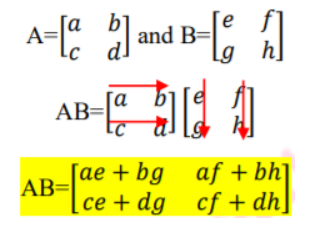
If
\( A = \begin{pmatrix} a & b \\ c & d \end{pmatrix}, \quad B = \begin{pmatrix} e & f \\ g & h \end{pmatrix} \)
then the product \( AB \) is
\( AB = \begin{pmatrix} ae + bg & af + bh \\ ce + dg & cf + dh \end{pmatrix} \)
Important properties:
Matrix multiplication is associative: \( A(BC) = (AB)C \)
Matrix multiplication is not commutative: \( AB \neq BA \) in general
3. Geometric Interpretation
When combining transformations:

- The order of transformations matters
- Different orders generally give different final images
For example, rotating then reflecting usually gives a different result from reflecting then rotating.
Example
Let
\( A = \begin{pmatrix} 0 & -1 \\ 1 & 0 \end{pmatrix} \), \( B = \begin{pmatrix} 1 & 0 \\ 0 & -1 \end{pmatrix} \)
Describe the combined transformation represented by \( AB \).
▶️ Answer / Explanation
Matrix \( B \) reflects in the x-axis.
Matrix \( A \) rotates vectors through \( 90^\circ \) anticlockwise.
\( AB = \begin{pmatrix} 0 & -1 \\ 1 & 0 \end{pmatrix} \begin{pmatrix} 1 & 0 \\ 0 & -1 \end{pmatrix} = \begin{pmatrix} 0 & 1 \\ 1 & 0 \end{pmatrix} \)
Conclusion: The transformation is reflection in the line \( y = x \).
Example
Using the matrices in Example 1, find \( BA \) and compare it with \( AB \).
▶️ Answer / Explanation
\( BA = \begin{pmatrix} 1 & 0 \\ 0 & -1 \end{pmatrix} \begin{pmatrix} 0 & -1 \\ 1 & 0 \end{pmatrix} = \begin{pmatrix} 0 & -1 \\ -1 & 0 \end{pmatrix} \)
This represents reflection in the line \( y = -x \).
Conclusion: Since \( AB \neq BA \), matrix multiplication is not commutative.
Example
A transformation \( T_1 \) scales vectors by factor 2 in the x-direction and is represented by
\( A = \begin{pmatrix} 2 & 0 & 0 \\ 0 & 1 & 0 \\ 0 & 0 & 1 \end{pmatrix} \)
A transformation \( T_2 \) reflects vectors in the \( xy \)-plane and is represented by
\( B = \begin{pmatrix} 1 & 0 & 0 \\ 0 & 1 & 0 \\ 0 & 0 & -1 \end{pmatrix} \)
Find the matrix representing \( T_2 \) followed by \( T_1 \).
▶️ Answer / Explanation
Since \( T_2 \) is followed by \( T_1 \), the matrix is \( AB \).
\( AB = \begin{pmatrix} 2 & 0 & 0 \\ 0 & 1 & 0 \\ 0 & 0 & 1 \end{pmatrix} \begin{pmatrix} 1 & 0 & 0 \\ 0 & 1 & 0 \\ 0 & 0 & -1 \end{pmatrix} = \begin{pmatrix} 2 & 0 & 0 \\ 0 & 1 & 0 \\ 0 & 0 & -1 \end{pmatrix} \)
Conclusion: This matrix represents the combined transformation.