
Transpose of a Matrix
The transpose of a matrix is formed by interchanging its rows and columns. The transpose operation is fundamental in matrix algebra and is widely used when working with matrix identities, symmetry, and linear transformations.
1. Definition of the Transpose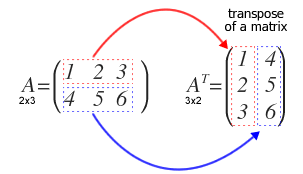
If
\( A = \begin{pmatrix} a_{11} & a_{12} & \cdots & a_{1n} \\ a_{21} & a_{22} & \cdots & a_{2n} \\ \vdots & \vdots & \ddots & \vdots \\ a_{m1} & a_{m2} & \cdots & a_{mn} \end{pmatrix} \)
then the transpose of \( A \), written \( A^{\mathrm{T}} \), is
\( A^{\mathrm{T}} = \begin{pmatrix} a_{11} & a_{21} & \cdots & a_{m1} \\ a_{12} & a_{22} & \cdots & a_{m2} \\ \vdots & \vdots & \ddots & \vdots \\ a_{1n} & a_{2n} & \cdots & a_{mn} \end{pmatrix} \)
That is, the first row of \( A \) becomes the first column of \( A^{\mathrm{T}} \), and so on.
2. Basic Properties of the Transpose
- \( (A^{\mathrm{T}})^{\mathrm{T}} = A \)
- \( (A + B)^{\mathrm{T}} = A^{\mathrm{T}} + B^{\mathrm{T}} \)
- \( (kA)^{\mathrm{T}} = kA^{\mathrm{T}} \), where \( k \) is a scalar
3. Transpose of a Product of Matrices
For matrices \( A \) and \( B \) of compatible dimensions, an extremely important identity is
\( (AB)^{\mathrm{T}} = B^{\mathrm{T}} A^{\mathrm{T}} \)
Note carefully that the order of multiplication is reversed when taking the transpose.
Why the Order Reverses
Matrix multiplication is not commutative. When transposing a product, rows become columns, which reverses the order of multiplication. This mirrors the idea that
first multiply by \( B \), then by \( A \)
corresponds to
first transpose \( A \), then transpose \( B \)
Example
Find the transpose of the matrix
\( A = \begin{pmatrix} 2 & -1 & 4 \\ 0 & 3 & 5 \end{pmatrix} \).
▶️ Answer / Explanation
Interchange rows and columns:
\( A^{\mathrm{T}} = \begin{pmatrix} 2 & 0 \\ -1 & 3 \\ 4 & 5 \end{pmatrix} \)
Conclusion: This is the transpose of \( A \).
Example
Given
\( A = \begin{pmatrix} 1 & 2 \\ 3 & 4 \end{pmatrix}, \quad B = \begin{pmatrix} 0 & 1 \\ -1 & 2 \end{pmatrix} \),
find \( (AB)^{\mathrm{T}} \).
▶️ Answer / Explanation
First calculate \( AB \):
\( AB = \begin{pmatrix} -2 & 5 \\ -4 & 11 \end{pmatrix} \)
Now transpose:
\( (AB)^{\mathrm{T}} = \begin{pmatrix} -2 & -4 \\ 5 & 11 \end{pmatrix} \)
Conclusion: This is \( (AB)^{\mathrm{T}} \).
Example
Verify that
\( (AB)^{\mathrm{T}} = B^{\mathrm{T}} A^{\mathrm{T}} \)
for the matrices in Example 2.
▶️ Answer / Explanation
First find the transposes:
\( A^{\mathrm{T}} = \begin{pmatrix} 1 & 3 \\ 2 & 4 \end{pmatrix}, \quad B^{\mathrm{T}} = \begin{pmatrix} 0 & -1 \\ 1 & 2 \end{pmatrix} \)
Now multiply:
\( B^{\mathrm{T}}A^{\mathrm{T}} = \begin{pmatrix} -2 & -4 \\ 5 & 11 \end{pmatrix} \)
This matches \( (AB)^{\mathrm{T}} \).
Conclusion: The identity is verified.