
Evaluation of \(3 \times 3\) Determinants. Singular and Non-Singular Matrices
The determinant of a square matrix is a scalar value that provides important information about the matrix, including whether the matrix is invertible.
1. Determinant of a \(3 \times 3\) Matrix
For a matrix
\( A = \begin{pmatrix} a & b & c \\ d & e & f \\ g & h & i \end{pmatrix} \)
the determinant of \( A \), written \( \det A \) or \( |A| \), is
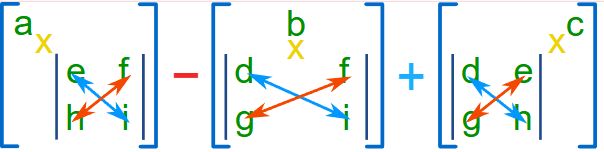
\( |A| = a(ei – fh) – b(di – fg) + c(dh – eg) \)
This method is known as expansion by the first row. Expansion by any row or column gives the same result.
2. Determinant Using Minors and Cofactors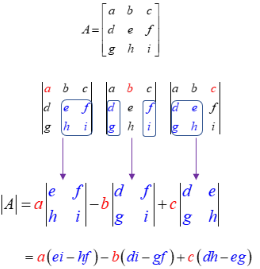
Each term in the expansion consists of:
- An entry of the matrix
- Multiplied by the determinant of a \(2 \times 2\) minor
- With alternating signs \( +, -, + \)
This structure is important for later topics such as matrix inverses.
3. Singular and Non-Singular Matrices
A square matrix is classified using its determinant:
Non-singular matrix: \( \det A \neq 0 \)
Singular matrix: \( \det A = 0 \)
Key consequences:
- A non-singular matrix has an inverse
- A singular matrix does not have an inverse
- A singular matrix corresponds to linearly dependent rows or columns
Example
Evaluate the determinant
\( \begin{vmatrix} 1 & 2 & 3 \\ 4 & 0 & 1 \\ 2 & -1 & 5 \end{vmatrix} \)
▶️ Answer / Explanation
Expand along the first row:
\( = 1(0\cdot5 – 1(-1)) – 2(4\cdot5 – 1\cdot2) + 3(4(-1) – 0\cdot2) \)
\( = 1(1) – 2(18) + 3(-4) \)
\( = 1 – 36 – 12 = -47 \)
Conclusion: The determinant is \( -47 \).
Example
Determine whether the matrix
\( A = \begin{pmatrix} 2 & 1 & 3 \\ 4 & 2 & 6 \\ 1 & 0 & 1 \end{pmatrix} \)
is singular or non-singular.
▶️ Answer / Explanation
Expand the determinant:
\( |A| = 2(2\cdot1 – 6\cdot0) – 1(4\cdot1 – 6\cdot1) + 3(4\cdot0 – 2\cdot1) \)
\( = 2(2) – 1(-2) + 3(-2) \)
\( = 4 + 2 – 6 = 0 \)
Conclusion: Since the determinant is zero, the matrix is singular.
Example
Find the value of \( k \) for which the matrix
\( \begin{pmatrix} 1 & 2 & 3 \\ 2 & k & 6 \\ 1 & 1 & 2 \end{pmatrix} \)
is singular.
▶️ Answer / Explanation
Compute the determinant:
\( |A| = 1(2k – 6) – 2(4 – 6) + 3(2 – k) \)
\( = 2k – 6 – 2(-2) + 6 – 3k \)
\( = -k + 4 \)
For a singular matrix, \( |A| = 0 \):
\( -k + 4 = 0 \Rightarrow k = 4 \)
Conclusion: The matrix is singular when \( k = 4 \).