
Inverse of \( 3 \times 3 \) Matrices
The inverse of a square matrix \( A \), denoted \( A^{-1} \), is defined by

\( AA^{-1} = A^{-1}A = I \)
where \( I \) is the identity matrix. At IAL level, students are required to find the inverse of a \( 3 \times 3 \) non-singular matrix and to use the identity
\( (AB)^{-1} = B^{-1}A^{-1} \)
1. Condition for the Existence of an Inverse
A square matrix \( A \) has an inverse if and only if

\( \det A \neq 0 \)
Such a matrix is called non-singular. If \( \det A = 0 \), the matrix is singular and has no inverse.
2. Formula for the Inverse of a \( 3 \times 3 \) Matrix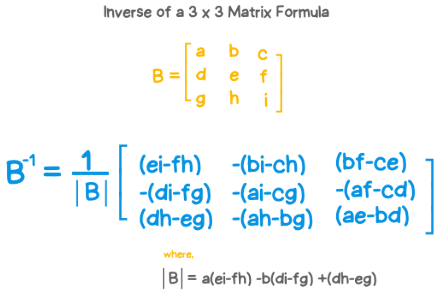
For a matrix
\( A = \begin{pmatrix} a & b & c \\ d & e & f \\ g & h & i \end{pmatrix} \)
the inverse is given by
\( A^{-1} = \dfrac{1}{\det A}\,\operatorname{adj}(A) \)
where \( \operatorname{adj}(A) \) is the adjugate matrix, obtained by:
finding all cofactors
arranging them into the cofactor matrix
taking the transpose
3. Inverse of a Product of Matrices
If matrices \( A \) and \( B \) are both invertible, then
\( (AB)^{-1} = B^{-1}A^{-1} \)
Note carefully that the order is reversed. This is a direct consequence of matrix multiplication not being commutative.
Example
Find the inverse of the matrix
\( A = \begin{pmatrix} 1 & 2 & 1 \\ 0 & 1 & 1 \\ 1 & 0 & 1 \end{pmatrix} \)
▶️ Answer / Explanation
First find the determinant:
\( |A| = 1(1 – 0) – 2(0 – 1) + 1(0 – 1) = 1 + 2 – 1 = 2 \)
Now form the adjugate matrix:
\( \operatorname{adj}(A) = \begin{pmatrix} 1 & -2 & 1 \\ 1 & 0 & -1 \\ -1 & 2 & 1 \end{pmatrix} \)
Hence
\( A^{-1} = \dfrac{1}{2} \begin{pmatrix} 1 & -2 & 1 \\ 1 & 0 & -1 \\ -1 & 2 & 1 \end{pmatrix} \)
Conclusion: This is the inverse of \( A \).
Example
Verify that the matrix
\( B = \begin{pmatrix} 2 & 1 & 0 \\ 1 & 1 & 1 \\ 0 & 1 & 1 \end{pmatrix} \)
is non-singular and hence find \( B^{-1} \).
▶️ Answer / Explanation
Determinant:
\( |B| = 2(1 – 1) – 1(1 – 0) + 0 = -1 \neq 0 \)
Hence \( B \) is non-singular.
The adjugate matrix is
\( \operatorname{adj}(B) = \begin{pmatrix} 0 & -1 & 1 \\ -1 & 2 & -2 \\ 1 & -2 & 1 \end{pmatrix} \)
Therefore
\( B^{-1} = -\begin{pmatrix} 0 & -1 & 1 \\ -1 & 2 & -2 \\ 1 & -2 & 1 \end{pmatrix} \)
Conclusion: This is the inverse of \( B \).
Example
Given that
\( A = \begin{pmatrix} 1 & 1 & 0 \\ 0 & 1 & 1 \\ 0 & 0 & 1 \end{pmatrix}, \quad B = \begin{pmatrix} 2 & 0 & 0 \\ 0 & 1 & 0 \\ 0 & 0 & 1 \end{pmatrix} \),
find \( (AB)^{-1} \).
▶️ Answer / Explanation
First find the inverses:
\( A^{-1} = \begin{pmatrix} 1 & -1 & 1 \\ 0 & 1 & -1 \\ 0 & 0 & 1 \end{pmatrix}, \quad B^{-1} = \begin{pmatrix} \frac{1}{2} & 0 & 0 \\ 0 & 1 & 0 \\ 0 & 0 & 1 \end{pmatrix} \)
Using \( (AB)^{-1} = B^{-1}A^{-1} \):
\( (AB)^{-1} = \begin{pmatrix} \frac{1}{2} & 0 & 0 \\ 0 & 1 & 0 \\ 0 & 0 & 1 \end{pmatrix} \begin{pmatrix} 1 & -1 & 1 \\ 0 & 1 & -1 \\ 0 & 0 & 1 \end{pmatrix} \)
Conclusion: This gives the inverse of \( AB \).