
Inverse of a Transformation and of a Combination of Transformations
A linear transformation may have an inverse transformation which reverses its effect. At IAL level, students must be able to determine the inverse (when it exists) of a single transformation and of a combination of transformations, using matrix methods.
1. Inverse of a Linear Transformation
A transformation \( T \) has an inverse transformation \( T^{-1} \) if applying \( T^{-1} \) after \( T \) returns every vector to its original position.
\( T^{-1}(T(\mathbf{x})) = \mathbf{x} \)
If a transformation is represented by a matrix \( A \), then its inverse transformation is represented by the matrix \( A^{-1} \), provided that
\( \det A \neq 0 \)
If \( \det A = 0 \), the transformation is not invertible.
2. Meaning of an Inverse Transformation
Geometrically, the inverse transformation:
- undoes the effect of the original transformation
- reverses stretches, rotations, and reflections
For example:
- A stretch by factor \( k \) has inverse stretch by factor \( \dfrac{1}{k} \), \( k \neq 0 \)
- A rotation through angle \( \theta \) has inverse rotation through angle \( -\theta \)
- A reflection is its own inverse
3. Inverse of a Combination of Transformations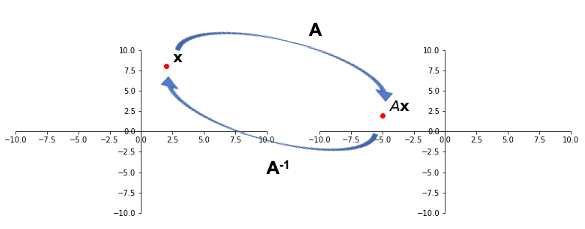
Suppose two transformations are represented by matrices \( A \) and \( B \).
If a vector is transformed by \( B \) followed by \( A \), the combined transformation is represented by
\( AB \)
The inverse of this combined transformation (when it exists) is
\( (AB)^{-1} = B^{-1}A^{-1} \)
This means:
the order of transformations is reversed
each transformation is replaced by its inverse
4. When an Inverse Does Not Exist
A transformation does not have an inverse if:
- it collapses space into a lower dimension (e.g. projection onto a line or plane)
- its matrix has determinant zero
In such cases, information is lost and the original vector cannot be uniquely recovered.
Summary
- A transformation has an inverse if and only if its matrix is non-singular
- The inverse transformation is represented by the inverse matrix
- For combined transformations, reverse the order and invert each matrix
Exam Note
- Always check whether the inverse exists before attempting to find it
- Write transformation order clearly using matrices
Example
A linear transformation \( T \) in two dimensions is represented by the matrix
\( A = \begin{pmatrix} 3 & 0 \\ 0 & 2 \end{pmatrix} \).
Find the inverse transformation.
▶️ Answer / Explanation
First find the determinant:
\( \det A = 3 \times 2 = 6 \neq 0 \)
Hence the inverse exists.
The inverse matrix is obtained by inverting each scale factor:
\( A^{-1} = \begin{pmatrix} \dfrac{1}{3} & 0 \\ 0 & \dfrac{1}{2} \end{pmatrix} \)
Conclusion: The inverse transformation is a stretch by factor \( \dfrac{1}{3} \) in the x-direction and \( \dfrac{1}{2} \) in the y-direction.
Example
A transformation in three dimensions is represented by
\( B = \begin{pmatrix} 1 & 0 & 0 \\ 0 & 2 & 0 \\ 0 & 0 & -1 \end{pmatrix} \).
Find the inverse transformation.
▶️ Answer / Explanation
The determinant is
\( \det B = 1 \times 2 \times (-1) = -2 \neq 0 \)
So the inverse exists.
Each diagonal entry is inverted:
\( B^{-1} = \begin{pmatrix} 1 & 0 & 0 \\ 0 & \dfrac{1}{2} & 0 \\ 0 & 0 & -1 \end{pmatrix} \)
Conclusion: The inverse reverses the stretch in the y-direction and reflects again in the \( xy \)-plane.
Example
Two transformations are represented by the matrices
\( A = \begin{pmatrix} 0 & -1 \\ 1 & 0 \end{pmatrix}, \quad B = \begin{pmatrix} 2 & 0 \\ 0 & 1 \end{pmatrix} \).
The combined transformation is \( AB \).
Find the inverse of this combined transformation.
▶️ Answer / Explanation
The inverse of the combined transformation is
\( (AB)^{-1} = B^{-1}A^{-1} \)
Find each inverse:
\( A^{-1} = \begin{pmatrix} 0 & 1 \\ -1 & 0 \end{pmatrix}, \quad B^{-1} = \begin{pmatrix} \dfrac{1}{2} & 0 \\ 0 & 1 \end{pmatrix} \)
Now multiply in the correct order:
\( (AB)^{-1} = \begin{pmatrix} \dfrac{1}{2} & 0 \\ 0 & 1 \end{pmatrix} \begin{pmatrix} 0 & 1 \\ -1 & 0 \end{pmatrix} = \begin{pmatrix} 0 & \dfrac{1}{2} \\ -1 & 0 \end{pmatrix} \)
Conclusion: The inverse is obtained by reversing the order and inverting each transformation.