
Eigenvalues and Eigenvectors of \( 2 \times 2 \) Matrices
Eigenvalues and eigenvectors describe directions that remain unchanged in direction when a linear transformation is applied. They are fundamental in understanding the geometric effect of matrices and are an important part of the IAL syllabus.
1. Definitions
Let \( A \) be a \( 2 \times 2 \) matrix. A non-zero vector \( \mathbf{v} \) is called an eigenvector of \( A \) if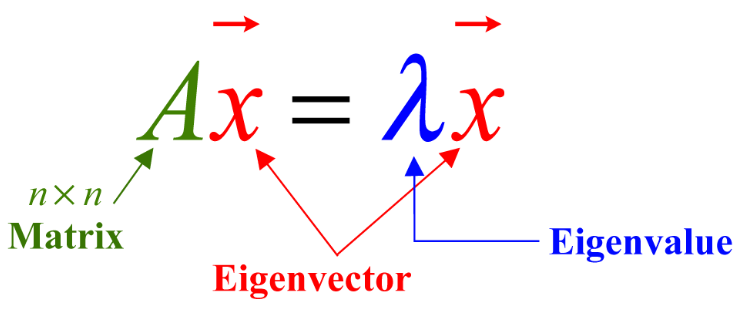
\( A\mathbf{v} = \lambda \mathbf{v} \)
where \( \lambda \) is a scalar called the eigenvalue corresponding to \( \mathbf{v} \).
Geometrically:
- the eigenvector gives a direction
- the eigenvalue gives the scale factor in that direction
2. Finding Eigenvalues
Eigenvalues are found by solving the characteristic equation
\( \det(A – \lambda I) = 0 \)
For
\( A = \begin{pmatrix} a & b \\ c & d \end{pmatrix} \),
this gives
\( \begin{vmatrix} a-\lambda & b \\ c & d-\lambda \end{vmatrix} = 0 \)
which simplifies to a quadratic equation in \( \lambda \).
3. Finding Eigenvectors
For each eigenvalue \( \lambda \), eigenvectors are found by solving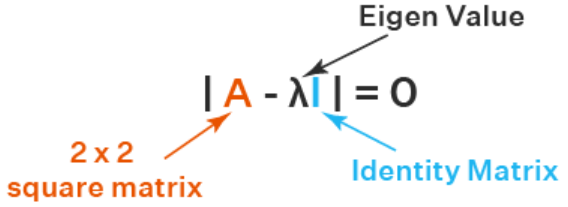
\( (A – \lambda I)\mathbf{v} = \mathbf{0} \)
Any non-zero solution is an eigenvector. Eigenvectors may be scaled freely.
4. Normalised Eigenvectors
A normalised eigenvector has magnitude 1.
If \( \mathbf{v} = \begin{pmatrix}x\\y\end{pmatrix} \), then its magnitude is
\( |\mathbf{v}| = \sqrt{x^2 + y^2} \)
The corresponding normalised vector is
\( \dfrac{1}{|\mathbf{v}|}\mathbf{v} \)
Example
Find the eigenvalues of
\( A = \begin{pmatrix} 4 & 1 \\ 2 & 3 \end{pmatrix} \).
▶️ Answer / Explanation
Form the characteristic equation:
\( \begin{vmatrix} 4-\lambda & 1 \\ 2 & 3-\lambda \end{vmatrix} = 0 \)
\( (4-\lambda)(3-\lambda) – 2 = 0 \)
\( \lambda^2 – 7\lambda + 10 = 0 \)
\( (\lambda – 5)(\lambda – 2) = 0 \)
Conclusion: The eigenvalues are \( \lambda = 5 \) and \( \lambda = 2 \).
Example
Find a normalised eigenvector corresponding to the eigenvalue \( \lambda = 2 \) for the matrix in Example 1.
▶️ Answer / Explanation
Solve \( (A – 2I)\mathbf{v} = \mathbf{0} \):
\( \begin{pmatrix} 2 & 1 \\ 2 & 1 \end{pmatrix} \begin{pmatrix} x \\ y \end{pmatrix} = \mathbf{0} \)
\( 2x + y = 0 \Rightarrow y = -2x \)
An eigenvector is
\( \mathbf{v} = \begin{pmatrix}1\\-2\end{pmatrix} \)
Magnitude:
\( |\mathbf{v}| = \sqrt{1^2 + (-2)^2} = \sqrt{5} \)
Normalised eigenvector:
\( \dfrac{1}{\sqrt{5}}\begin{pmatrix}1\\-2\end{pmatrix} \)
Conclusion: This is a normalised eigenvector for \( \lambda = 2 \).
Example
Find the eigenvalues and eigenvectors of
\( A = \begin{pmatrix} 2 & 1 \\ 0 & 2 \end{pmatrix} \).
▶️ Answer / Explanation
Characteristic equation:
\( (2-\lambda)^2 = 0 \)
Eigenvalue:
\( \lambda = 2 \) (repeated)
Eigenvectors from \( (A-2I)\mathbf{v}=\mathbf{0} \):
\( \begin{pmatrix} 0 & 1 \\ 0 & 0 \end{pmatrix} \begin{pmatrix} x\\y \end{pmatrix} = \mathbf{0} \Rightarrow y = 0 \)
Eigenvectors are multiples of
\( \begin{pmatrix}1\\0\end{pmatrix} \)
Conclusion: The matrix has a repeated eigenvalue with a single eigenvector direction.
Eigenvalues and Eigenvectors of \( 3 \times 3 \) Matrices
Eigenvalues and eigenvectors extend naturally from the \(2 \times 2\) case to \(3 \times 3\) matrices. They describe directions in three-dimensional space that are unchanged in direction (though possibly scaled) by a linear transformation.
1. Definitions
Let \( A \) be a \( 3 \times 3 \) matrix. A non-zero vector \( \mathbf{v} \) is an eigenvector of \( A \) corresponding to the eigenvalue \( \lambda \) if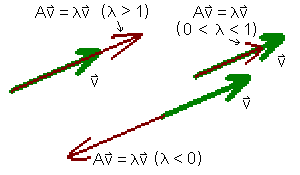
\( A\mathbf{v} = \lambda \mathbf{v} \)
Equivalently,
\( (A – \lambda I)\mathbf{v} = \mathbf{0} \)
2. Finding Eigenvalues
Eigenvalues are found by solving the characteristic equation
\( \det(A – \lambda I) = 0 \)
For a \( 3 \times 3 \) matrix, this leads to a cubic equation in \( \lambda \). In IAL questions, the cubic will usually factorise.
3. Finding Eigenvectors
For each eigenvalue \( \lambda \), substitute into
\( (A – \lambda I)\mathbf{v} = \mathbf{0} \)
This gives a system of linear equations. Any non-zero solution is an eigenvector. Eigenvectors corresponding to the same eigenvalue form a line or plane through the origin.
4. Normalised Eigenvectors
A normalised eigenvector has magnitude 1.
For \( \mathbf{v} = \begin{pmatrix}x\\y\\z\end{pmatrix} \), the magnitude is
\( |\mathbf{v}| = \sqrt{x^2 + y^2 + z^2} \)
The normalised eigenvector is
\( \dfrac{1}{|\mathbf{v}|}\mathbf{v} \)
Example
Find the eigenvalues of
\( A = \begin{pmatrix} 2 & 1 & 0 \\ 0 & 2 & 0 \\ 0 & 0 & 3 \end{pmatrix} \).
▶️ Answer / Explanation
Form \( A – \lambda I \):
\( \begin{pmatrix} 2-\lambda & 1 & 0 \\ 0 & 2-\lambda & 0 \\ 0 & 0 & 3-\lambda \end{pmatrix} \)
Determinant:
\( (2-\lambda)^2(3-\lambda) = 0 \)
Conclusion: The eigenvalues are \( \lambda = 2 \) (repeated) and \( \lambda = 3 \).
Example
Find a normalised eigenvector corresponding to the eigenvalue \( \lambda = 3 \) for the matrix in Example 1.
▶️ Answer / Explanation
Solve \( (A – 3I)\mathbf{v} = \mathbf{0} \):
\( \begin{pmatrix} -1 & 1 & 0 \\ 0 & -1 & 0 \\ 0 & 0 & 0 \end{pmatrix} \begin{pmatrix} x\\y\\z \end{pmatrix} = \mathbf{0} \)
\( -x + y = 0,\; -y = 0 \Rightarrow x = 0,\; y = 0 \)
An eigenvector is
\( \mathbf{v} = \begin{pmatrix}0\\0\\1\end{pmatrix} \)
Magnitude \( = 1 \).
Conclusion: The normalised eigenvector is \( \begin{pmatrix}0\\0\\1\end{pmatrix} \).
Example
Find the eigenvalues and one eigenvector for each eigenvalue of
\( A = \begin{pmatrix} 1 & 0 & 0 \\ 0 & 2 & 1 \\ 0 & 1 & 2 \end{pmatrix} \).
▶️ Answer / Explanation
Characteristic equation:
\( (1-\lambda)\begin{vmatrix} 2-\lambda & 1 \\ 1 & 2-\lambda \end{vmatrix} = 0 \)
\( (1-\lambda)\big[(2-\lambda)^2 – 1\big] = 0 \)
Eigenvalues:
\( \lambda = 1,\; 3,\; 1 \)
For \( \lambda = 3 \):
Eigenvector \( \begin{pmatrix}0\\1\\1\end{pmatrix} \)
Conclusion: The matrix has three real eigenvalues with corresponding eigenvector directions.