
Basic Ideas of Mathematical Modelling in Mechanics
In mechanics, real physical situations are often too complex to analyze exactly. Mathematical modelling simplifies these situations by making reasonable assumptions so that the motion or equilibrium of objects can be described using mathematics.
A model focuses on the essential features of a situation and ignores effects that are considered negligible, allowing predictions to be made using equations and diagrams.
Common Modelling Terms and Assumptions
Particle
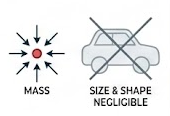
A particle is an object whose size and shape are negligible compared to the distances involved. All the mass is assumed to be concentrated at a single point, so rotation and shape are ignored.
Lamina
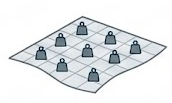
A lamina is a thin flat object whose thickness is negligible. Its mass is distributed over an area, and it is often used when studying centers of mass or rotational effects.
Rigid Body
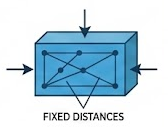
A rigid body is an object that does not deform under applied forces. The distances between all points of the body remain constant.
Rod
A rod is a rigid body whose length is much greater than its width and thickness.
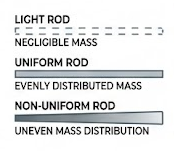
• A light rod has negligible mass.
• A uniform rod has mass evenly distributed along its length.
• A non-uniform rod has mass unevenly distributed.
Inextensible String
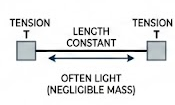
An inextensible string is a string that does not stretch under tension. Its length remains constant, and it is often assumed to be light, meaning its mass is negligible.
Smooth and Rough Surface
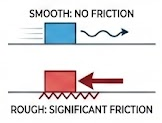
A smooth surface is one on which friction is negligible. Objects can move freely along the surface without any resistive force due to friction.
A rough surface is one on which friction is significant. The frictional force depends on the nature of the surfaces in contact.
Light Smooth Pulley
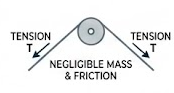
A light smooth pulley has negligible mass and no friction. The tension in the string is the same on both sides of the pulley.
Bead & Wire
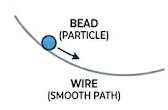
A bead is a small object that can slide freely along a wire or rod. It is often treated as a particle.
A wire is a fixed curve or straight line along which a bead or particle may move. It is usually assumed to be smooth.
Peg
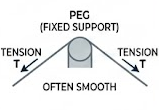
A peg is a small fixed support over which a string may pass. It is often assumed to be smooth, so the tension remains the same on either side.
General Modelling Assumptions
• Air resistance is neglected unless stated otherwise.
• Gravitational acceleration is taken as constant.
• Objects behave exactly as defined by the chosen model.
These idealizations allow mechanics problems to be solved using equations of motion, forces, and moments while still closely representing real-world behavior.
Example :
A small block is pulled along a horizontal smooth table by a light inextensible string attached to a light smooth pulley. The block is modeled as a particle.Explain the mode.
▶️ Explanation
In this model:
• The block is treated as a particle, so its size and rotation are ignored.
• The table is smooth, so no frictional force acts on the block.
• The string is light and inextensible, so its mass is neglected and its length remains constant.
• The pulley is light and smooth, so the tension is the same throughout the string.
These assumptions simplify the situation so that only forces such as tension and weight need to be considered when applying Newton’s laws.
Example :
A uniform rod rests with one end against a smooth vertical wall and the other end on a rough horizontal floor. A light inextensible string is attached to the rod and passes over a smooth peg.Explain the mode.
▶️ Explanation
In this model:
• The rod is uniform, so its weight acts at its midpoint.
• The rod is treated as a rigid body, so it does not bend or stretch.
• The wall is smooth, so it exerts only a normal reaction force.
• The floor is rough, so both friction and a normal reaction act at the point of contact.
• The string and peg are light and smooth, so the tension is constant.
These assumptions allow equilibrium conditions involving forces and moments to be applied to analyze the system.