
Applications of Vectors in Mechanics
In mechanics, vectors are used to model physical quantities that have both magnitude and direction. Common vector quantities include displacement, velocity, acceleration, and force.
These quantities are often analyzed in a plane using component form or unit vectors \( \mathbf{i} \) and \( \mathbf{j} \).
Displacement Vectors
Displacement describes the change in position of a particle. If a particle moves from point \( A(x_1, y_1) \) to point \( B(x_2, y_2) \), the displacement vector is
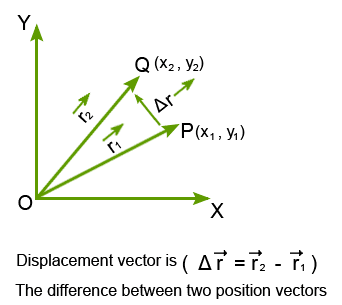
\( \mathbf{s} = \langle x_2 – x_1,\; y_2 – y_1 \rangle \)
Velocity Vectors
Velocity describes the rate of change of displacement with respect to time.
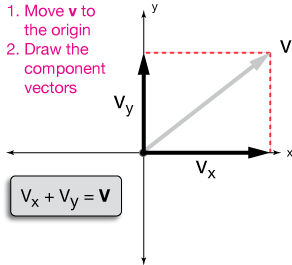
For constant velocity, velocity is given by
\( \mathbf{v} = \dfrac{\text{change in displacement}}{\text{time}} = \dfrac{\mathbf{s}}{t} \)
Velocity is a vector and has the same direction as the displacement.
Acceleration Vectors
Acceleration describes the rate of change of velocity with respect to time.
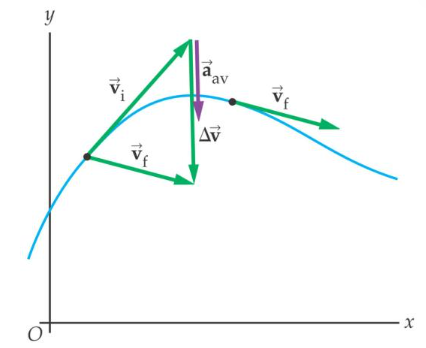
For constant acceleration, acceleration is given by
\( \mathbf{a} = \dfrac{\text{change in velocity}}{\text{time}} = \dfrac{\mathbf{v}_2 – \mathbf{v}_1}{t} \)
Acceleration may change the magnitude of velocity, its direction, or both.
Force Vectors
A force is a vector quantity that can cause a change in motion. Forces are often resolved into horizontal and vertical components and combined using vector addition to find a resultant force.
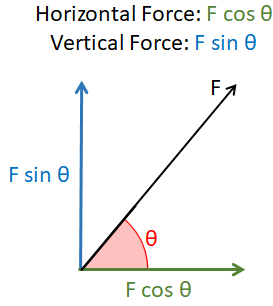
When multiple forces act on a particle, their combined effect is represented by the resultant force, found by adding the force vectors.
Example :
A particle moves from point \( (2, 1) \) to point \( (10, 5) \) in 4 seconds at constant velocity. Find its velocity vector.
▶️ Answer/Explanation
Displacement
\( \mathbf{s} = \langle 10 – 2,\; 5 – 1 \rangle = \langle 8,\; 4 \rangle \)
Velocity
\( \mathbf{v} = \dfrac{1}{4}\langle 8,\; 4 \rangle = \langle 2,\; 1 \rangle \)
Conclusion: The velocity vector is \( 2\mathbf{i} + \mathbf{j} \) units per second.
Example :
A particle has velocity \( \mathbf{v}_1 = 3\mathbf{i} + 2\mathbf{j} \) m/s. After 5 seconds, its velocity becomes \( \mathbf{v}_2 = 8\mathbf{i} – 3\mathbf{j} \) m/s. Find the constant acceleration.
▶️ Answer/Explanation
Change in velocity
\( \mathbf{v}_2 – \mathbf{v}_1 = \langle 8 – 3,\; -3 – 2 \rangle = \langle 5,\; -5 \rangle \)
Acceleration
\( \mathbf{a} = \dfrac{1}{5}\langle 5,\; -5 \rangle = \langle 1,\; -1 \rangle \)
Conclusion: The acceleration vector is \( \mathbf{i} – \mathbf{j} \) m/s².