
Motion in a Straight Line with Constant Acceleration
Motion in a straight line with constant acceleration occurs when a particle moves along a single straight path and its acceleration remains constant in both magnitude and direction.
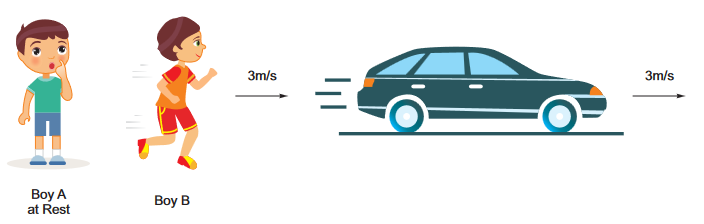
In this type of motion, displacement, velocity, acceleration, and time are related by a set of standard equations known as the equations of motion.
Key Quantities
• Displacement: \( s \)
• Initial velocity: \( u \)
• Final velocity: \( v \)
• Acceleration: \( a \) (constant)
• Time: \( t \)
Definitions
Velocity is defined as the rate of change of displacement:

\( v = \dfrac{\text{change in displacement}}{\text{time}} \)
Acceleration is defined as the rate of change of velocity:

\( a = \dfrac{\text{change in velocity}}{\text{time}} \)
Equations of Motion (Constant Acceleration)
From these definitions, the following equations are derived:
1. \( v = u + at \)
2. \( s = ut + \dfrac{1}{2}at^2 \)
3. \( v^2 = u^2 + 2as \)
These equations apply only when acceleration is constant and motion is along a straight line.
Sign Convention

A direction is chosen as positive. Velocities, accelerations, and displacements acting in the opposite direction are taken as negative.
Example :
A particle moves in a straight line with initial velocity \( u = 5 \,\text{m/s} \) and constant acceleration \( a = 2 \,\text{m/s}^2 \). Find its velocity after 6 seconds.
▶️ Answer/Explanation
Use the equation
\( v = u + at \)
\( v = 5 + (2)(6) = 17 \)
Conclusion: The velocity after 6 seconds is \( 17 \,\text{m/s} \).
Example :
A car traveling at \( 20 \,\text{m/s} \) brakes uniformly and comes to rest after traveling 50 m. Find the acceleration.
▶️ Answer/Explanation
Known values:
\( u = 20 \), \( v = 0 \), \( s = 50 \)
Use the equation
\( v^2 = u^2 + 2as \)
\( 0 = 400 + 100a \)
\( a = -4 \)
Conclusion: The acceleration is \( -4 \,\text{m/s}^2 \), indicating a deceleration.
Graphical Solutions for Motion with Constant Acceleration
Graphical methods are commonly used to analyze motion in a straight line, especially when acceleration is constant. The most important graphs are displacement–time, velocity–time, speed–time, and acceleration–time graphs.
These graphs provide visual interpretations of the equations of motion and allow quantities such as displacement, velocity, and acceleration to be determined.
Displacement–Time Graph
A displacement–time graph shows how displacement varies with time.

• The gradient of the graph represents the velocity.
• A straight line indicates constant velocity.
• A curved graph indicates changing velocity.
Velocity–Time Graph
A velocity–time graph shows how velocity varies with time.

• The gradient of the graph represents acceleration.
• A straight line indicates constant acceleration.
• The area under the graph represents displacement.
Speed–Time Graph
A speed–time graph is similar to a velocity–time graph but shows only speed, which is always nonnegative.

• The area under the graph represents distance travelled.
Acceleration–Time Graph
An acceleration–time graph shows how acceleration varies with time.

• A horizontal line indicates constant acceleration.
• The area under the graph represents change in velocity.
Connection with Formulae for Constant Acceleration
When acceleration is constant, graphical interpretations agree with the standard equations of motion:
\( v = u + at \)
\( s = ut + \dfrac{1}{2}at^2 \)
\( v^2 = u^2 + 2as \)
For example, the area under a velocity–time graph with constant acceleration forms a trapezium, whose area matches the displacement calculated using these formulae.
Example :
A particle moves with constant acceleration. Its velocity increases uniformly from \( 4 \,\text{m/s} \) to \( 16 \,\text{m/s} \) in 6 seconds.
▶️ Answer/Explanation
Acceleration is the gradient of the velocity–time graph:
\( a = \dfrac{16 – 4}{6} = 2 \,\text{m/s}^2 \)
Displacement is the area under the velocity–time graph:
\( s = \dfrac{1}{2}(4 + 16)\times 6 = 60 \,\text{m} \)
Conclusion: The acceleration is \( 2 \,\text{m/s}^2 \) and the displacement is \( 60 \,\text{m} \).
Example :
A particle moves with constant acceleration of \( 3 \,\text{m/s}^2 \) for 5 seconds, starting from rest. Use graphical ideas to find its final velocity and displacement.
▶️ Answer/Explanation
Change in velocity is the area under the acceleration–time graph:
\( \Delta v = 3 \times 5 = 15 \,\text{m/s} \)
So the final velocity is \( v = 15 \,\text{m/s} \).
Displacement is the area under the velocity–time graph:
\( s = \dfrac{1}{2} \times 5 \times 15 = 37.5 \,\text{m} \)
Conclusion: The final velocity is \( 15 \,\text{m/s} \) and the displacement is \( 37.5 \,\text{m} \).