
The Concept of a Force and Newton’s Laws of Motion
In mechanics, a force is an interaction that can change the motion or shape of an object. Forces can cause an object to start moving, stop moving, change speed, or change direction.
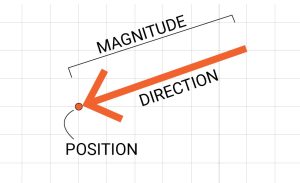
Force is a vector quantity, meaning it has both magnitude and direction. In the SI system, force is measured in newtons (N).
Examples of forces include gravitational force, tension, friction, normal reaction, and applied forces.
Newton’s First Law of Motion

- Newton’s First Law states that a body will remain at rest or move with constant velocity in a straight line unless acted upon by a resultant external force.
- This law describes the concept of inertia, which is the tendency of an object to resist changes in its motion.
If the resultant force on a body is zero, then:
The body is either at rest or moving with constant velocity.
Newton’s Second Law of Motion

The acceleration of a particle is proportional to the resultant force acting on it and occurs in the direction of that force.
\( \mathbf{F} = m\mathbf{a} \)
Here, \( \mathbf{F} \) is the resultant force, \( m \) is the mass, and \( \mathbf{a} \) is the acceleration.
In two dimensions, acceleration may be written as a vector of the form
\( \mathbf{a} = a\mathbf{i} + b\mathbf{j} \)
and Newton’s second law applies separately in each direction.
Newton’s Third Law of Motion

- Newton’s Third Law states that for every action, there is an equal and opposite reaction.
- If body A exerts a force on body B, then body B simultaneously exerts a force of equal magnitude but opposite direction on body A.
- These forces act on different bodies, so they do not cancel each other out.
Resultant Force
The resultant force is the single force that has the same effect as all the forces acting on a body combined.
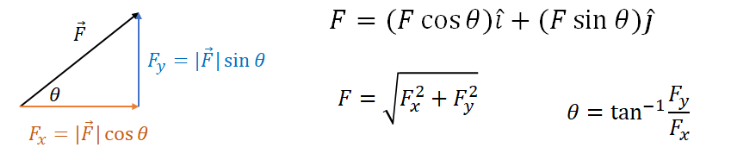
- When multiple forces act on a body, the resultant force is found by adding the forces vectorially.
- If the resultant force is zero, the body is said to be in equilibrium.
Forces and Constant Acceleration
When the resultant force on a particle is constant, the acceleration is constant. Motion can then be analyzed using the equations of motion.
In scalar form (one dimension):
\( v = u + at \)
\( s = ut + \dfrac{1}{2}at^2 \)
In vector form (two dimensions):
\( \mathbf{v} = \mathbf{u} + \mathbf{a}t \)
Example :
A particle of mass 2 kg moves in a straight line under a constant force of 10 N. Find its acceleration.
▶️ Answer/Explanation
Using Newton’s second law:
\( F = ma \)
\( 10 = 2a \Rightarrow a = 5 \)
Conclusion: The acceleration of the particle is \( 5 \,\text{m/s}^2 \).
Example :
A particle of mass 4 kg is acted upon by a constant force \( \mathbf{F} = 12\mathbf{i} – 8\mathbf{j} \) N. Find its acceleration vector.
▶️ Answer/Explanation
Apply Newton’s second law in vector form:
\( \mathbf{a} = \dfrac{\mathbf{F}}{m} \)
\( \mathbf{a} = \dfrac{1}{4}(12\mathbf{i} – 8\mathbf{j}) = 3\mathbf{i} – 2\mathbf{j} \)
Conclusion: The acceleration vector is \( 3\mathbf{i} – 2\mathbf{j} \,\text{m/s}^2 \).
Example :
A particle of mass \( 4 \) kg is acted upon by a resultant force of \( 12 \) N. Find the acceleration of the particle.
▶️ Answer/Explanation
Using Newton’s Second Law:
\( F = ma \)
\( 12 = 4a \)
\( a = 3 \)
Conclusion: The acceleration of the particle is \( 3 \,\text{m s}^{-2} \).