
Simple Applications of Newton’s Laws
In this section, Newton’s laws of motion are applied to a variety of common mechanical situations. The motion is always analysed by identifying the forces acting on each particle and then applying Newton’s Second Law along the line of motion.
(i) Motion of Two Connected Particles
Two particles may be connected by a light inextensible string. The string is assumed to pass over a smooth fixed pulley or peg, so that the tension is the same throughout the string.
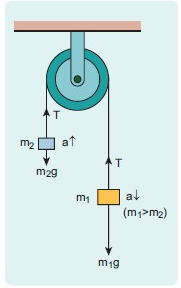
If the particles move together, they have the same magnitude of acceleration. Each particle must be considered separately using a free body diagram, but their accelerations are linked.
Typical forces acting include:
- Weight \( mg \)
- Tension \( T \)
- Normal reaction and friction, if applicable
Newton’s Second Law is applied to each particle along the direction of motion.
Example :
Two particles \( A \) and \( B \) of masses \( 3 \) kg and \( 5 \) kg respectively are connected by a light inextensible string passing over a smooth pulley. The system is released from rest. Find the acceleration of the system and the tension in the string.
▶️ Answer/Explanation
Let the heavier particle move downwards with acceleration \( a \).
For particle \( B \) (5 kg):
\( 5g – T = 5a \)
For particle \( A \) (3 kg):
\( T – 3g = 3a \)
Adding the equations:
\( 2g = 8a \Rightarrow a = \dfrac{g}{4} \)
Substitute into \( T – 3g = 3a \):
\( T = 3g + 3\left(\dfrac{g}{4}\right) = \dfrac{15g}{4} \)
Conclusion: The acceleration is \( \dfrac{g}{4} \,\text{m s}^{-2} \) and the tension is \( \dfrac{15g}{4} \) N.
(ii) Motion Under a Force Which Changes Value
In some problems, the force acting on a particle changes suddenly. The motion must then be analysed in separate stages, with Newton’s laws applied independently to each stage.
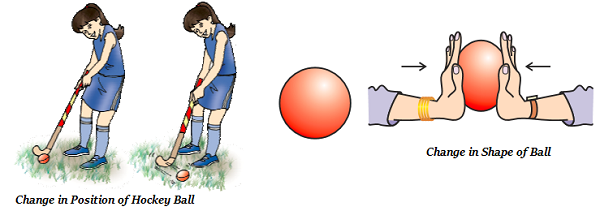
A common example is a particle falling freely and then hitting the ground, where a new force acts during impact.
Key points:
- Treat each stage separately
- Initial conditions for the second stage come from the final conditions of the first stage
Example :
A particle of mass \( 2 \) kg falls freely under gravity. On hitting the ground, it experiences an upward force of \( 30 \) N. Find the acceleration immediately after impact.
▶️ Answer/Explanation
After impact, two forces act on the particle:
Upward force \( 30 \) N
Weight \( 2g \) downward
Resultant upward force:
\( 30 – 2g \)
Using \( F = ma \):
\( 30 – 2g = 2a \Rightarrow a = 15 – g \)
Conclusion: The acceleration immediately after impact is \( (15 – g)\,\text{m s}^{-2} \) upwards.
(iii) Motion on a Smooth or Rough Inclined Plane
When a particle moves on an inclined plane, the weight is resolved into components parallel and perpendicular to the plane.
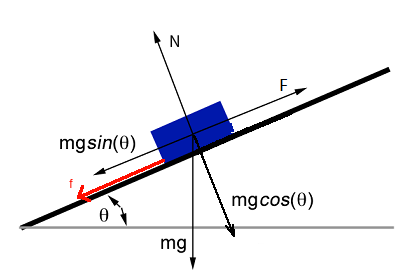
For a plane inclined at angle \( \theta \):
Component of weight down the plane: \( mg\sin \theta \)
Normal reaction: \( mg\cos \theta \)
If the plane is smooth, no friction acts. If the plane is rough, a frictional force acts opposing the motion, with magnitude \( \mu R \).
Example :
A particle of mass \( 4 \) kg slides down a rough plane inclined at \( 30^\circ \) to the horizontal. The coefficient of friction is \( 0.2 \). Find the acceleration of the particle.
▶️ Answer/Explanation
Normal reaction:
\( R = 4g\cos 30^\circ \)
Frictional force:
\( F = 0.2R = 0.8g\cos 30^\circ \)
Component of weight down the plane:
\( 4g\sin 30^\circ = 2g \)
Resultant force down the plane:
\( 2g – 0.8g\cos 30^\circ \)
Using \( F = ma \):
\( 2g – 0.8g\cos 30^\circ = 4a \)
Conclusion: The acceleration is found by solving this equation and acts down the plane.