
Coefficient of Friction
When two surfaces are in contact, a force called friction may act between them. Friction acts along the surface of contact and always opposes the motion of the particle.
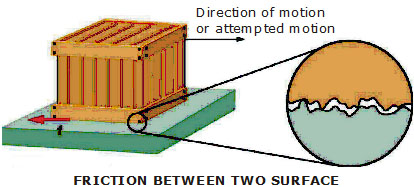
Friction is present only when there is contact between surfaces and when there is either motion or a tendency for motion.
Normal Reaction
The normal reaction, usually denoted by \( R \), is the force exerted by a surface on a particle in contact with it. This force acts perpendicular to the surface.
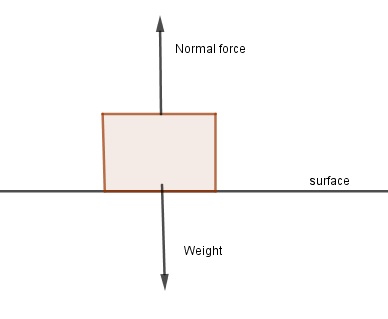
The magnitude of the normal reaction depends on the forces acting on the particle and the orientation of the surface.
Coefficient of Friction
The coefficient of friction, denoted by \( \mu \), is a dimensionless constant that depends on the nature of the two surfaces in contact.
When a particle is moving, the frictional force has a constant magnitude given by
\( F = \mu R \)
This frictional force always acts in the direction opposite to the motion of the particle.
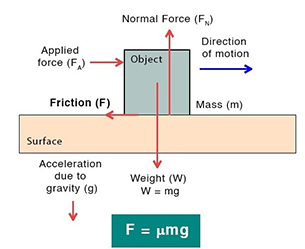
Direction of Friction
To determine the direction of friction:
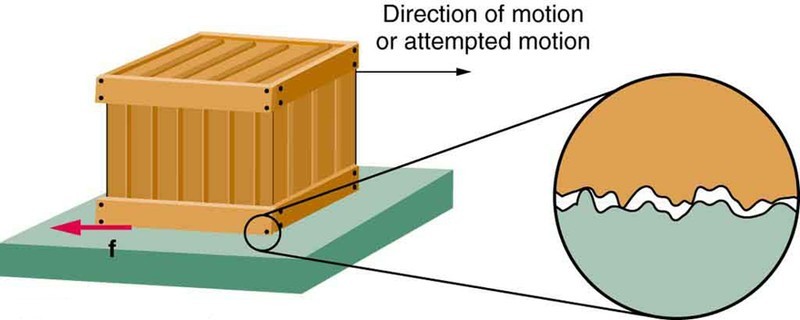
- Assume a direction of motion
- Friction acts in the opposite direction
In exam questions, it is often useful to state the assumed direction of motion clearly before resolving forces.
Applying Newton’s Second Law with Friction
When a particle moves on a rough surface, Newton’s Second Law is applied along the line of motion, taking friction into account.
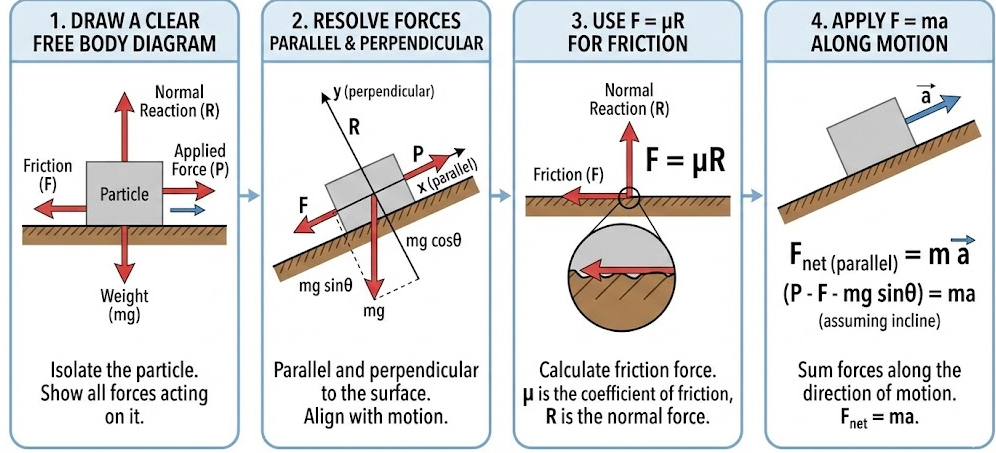
The typical steps are:
- Draw a clear free body diagram
- Resolve forces parallel and perpendicular to the surface
- Use \( F = \mu R \) for the frictional force
- Apply \( F = ma \) along the direction of motion
Example :
A particle of mass \( 5 \) kg moves on a rough horizontal surface. The coefficient of friction between the particle and the surface is \( 0.3 \). Find the magnitude of the frictional force.
▶️ Answer/Explanation
On a horizontal surface, the normal reaction equals the weight:
\( R = 5g \)
Using \( F = \mu R \):
\( F = 0.3 \times 5g = 1.5g \)
Conclusion: The frictional force has magnitude \( 1.5g \) N and acts opposite to the motion.
Example :
A block of mass \( 4 \) kg is pulled along a rough horizontal surface by a horizontal force of \( 20 \) N. The coefficient of friction is \( 0.25 \). Find the acceleration of the block.
▶️ Answer/Explanation
Normal reaction:
\( R = 4g \)
Frictional force:
\( F = 0.25 \times 4g = g \)
Resultant force in the direction of motion:
\( 20 – g \)
Applying Newton’s Second Law:
\( 20 – g = 4a \)
Conclusion: The acceleration of the block is \( \dfrac{20 – g}{4} \,\text{m s}^{-2} \).