
Forces Treated as Vectors
A force is a vector quantity, meaning that it has both magnitude and direction. When more than one force acts on a particle, their combined effect depends on both of these properties.
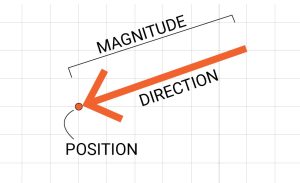
Forces are therefore treated as vectors and are combined using the rules of vector addition.
Resultant Force
The resultant force is the single force that has the same effect as all the forces acting together on a particle.
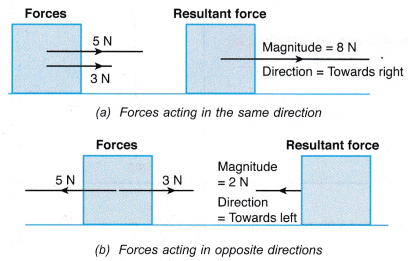
If two or more forces act at a point, the resultant force is found by adding the forces vectorially.
Resolution of Forces
Resolving a force means replacing it with two or more component forces whose combined effect is equivalent to the original force.
In mechanics, forces are usually resolved into two perpendicular components, most commonly horizontal and vertical components.

If a force of magnitude \( F \) acts at an angle \( \theta \) to the horizontal, its components are:
- Horizontal component: \( F\cos \theta \)
- Vertical component: \( F\sin \theta \)
These components act at right angles and together produce the original force.
Choosing Axis
For efficient problem solving, axis should be chosen carefully.
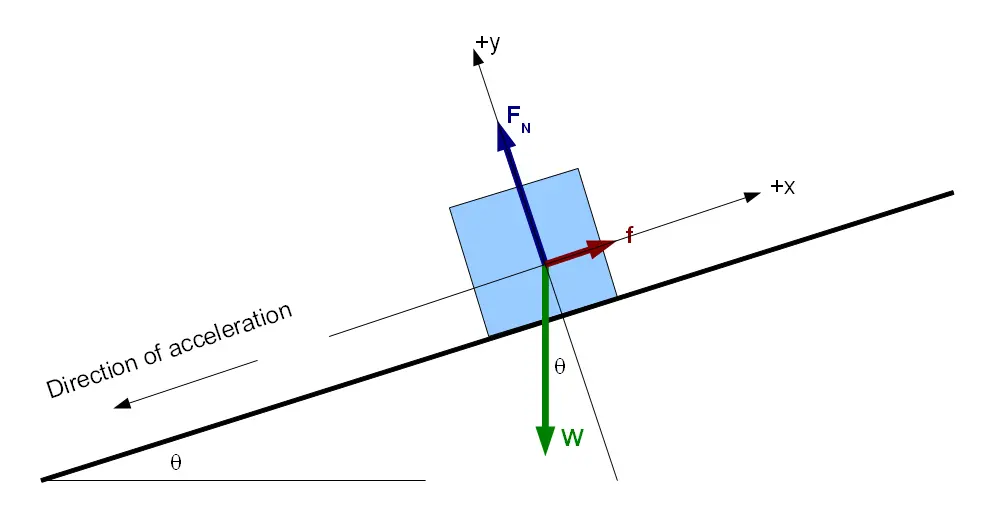
- Axis are often chosen parallel and perpendicular to the direction of motion or to a surface
- This simplifies the equations of motion
Applying Newton’s Second Law
Once forces have been resolved, Newton’s Second Law is applied independently in each perpendicular direction.
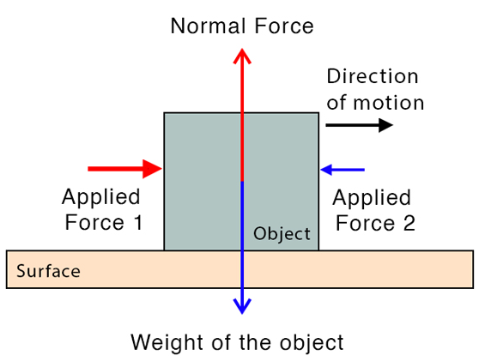
- Sum of forces in one direction \( = ma \)
- Sum of forces in the perpendicular direction \( = ma \) or zero if there is no acceleration in that direction
Example :
A force of \( 20 \) N acts on a particle at an angle of \( 30^\circ \) above the horizontal. Find the horizontal and vertical components of the force.
▶️ Answer/Explanation
Horizontal component:
\( 20\cos 30^\circ = 10\sqrt{3} \)
Vertical component:
\( 20\sin 30^\circ = 10 \)
Conclusion: The force has horizontal component \( 10\sqrt{3} \) N and vertical component \( 10 \) N.
Example :
A particle of mass \( 2 \) kg is acted on by two forces: a horizontal force of \( 8 \) N and a force of \( 10 \) N acting at \( 60^\circ \) above the horizontal. Find the resultant force on the particle.
▶️ Answer/Explanation
Resolve the \( 10 \) N force:
Horizontal component: \( 10\cos 60^\circ = 5 \)
Vertical component: \( 10\sin 60^\circ = 5\sqrt{3} \)
Total horizontal force:
\( 8 + 5 = 13 \)
Total vertical force:
\( 5\sqrt{3} \)
Conclusion: The resultant force has components \( 13 \) N horizontally and \( 5\sqrt{3} \) N vertically.