
Equilibrium of a Particle Under Coplanar Forces
A particle is said to be in equilibrium when it remains at rest or moves with constant velocity. In equilibrium, the forces acting on the particle balance so that there is no acceleration.
When all the forces acting on a particle lie in the same plane, they are called coplanar forces.
Conditions for Equilibrium
For a particle under coplanar forces to be in equilibrium, the resultant force must be zero.
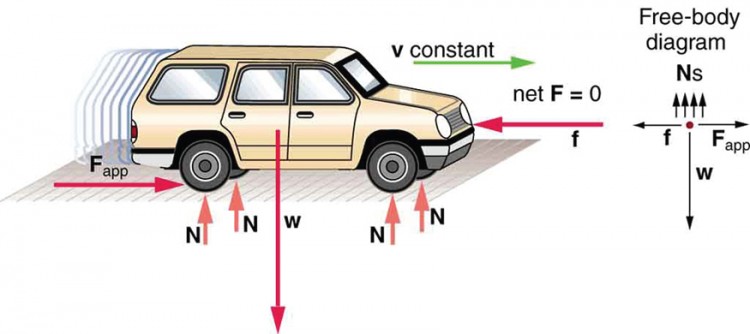
This gives two independent conditions:
- Sum of forces in one direction \( = 0 \)
- Sum of forces in a perpendicular direction \( = 0 \)
These directions are usually chosen to be horizontal and vertical, or parallel and perpendicular to a surface.
Common Forces Acting on a Particle
Weight
The weight of a particle is the force due to gravity acting vertically downwards. For a particle of mass \( m \), the weight is
\( mg \)
Normal Reaction
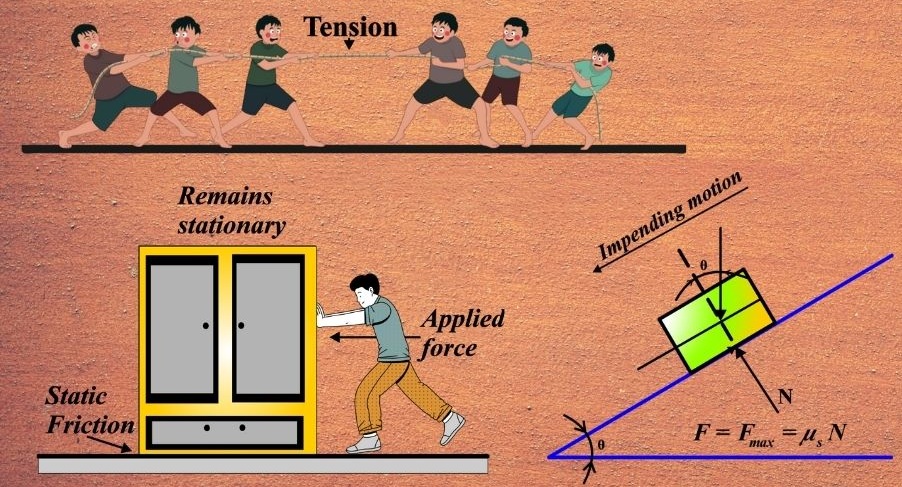
The normal reaction, denoted by \( R \), is the force exerted by a surface on a particle in contact with it. This force acts perpendicular to the surface.
Tension
The tension, denoted by \( T \), is the force transmitted through a light inextensible string or cable. Tension always acts along the string and pulls away from the particle.
Thrust
A thrust is a pushing force acting on a particle. Like tension, it acts along the line of contact, but it pushes rather than pulls.
Friction
When a particle is in contact with a rough surface, a frictional force may act. Friction acts along the surface and opposes the direction of motion or the tendency to move.
If the particle is moving, the frictional force has magnitude
\( F = \mu R \)
Applying Equilibrium Conditions
To solve equilibrium problems:
- Draw a clear free body diagram
- Resolve forces into chosen perpendicular directions
- Apply the two equilibrium equations
Only simple, uncomplicated systems are considered in this syllabus.
Example :
A particle of mass \( 5 \) kg rests on a smooth horizontal surface. Find the normal reaction.
▶️ Answer/Explanation
The particle is in equilibrium.
Vertical forces:
Upward: \( R \)
Downward: \( 5g \)
Applying equilibrium vertically:
\( R – 5g = 0 \Rightarrow R = 5g \)
Conclusion: The normal reaction is \( 5g \) N.
Example :
A particle of weight \( 20 \) N is held at rest on a rough horizontal surface by a horizontal force of \( 6 \) N. The coefficient of friction is \( 0.3 \). Determine whether equilibrium is possible.
▶️ Answer/Explanation
Normal reaction:
\( R = 20 \)
Maximum friction available:
\( F = \mu R = 0.3 \times 20 = 6 \)
The applied force is \( 6 \) N, which can be balanced by friction.
Conclusion: Equilibrium is possible.