
Coefficient of Friction in Equilibrium
When a particle is in contact with a rough surface, a frictional force may act between the surfaces. This friction acts along the surface and opposes the tendency of motion.
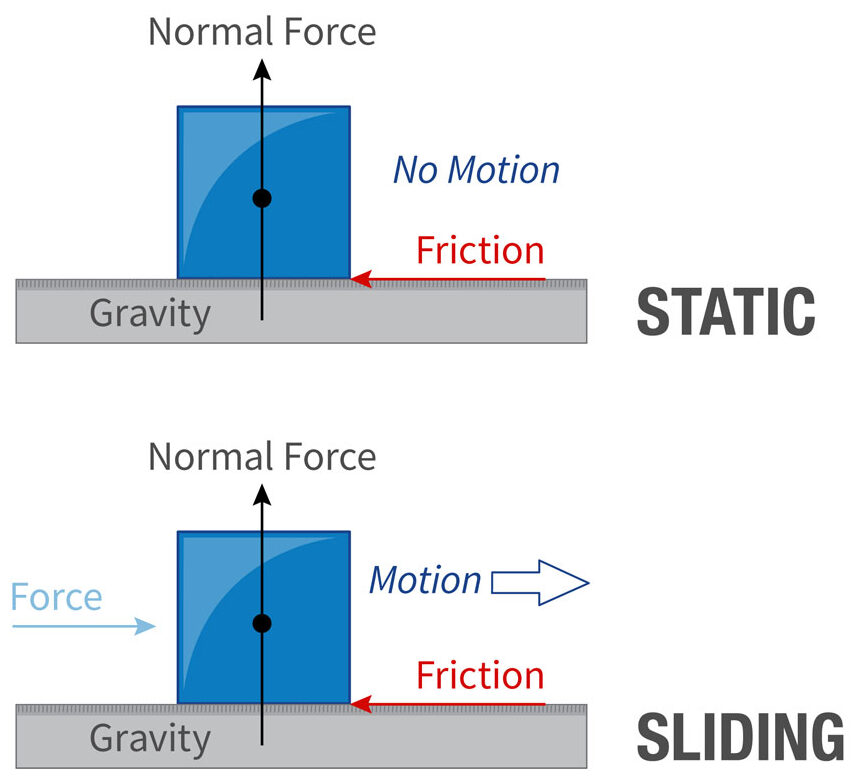
In situations of equilibrium, the particle is either at rest or moving with constant velocity, so the resultant force on the particle is zero.
Normal Reaction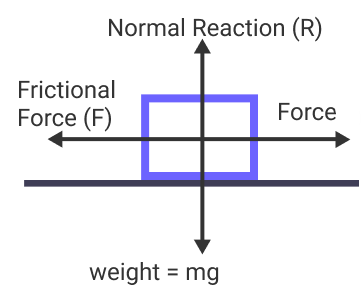
The normal reaction, denoted by \( R \), is the force exerted by a surface on a particle in contact with it. It acts perpendicular to the surface.
Coefficient of Friction
The coefficient of friction, denoted by \( \mu \), depends on the nature of the two surfaces in contact and has no units.
Friction in Equilibrium
When a particle is in equilibrium, the frictional force does not necessarily have magnitude \( \mu R \).
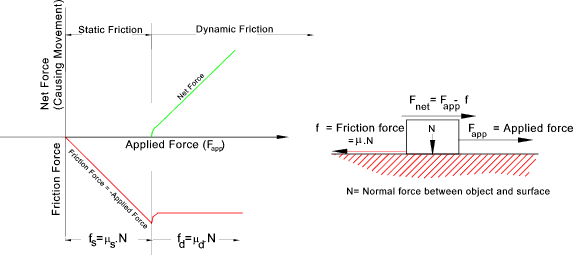
Instead, the frictional force adjusts itself to whatever value is required to maintain equilibrium, up to a maximum value.
The magnitude of the frictional force \( F \) satisfies
\( F \leq \mu R \)

The value \( \mu R \) is called the limiting friction. It is the maximum possible frictional force before motion begins.
Key Interpretations
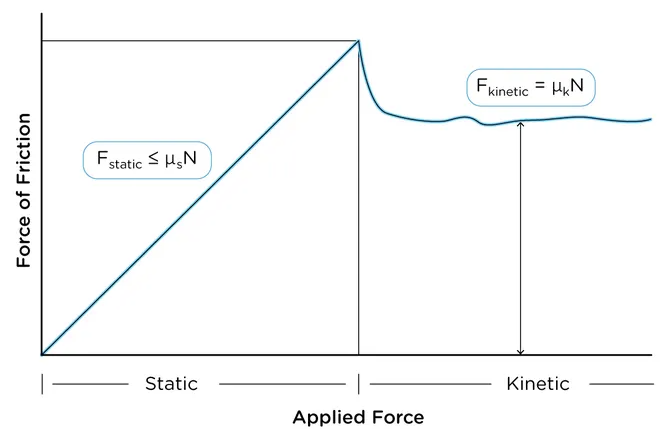
If \( F < \mu R \), the particle is in equilibrium and not on the point of slipping
If \( F = \mu R \), the particle is in equilibrium and on the point of slipping
In equilibrium problems, friction always acts in the direction that prevents motion.
Applying Equilibrium with Friction
To solve equilibrium problems involving friction:
- Assume a possible direction of motion
- Draw a free body diagram showing friction opposing this motion
- Use equilibrium equations in perpendicular directions
- Use \( F \leq \mu R \) to check consistency
Example :
A block of weight \( 20 \) N rests on a rough horizontal surface. The coefficient of friction between the block and the surface is \( 0.4 \). Find the maximum possible frictional force.
▶️ Answer/Explanation
Normal reaction:
\( R = 20 \)
Maximum friction (limiting friction):
\( \mu R = 0.4 \times 20 = 8 \)
Conclusion: The frictional force can take any value up to a maximum of \( 8 \) N.
Example :
A particle is held in equilibrium on a rough horizontal surface by a horizontal force of \( 5 \) N. The coefficient of friction is \( 0.5 \) and the normal reaction is \( 12 \) N. Determine whether equilibrium is possible.
▶️ Answer/Explanation
Maximum friction available:
\( \mu R = 0.5 \times 12 = 6 \)
Friction required for equilibrium is \( 5 \) N.
Since
\( 5 \leq 6 \)
Conclusion: Equilibrium is possible.