
Moment of a Force
The moment of a force measures the turning effect of a force about a fixed point or axis.
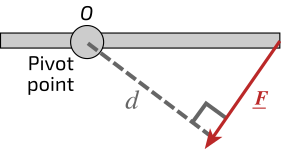
The moment of a force about a point is defined as the product of the magnitude of the force and the perpendicular distance from the point to the line of action of the force.
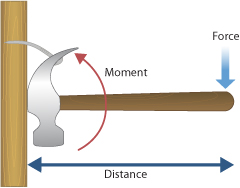
\( \text{Moment} = \text{Force} \times \text{perpendicular distance} \)
The SI unit of moment is the newton metre (Nm).
Direction of a Moment
A moment may tend to rotate a body in one of two directions:
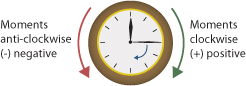
- Clockwise
- Anticlockwise
By convention, moments tending to rotate a body anticlockwise are usually taken as positive.
Coplanar Parallel Forces
When forces act in the same plane and are all parallel to each other, they are called coplanar parallel forces.
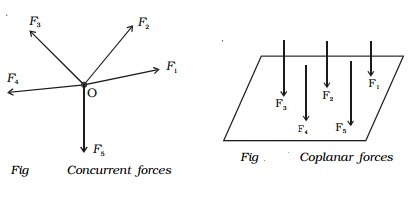
Such forces may cause a body to:
- Translate (move in a straight line)
- Rotate
- Remain in equilibrium
Conditions for Equilibrium of a Rigid Body
For a body acted upon by coplanar parallel forces to be in equilibrium, two conditions must be satisfied:

- The resultant force must be zero
- The resultant moment about any point must be zero
These are usually written as:
- Sum of upward forces = sum of downward forces
- Sum of clockwise moments = sum of anticlockwise moments
Choosing a Point for Moments
Moments may be taken about any convenient point. A good choice often eliminates unknown forces from the moment equation.
This simplifies the calculations.
Example :
A force of \( 10 \) N acts at a perpendicular distance of \( 0.5 \) m from a fixed point. Find the moment of the force about that point.
▶️ Answer/Explanation
Using the definition of moment:
\( \text{Moment} = 10 \times 0.5 = 5 \)
Conclusion: The moment of the force is \( 5 \) Nm.
Example :
A uniform beam of length \( 4 \) m and weight \( 20 \) N rests horizontally on two supports at its ends. Find the reaction forces at the supports.
▶️ Answer/Explanation
Let the reactions at the left and right supports be \( R_1 \) and \( R_2 \).
The weight acts at the midpoint, \( 2 \) m from each end.
Vertical equilibrium:
\( R_1 + R_2 = 20 \)
Taking moments about the left end:
\( R_2 \times 4 = 20 \times 2 \)
\( R_2 = 10 \)
Substitute into \( R_1 + R_2 = 20 \):
\( R_1 = 10 \)
Conclusion: Each support provides an upward reaction of \( 10 \) N.
Example :
A uniform rod of weight \( 12 \) N is supported horizontally by a hinge at one end and a vertical string at the other end. Find the tension in the string.
▶️ Answer/Explanation
Let the length of the rod be \( L \).
The weight acts at the midpoint, \( \dfrac{L}{2} \) from the hinge.
Taking moments about the hinge:
\( T \times L = 12 \times \dfrac{L}{2} \)
\( T = 6 \)
Conclusion: The tension in the string is \( 6 \) N.