
Motion in a Vertical Plane with Constant Acceleration
Motion in a vertical plane occurs when a particle moves vertically upward or downward under the action of gravity. In such motion, the acceleration is constant and is due to gravity.

The acceleration due to gravity is denoted by \( g \) and acts vertically downwards. Its magnitude is taken as \( g = 9.8 \,\text{m s}^{-2} \), unless otherwise stated.
Choice of Direction
A positive direction must be chosen before forming equations.
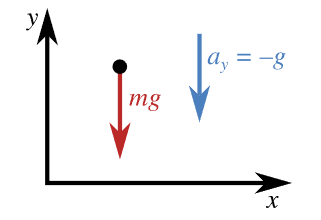
If upward is chosen as positive, acceleration is \( -g \)
If downward is chosen as positive, acceleration is \( +g \)
The equations of motion for constant acceleration are then applied.
Equations of Motion
For constant acceleration, the standard kinematic equations are:
- \( v = u + at \)
- \( s = ut + \dfrac{1}{2}at^2 \)
- \( v^2 = u^2 + 2as \)
Here, \( u \) is the initial velocity, \( v \) is the final velocity, \( a =\pm g\) is the acceleration, \( t \) is the time, and \( s \) is the displacement.
Key Features of Vertical Motion
- At the highest point of upward motion, the velocity is zero
- Acceleration due to gravity is constant throughout the motion
- Upward and downward motions are treated using the same equations
Example :
A particle is projected vertically upwards with speed \( 14 \,\text{m s}^{-1} \). Find the maximum height reached.
▶️ Answer/Explanation
Take upward as positive.
\( u = 14,\; v = 0,\; a = -g \)
Using \( v^2 = u^2 + 2as \):
\( 0 = 14^2 – 2gs \)
\( s = \dfrac{196}{2g} = 10 \)
Conclusion: The maximum height reached is \( 10 \) m.
Example :
A particle is dropped from rest from a height of \( 20 \) m.
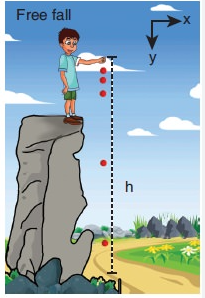
Find the time taken to reach the ground.
▶️ Answer/Explanation
Take downward as positive.
\( u = 0,\; a = g,\; s = 20 \)
Using \( s = ut + \dfrac{1}{2}at^2 \):
\( 20 = \dfrac{1}{2}gt^2 \)
\( t^2 = \dfrac{40}{g} \Rightarrow t \approx 2.02 \)
Conclusion: The particle reaches the ground after approximately \( 2.0 \) s.
Example :
A particle is projected vertically upwards with speed \( 12 \,\text{m s}^{-1} \). Find the time taken for the particle to return to its point of projection.
▶️ Answer/Explanation
Take upward as positive.
\( u = 12,\; a = -g \)
At return point, displacement \( s = 0 \).
Using \( s = ut + \dfrac{1}{2}at^2 \):
\( 0 = 12t – \dfrac{1}{2}gt^2 \)
\( t(12 – \dfrac{1}{2}gt) = 0 \Rightarrow t = \dfrac{24}{g} \)
Conclusion: The particle returns to its starting point after \( \dfrac{24}{g} \) s.