
Velocity and Acceleration When Displacement Is a Function of Time
In kinematics, the motion of a particle can be described by giving its displacement as a function of time. Calculus is then used to find expressions for velocity and acceleration.
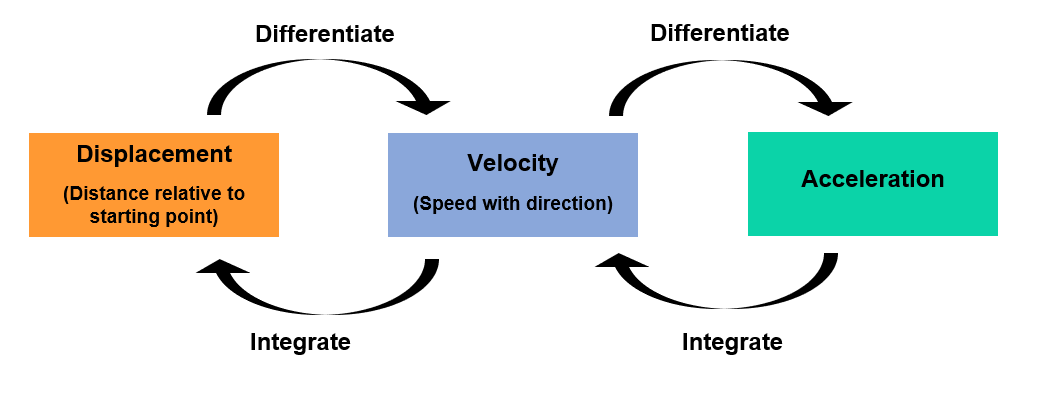
Let the displacement of a particle from a fixed origin at time \( t \) be given by
\( x = x(t) \)
Velocity
The velocity of the particle is the rate of change of displacement with respect to time:
\( v = \dfrac{dx}{dt} \)
Acceleration
The acceleration of the particle is the rate of change of velocity with respect to time:
\( a = \dfrac{dv}{dt} = \dfrac{d^2x}{dt^2} \)
These definitions apply to motion in a straight line.
Equations of the Form \( \dfrac{dx}{dt} = f(t) \)
If the velocity of a particle is given as a function of time,
\( \dfrac{dx}{dt} = f(t) \)
then the displacement \( x \) is found by integrating with respect to \( t \):
\( x = \displaystyle \int f(t)\,dt \)
An initial condition is used to find the constant of integration.
Equations of the Form \( \dfrac{dv}{dt} = g(t) \)
If the acceleration is given as a function of time,
\( \dfrac{dv}{dt} = g(t) \)
then the velocity is found by integrating:
\( v = \displaystyle \int g(t)\,dt \)
The displacement may then be found by integrating the velocity.
All integration and differentiation used here is consistent with the calculus content of P1, P2, P3, and P4.
Example :
The displacement of a particle is given by \( x = t^3 – 6t^2 + 9t \). Find expressions for the velocity and acceleration.
▶️ Answer/Explanation
Velocity:
\( v = \dfrac{dx}{dt} = 3t^2 – 12t + 9 \)
Acceleration:
\( a = \dfrac{dv}{dt} = 6t – 12 \)
Conclusion: The velocity is \( 3t^2 – 12t + 9 \) and the acceleration is \( 6t – 12 \).
Example :
A particle moves so that \( \dfrac{dx}{dt} = 4t – 2 \). Given that \( x = 3 \) when \( t = 0 \), find the displacement at time \( t \).
▶️ Answer/Explanation
Integrate the velocity:
\( x = \displaystyle \int (4t – 2)\,dt = 2t^2 – 2t + C \)
Use the initial condition \( x = 3 \) when \( t = 0 \):
\( 3 = C \)
So
\( x = 2t^2 – 2t + 3 \)
Conclusion: The displacement is \( x = 2t^2 – 2t + 3 \).
Example :
The acceleration of a particle is given by \( \dfrac{dv}{dt} = 6t \). Given that the velocity is zero when \( t = 0 \), find the velocity and displacement as functions of time.
▶️ Answer/Explanation
Integrate acceleration to find velocity:
\( v = \displaystyle \int 6t\,dt = 3t^2 + C \)
Using \( v = 0 \) when \( t = 0 \):
\( C = 0 \)
So \( v = 3t^2 \).
Integrate velocity to find displacement:
\( x = \displaystyle \int 3t^2\,dt = t^3 + D \)
If the particle starts from the origin, \( D = 0 \).
Conclusion: The velocity is \( 3t^2 \) and the displacement is \( x = t^3 \).