
Differentiation and Integration of a Vector with Respect to Time
In mechanics, the position of a particle moving in a plane is often described by a vector function of time.
If the position vector of a particle at time \( t \) is
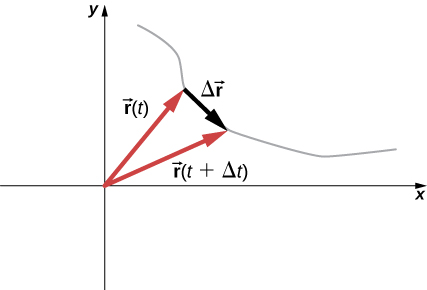
\( \mathbf{r} = x(t)\mathbf{i} + y(t)\mathbf{j} \)
then calculus is applied to each component separately.
Velocity Vector
The velocity vector is the rate of change of the position vector with respect to time.
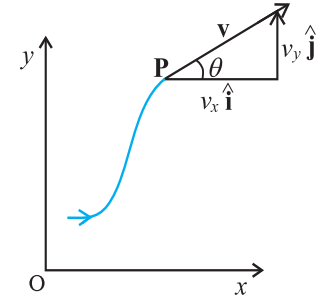
\( \dot{\mathbf{r}} = \dfrac{d\mathbf{r}}{dt} \)
If \( \mathbf{r} = x(t)\mathbf{i} + y(t)\mathbf{j} \), then
\( \dot{\mathbf{r}} = \dfrac{dx}{dt}\mathbf{i} + \dfrac{dy}{dt}\mathbf{j} \)
Acceleration Vector
The acceleration vector is the rate of change of velocity with respect to time.
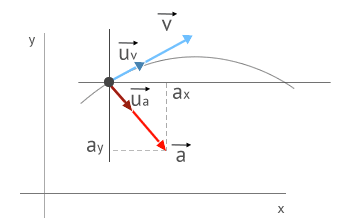
\( \ddot{\mathbf{r}} = \dfrac{d^2\mathbf{r}}{dt^2} \)
So
\( \ddot{\mathbf{r}} = \dfrac{d^2x}{dt^2}\mathbf{i} + \dfrac{d^2y}{dt^2}\mathbf{j} \)
Integration of a Vector with Respect to Time
Integration is performed component by component.
If
\( \dot{\mathbf{r}} = f(t)\mathbf{i} + g(t)\mathbf{j} \)
then
\( \mathbf{r} = \displaystyle \int f(t)\,dt\,\mathbf{i} + \int g(t)\,dt\,\mathbf{j} \)
Constants of integration are found using given initial conditions.
Example :
Given that \( \mathbf{r} = t^2\mathbf{i} + t^3\mathbf{j} \), find \( \dot{\mathbf{r}} \) and \( \ddot{\mathbf{r}} \).
▶️ Answer/Explanation
Differentiate each component with respect to \( t \).
Velocity:
\( \dot{\mathbf{r}} = 2t\mathbf{i} + 3t^2\mathbf{j} \)
Acceleration:
\( \ddot{\mathbf{r}} = 2\mathbf{i} + 6t\mathbf{j} \)
Conclusion: The velocity is \( 2t\mathbf{i} + 3t^2\mathbf{j} \) and the acceleration is \( 2\mathbf{i} + 6t\mathbf{j} \).
Example :
A particle has position vector \( \mathbf{r} = (3t^2 – t)\mathbf{i} + 4t\mathbf{j} \). Find the velocity and acceleration at time \( t = 2 \).
▶️ Answer/Explanation
Differentiate to find velocity:
\( \dot{\mathbf{r}} = (6t – 1)\mathbf{i} + 4\mathbf{j} \)
Differentiate again to find acceleration:
\( \ddot{\mathbf{r}} = 6\mathbf{i} \)
Substitute \( t = 2 \).
Velocity: \( (11\mathbf{i} + 4\mathbf{j}) \)
Acceleration: \( 6\mathbf{i} \)
Conclusion: At \( t = 2 \), the velocity is \( 11\mathbf{i} + 4\mathbf{j} \) and the acceleration is \( 6\mathbf{i} \).
Example :
The velocity of a particle is given by \( \dot{\mathbf{r}} = (4t – 2)\mathbf{i} + (6t^2)\mathbf{j} \). Given that \( \mathbf{r} = \mathbf{0} \) when \( t = 0 \), find the position vector \( \mathbf{r} \).
▶️ Answer/Explanation
Integrate each component with respect to \( t \).
\( \mathbf{r} = \displaystyle \int (4t – 2)\,dt\,\mathbf{i} + \int 6t^2\,dt\,\mathbf{j} \)
\( \mathbf{r} = (2t^2 – 2t + C_1)\mathbf{i} + (2t^3 + C_2)\mathbf{j} \)
Use the initial condition \( \mathbf{r} = \mathbf{0} \) when \( t = 0 \):
\( C_1 = 0,\; C_2 = 0 \)
Conclusion: The position vector is \( \mathbf{r} = (2t^2 – 2t)\mathbf{i} + 2t^3\mathbf{j} \).