
Centre of Mass of a Discrete Mass Distribution
The centre of mass of a system of particles is the single point at which the total mass of the system may be considered to act. It is the average position of the masses, weighted according to their magnitudes.
This concept is used extensively in mechanics to simplify problems involving motion and equilibrium.
Centre of Mass in One Dimension
Consider a system of particles of masses \( m_1, m_2, \dots, m_n \) located at positions \( x_1, x_2, \dots, x_n \) on a straight line.
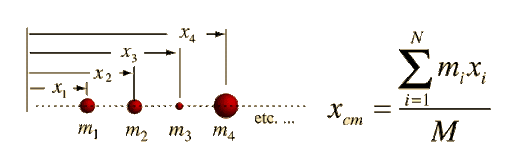
The coordinate of the centre of mass is given by
\( x = \dfrac{\sum m_ix_i}{\sum m_i} \)
Positions to the left of the chosen origin are taken as negative.
Centre of Mass in Two Dimensions
For particles in a plane, the centre of mass is found by considering each coordinate direction separately.

If particles of masses \( m_1, m_2, \dots, m_n \) are located at points \( (x_1, y_1), (x_2, y_2), \dots, (x_n, y_n) \), then
\( x = \dfrac{\sum m_ix_i}{\sum m_i} \)
\( y = \dfrac{\sum m_iy_i}{\sum m_i} \)
The centre of mass is the point \( (x, y) \).
Key Points
- The origin can be chosen for convenience
- The same method applies regardless of the number of particles
- Each coordinate direction is treated independently
Example :
Three particles of masses \( 2 \) kg, \( 3 \) kg, and \( 5 \) kg are placed on a straight line at positions \( x = 1 \) m, \( x = 4 \) m, and \( x = 7 \) m respectively. Find the position of the centre of mass.
▶️ Answer/Explanation
Use the one-dimensional centre of mass formula:
\( x = \dfrac{2(1) + 3(4) + 5(7)}{2 + 3 + 5} \)
\( x = \dfrac{2 + 12 + 35}{10} = \dfrac{49}{10} \)
Conclusion: The centre of mass is at \( x = 4.9 \) m.
Example :
Two particles of masses \( 4 \) kg and \( 6 \) kg are at positions \( x = -2 \) m and \( x = 3 \) m respectively. Find the centre of mass.
▶️ Answer/Explanation
Apply the formula, taking care with signs:
\( x = \dfrac{4(-2) + 6(3)}{4 + 6} \)
\( x = \dfrac{-8 + 18}{10} = 1 \)
Conclusion: The centre of mass is at \( x = 1 \) m.
Example :
Three particles of masses \( 1 \) kg, \( 2 \) kg, and \( 3 \) kg are located at points \( (2,1) \), \( (4,5) \), and \( (6,3) \) respectively. Find the coordinates of the centre of mass.
▶️ Answer/Explanation
Find the total mass:
\( \sum m = 1 + 2 + 3 = 6 \)
Find the \( x \)-coordinate:
\( x = \dfrac{1(2) + 2(4) + 3(6)}{6} = \dfrac{28}{6} = \dfrac{14}{3} \)
Find the \( y \)-coordinate:
\( y = \dfrac{1(1) + 2(5) + 3(3)}{6} = \dfrac{20}{6} = \dfrac{10}{3} \)
Conclusion: The centre of mass is at \( \left(\dfrac{14}{3}, \dfrac{10}{3}\right) \).