
Centre of Mass of Uniform Plane Figures
For a uniform plane figure, the mass is evenly distributed over the area. As a result, the centre of mass depends only on the shape and geometry of the figure, not on its total mass.
In this syllabus, results for standard shapes may be taken directly from the formulae book and do not need to be proved. The use of integration is not required.
Use of Symmetry
If a uniform lamina has one or more axes of symmetry, then its centre of mass lies on those axes.
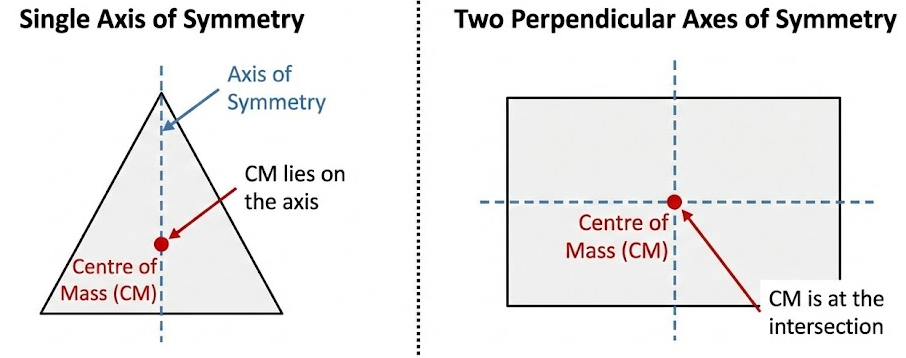
- If there is one axis of symmetry, the centre of mass lies somewhere on that axis
- If there are two perpendicular axes of symmetry, the centre of mass is at their intersection
Standard Results for Uniform Plane Figures
The following results may be quoted directly:
Centres of Mass of Standard Uniform Plane Figures
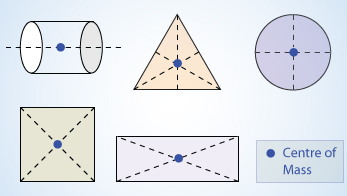
| Plane Figure | Position of Centre of Mass |
|---|---|
| Rectangle | At the intersection of the diagonals |
| Square | At the intersection of the diagonals |
| Circle | At its geometric centre |
| Triangle | At the intersection of the medians, \( \dfrac{1}{3} \) of the height from the base |
Composite Plane Figures
A composite plane figure is formed by combining two or more simple uniform figures.
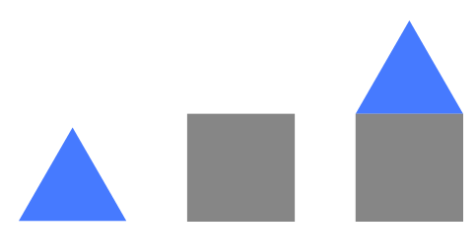
The centre of mass is found by treating each component as a separate lamina and using area-weighted coordinates.
If the areas of the components are \( A_1, A_2, \dots \) with centres at \( (x_1, y_1), (x_2, y_2), \dots \), then the centre of mass of the composite figure is given by
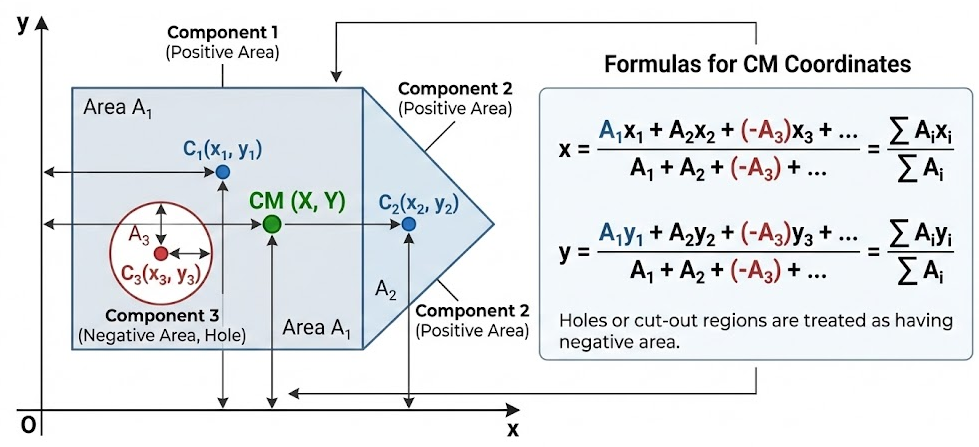
\( x = \dfrac{\sum A_ix_i}{\sum A_i} \)
\( y = \dfrac{\sum A_iy_i}{\sum A_i} \)
Holes or cut-out regions are treated as having negative area.
Example :
Find the centre of mass of a uniform rectangular lamina of length \( 8 \) m and width \( 4 \) m.
▶️ Answer/Explanation
A rectangle has two perpendicular axes of symmetry.
The centre of mass lies at the intersection of the diagonals.
Midpoint of length: \( 4 \)
Midpoint of width: \( 2 \)
Conclusion: The centre of mass is at \( (4,\,2) \).
Example :
A uniform triangular lamina has base \( 6 \) m and height \( 9 \) m. Find the distance of the centre of mass from the base.
▶️ Answer/Explanation
For a uniform triangle, the centre of mass lies on the medians.
It is located one third of the height from the base.
Distance from base \( = \dfrac{1}{3} \times 9 = 3 \)
Conclusion: The centre of mass is \( 3 \) m above the base.
Example :
A lamina consists of a rectangle of width \( 6 \) m and height \( 4 \) m with a semicircle of radius \( 2 \) m removed from the top edge. Find the position of the centre of mass.
▶️ Answer/Explanation
Take the bottom-left corner of the rectangle as the origin.
Rectangle:
Area \( A_1 = 6 \times 4 = 24 \)
Centre at \( (3,\,2) \)
Semicircle (removed):
Area \( A_2 = -\dfrac{1}{2}\pi(2)^2 = -2\pi \)
Centre at \( (3,\,4 – \dfrac{4}{3\pi}) \)
Using area-weighted coordinates:
\( x = \dfrac{24(3) + (-2\pi)(3)}{24 – 2\pi} = 3 \)
By symmetry, the centre lies on the vertical centre line.
Conclusion: The centre of mass lies on the line \( x = 3 \); its vertical position is found using the formulae book value for the semicircle centre.