
Simple Cases of Equilibrium of a Plane Lamina
A plane lamina is a thin flat body whose mass is uniformly distributed over its area. A lamina is in equilibrium when it remains at rest, meaning that there is no resultant force and no resultant turning effect.
For equilibrium of a plane lamina:
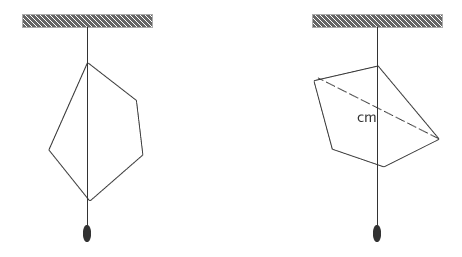
- The resultant force acting on the lamina is zero
- The resultant moment about any point is zero
In this syllabus, only simple and uncomplicated situations are considered.
(i) Lamina Suspended from a Fixed Point
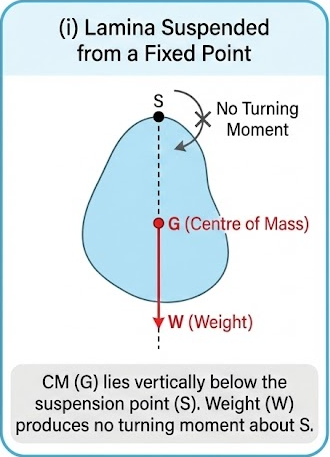
- When a lamina is suspended freely from a fixed point, it comes to rest with its centre of mass vertically below the point of suspension.
- This is because the weight of the lamina acts through the centre of mass, producing no turning moment about the suspension point.
(ii) Lamina Free to Rotate About a Fixed Horizontal Axis

- If a lamina is free to rotate about a fixed horizontal axis, equilibrium occurs when the centre of mass lies vertically below the axis.
- In this position, the moment due to the weight of the lamina about the axis is zero.
(iii) Lamina on an Inclined Plane
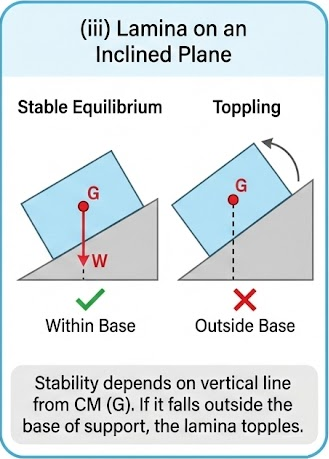
- When a lamina is placed on an inclined plane, equilibrium depends on whether the vertical line through the centre of mass falls within the base of support.
- If this vertical line falls outside the base, the lamina will topple.
Key Ideas for Solving Problems
- Locate the centre of mass of the lamina
- Identify pivot points or axes of rotation
- Apply the principle of moments
Example :
A uniform triangular lamina is suspended from a point on its boundary.
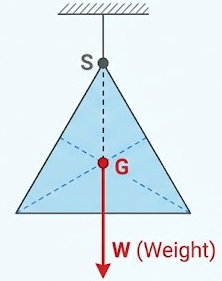
Describe the position in which the lamina will come to rest.
▶️ Answer/Explanation
The lamina is free to rotate about the point of suspension.
In equilibrium, the centre of mass must lie vertically below the suspension point.
For a triangle, the centre of mass is at the intersection of the medians.
Conclusion: The lamina comes to rest with its centre of mass vertically below the point of suspension.
Example :
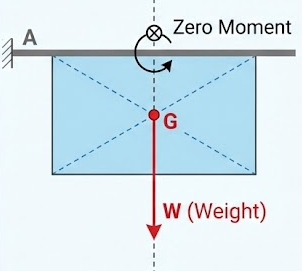
A uniform rectangular lamina is free to rotate about a fixed horizontal axis passing through one of its longer sides.
Describe the equilibrium position.
▶️ Answer/Explanation
The centre of mass of a rectangle is at its geometric centre.
For equilibrium, the centre of mass must lie vertically below the axis of rotation.
This occurs when the lamina hangs vertically.
Conclusion: The lamina is in equilibrium when it hangs with its centre of mass vertically below the fixed axis.
Example :
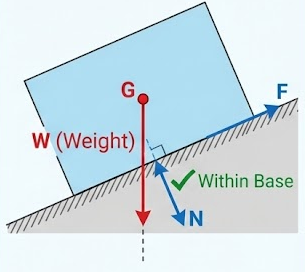
A uniform rectangular lamina rests on a rough inclined plane.
State the condition for the lamina to remain in equilibrium without toppling.
▶️ Answer/Explanation
The centre of mass of the lamina is at its geometric centre.
For equilibrium, the vertical line through the centre of mass must fall within the base of contact with the plane.
If this condition is satisfied, no turning moment causes toppling.
Conclusion: The lamina remains in equilibrium provided the vertical through its centre of mass lies within the base of support.