
Kinetic and Potential Energy
In mechanics, energy is the capacity to do work. Two important forms of mechanical energy are kinetic energy and potential energy.
Energy is a scalar quantity and is measured in joules (J).
Kinetic Energy
The kinetic energy of a particle is the energy it possesses due to its motion.

For a particle of mass \( m \) moving with speed \( v \), the kinetic energy is given by
\( \dfrac{1}{2}mv^2 \)
Kinetic energy depends on the square of the speed, so small changes in speed can produce large changes in kinetic energy.
Gravitational Potential Energy
The gravitational potential energy of a particle is the energy it possesses due to its position in a gravitational field.

Near the Earth’s surface, if a particle of mass \( m \) is raised through a vertical height \( h \), its gravitational potential energy is given by
\( mgh \)
The choice of the zero level for potential energy is arbitrary, but it must be used consistently throughout a problem.
Work Done and Energy
When a force causes a particle to move, it does work. The work done by a force is equal to the change in kinetic energy of the particle.
This leads to the work–energy principle, which is used extensively in mechanics problems.
Example :
A particle of mass \( 4 \) kg is moving with speed \( 6 \,\text{m s}^{-1} \). Find its kinetic energy.
▶️ Answer/Explanation
Use the kinetic energy formula:
\( \dfrac{1}{2}mv^2 = \dfrac{1}{2} \times 4 \times 6^2 \)
\( = 2 \times 36 = 72 \)
Conclusion: The kinetic energy of the particle is \( 72 \) J.
Example :
A block of mass \( 5 \) kg is raised vertically through a height of \( 3 \) m. Find the increase in gravitational potential energy.
▶️ Answer/Explanation
Use the gravitational potential energy formula:
\( mgh = 5 \times g \times 3 \)
\( = 15g \)
Conclusion: The increase in gravitational potential energy is \( 15g \) J.
Example :
A particle of mass \( 2 \) kg falls freely from rest through a vertical distance of \( 5 \) m. Find its speed just before reaching the ground.
▶️ Answer/Explanation
Loss of gravitational potential energy:
\( mgh = 2 \times g \times 5 = 10g \)
This is converted into kinetic energy:
\( \dfrac{1}{2}mv^2 = 10g \)
\( v^2 = 10g \Rightarrow v = \sqrt{10g} \)
Conclusion: The speed just before impact is \( \sqrt{10g} \,\text{m s}^{-1} \).
The Work–Energy Principle
The work–energy principle states that the work done by the resultant force acting on a particle is equal to the change in kinetic energy of the particle.
This principle provides a powerful alternative to using equations of motion, especially when forces and displacements are involved.
Statement of the Work–Energy Principle
If a particle of mass \( m \) moves with initial speed \( u \) and final speed \( v \), then
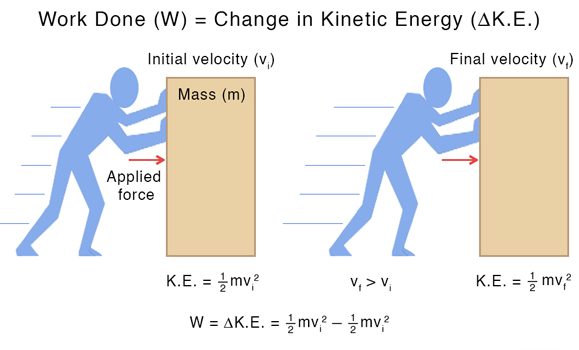
Work done by resultant force \( = \dfrac{1}{2}mv^2 – \dfrac{1}{2}mu^2 \)
That is,
Change in kinetic energy \( = \) final kinetic energy \( – \) initial kinetic energy
Key Features
- Only the resultant force does work
- The principle applies to motion in a straight line or a curve
- It is valid even when acceleration is not constant
Work Done by Common Forces
- Weight: work done \( = mgh \) for a vertical change of height \( h \)
- Friction: work done is negative and equals \( Fs \)
- Normal reaction: does no work if perpendicular to motion
Using the Work–Energy Principle
To apply the principle:
- Identify all forces doing work
- Calculate the total work done over the displacement
- Equate this to the change in kinetic energy
Example :
A particle of mass \( 2 \) kg moves along a straight line. A constant force of \( 6 \) N acts on it over a distance of \( 5 \) m. If the particle starts from rest, find its speed after moving this distance.
▶️ Answer/Explanation
Work done by the force:
\( W = Fs = 6 \times 5 = 30 \)
Initial kinetic energy:
\( \dfrac{1}{2}mu^2 = 0 \)
Final kinetic energy:
\( \dfrac{1}{2}mv^2 = 30 \)
\( v^2 = 30 \Rightarrow v = \sqrt{30} \)
Conclusion: The speed of the particle is \( \sqrt{30} \,\text{m s}^{-1} \).
Example :
A block of mass \( 4 \) kg slides down a smooth vertical drop of height \( 2 \) m from rest. Find its speed at the bottom.
▶️ Answer/Explanation
Work done by gravity:
\( mgh = 4 \times g \times 2 = 8g \)
This equals the gain in kinetic energy:
\( \dfrac{1}{2}mv^2 = 8g \)
\( v^2 = 4g \Rightarrow v = \sqrt{4g} \)
Conclusion: The speed at the bottom is \( \sqrt{4g} \,\text{m s}^{-1} \).
Example :
A particle of mass \( 1.5 \) kg moves along a rough horizontal surface with coefficient of friction \( 0.2 \). It has an initial speed of \( 8 \,\text{m s}^{-1} \). Find the distance travelled before it comes to rest.
▶️ Answer/Explanation
Frictional force:
\( F = \mu R = 0.2 \times 1.5g = 0.3g \)
Work done against friction over distance \( s \):
\( W = 0.3g\,s \)
Initial kinetic energy:
\( \dfrac{1}{2}mv^2 = \dfrac{1}{2} \times 1.5 \times 8^2 = 48 \)
Final kinetic energy is zero.
Using the work–energy principle:
\( 0.3g\,s = 48 \Rightarrow s = \dfrac{48}{0.3g} \)
Conclusion: The particle travels \( \dfrac{48}{0.3g} \) m before coming to rest.
Work and Power
In mechanics, work is done when a force causes a particle to move, while power measures how quickly work is done.
Both quantities are scalars and play an important role in the analysis of motion and energy.
Work Done by a Constant Force
When a constant force \( F \) acts on a particle and causes a displacement \( s \) in the same direction as the force, the work done is

\( Ws = Fs \)
More generally, if the force makes an angle \( \theta \) with the direction of displacement, the work done is

\( W = Fs\cos \theta \)
If the force is perpendicular to the direction of motion, no work is done.
Work Done Against Gravity
When a particle of mass \( m \) is raised vertically through a height \( h \), the work done against gravity is equal to the gain in gravitational potential energy:
\( mgh \)
Power
The power of a force is the rate at which work is done.

The average power is given by
\( \dfrac{\text{work done}}{\text{time taken}} \)
If a force \( F \) acts on a particle moving with speed \( v \) in the same direction, the instantaneous power is

\( P = Fv \)
The SI unit of power is the watt (W), where \( 1 \text{ W} = 1 \text{ J s}^{-1} \).

Connection with Energy
The work done by the resultant force on a particle is equal to the change in kinetic energy of the particle.
Example :
A force of \( 10 \) N acts on a particle, causing it to move \( 5 \) m in the direction of the force. Find the work done.
▶️ Answer/Explanation
Since the force acts in the direction of motion,
\( W = Fs = 10 \times 5 \)
\( = 50 \)
Conclusion: The work done is \( 50 \) J.
Example :
A block of mass \( 3 \) kg is pulled up a smooth inclined plane of length \( 4 \) m by a force of \( 20 \) N acting parallel to the plane. Find the work done by the force.
▶️ Answer/Explanation
The force acts along the direction of motion.
\( W = Fs = 20 \times 4 = 80 \)
Conclusion: The work done by the force is \( 80 \) J.
Example :
An engine pulls a car with a constant force of \( 500 \) N at a steady speed of \( 20 \,\text{m s}^{-1} \). Find the power developed by the engine.
▶️ Answer/Explanation
Use the power formula:
\( P = Fv = 500 \times 20 \)
\( = 10000 \)
Conclusion: The power developed by the engine is \( 10\,000 \) W.