
The Principle of Conservation of Mechanical Energy
The mechanical energy of a particle is the sum of its kinetic energy and potential energy.
If only conservative forces act on a particle, the total mechanical energy remains constant throughout the motion.
Statement of the Principle
When no energy is lost to non-conservative forces,

Total mechanical energy remains constant
\( \dfrac{1}{2}mu^2 + mgh_1 = \dfrac{1}{2}mv^2 + mgh_2 \)
This principle is often used instead of equations of motion, especially when speeds and heights are involved.
Motion with Constant Resistance
If a particle moves under a constant resistive force such as friction or air resistance, mechanical energy is not conserved.
In this case, the work done against resistance must be included:
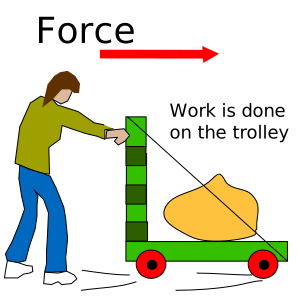
Loss in mechanical energy \( = \) work done against resistance
Motion on an Inclined Plane
For motion up or down a plane inclined at an angle \( \theta \):
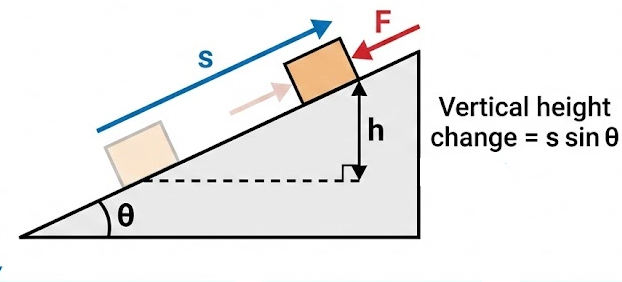
Vertical height change \( = s\sin \theta \)
Work done against resistance \( = Fs \)
The conservation of energy is applied by accounting for both gravitational potential energy and energy lost to resistance.
Example :
A particle of mass \( 3 \) kg is released from rest and falls freely through a vertical height of \( 4 \) m. Find its speed at the bottom.
▶️ Answer/Explanation
Initial mechanical energy:
\( \dfrac{1}{2}mu^2 + mgh = 0 + 3g \times 4 = 12g \)
Final mechanical energy:
\( \dfrac{1}{2}mv^2 \)
Using conservation of mechanical energy:
\( \dfrac{1}{2}mv^2 = 12g \)
\( v^2 = 8g \Rightarrow v = \sqrt{8g} \)
Conclusion: The speed at the bottom is \( \sqrt{8g} \,\text{m s}^{-1} \).
Example :
A block of mass \( 5 \) kg slides down a smooth plane inclined at \( 30^\circ \) to the horizontal. It starts from rest and travels \( 6 \) m down the plane. Find its speed.
▶️ Answer/Explanation
Vertical height fallen:
\( h = 6\sin 30^\circ = 3 \)
Loss of potential energy:
\( mgh = 5g \times 3 = 15g \)
This becomes kinetic energy:
\( \dfrac{1}{2}mv^2 = 15g \)
\( v^2 = 6g \Rightarrow v = \sqrt{6g} \)
Conclusion: The speed of the block is \( \sqrt{6g} \,\text{m s}^{-1} \).
Example :
A particle of mass \( 2 \) kg is projected up a rough plane inclined at \( 20^\circ \) to the horizontal with speed \( 10 \,\text{m s}^{-1} \). A constant resistive force of \( 3 \) N acts on the particle. Find the distance travelled up the plane before it comes to rest.
▶️ Answer/Explanation
Initial kinetic energy:
\( \dfrac{1}{2}mu^2 = \dfrac{1}{2} \times 2 \times 10^2 = 100 \)
Gain in potential energy after distance \( s \):
\( mg(s\sin 20^\circ) = 2g s\sin 20^\circ \)
Work done against resistance:
\( 3s \)
Using energy balance:
\( 100 = 2g s\sin 20^\circ + 3s \)
\( s = \dfrac{100}{2g\sin 20^\circ + 3} \)
Conclusion: The particle travels \( \dfrac{100}{2g\sin 20^\circ + 3} \) m up the plane.