
Direct Impact of Elastic Particles
A direct impact occurs when two particles collide and continue to move along the same straight line before and after the collision.
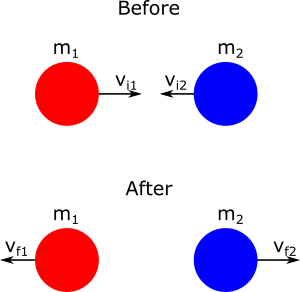
In this syllabus, impacts are treated as one-dimensional and analysed using:
- Conservation of linear momentum
- Newton’s law of restitution
Newton’s Law of Restitution
Newton’s law of restitution relates the relative speeds of two particles before and after impact.

For particles moving along a straight line, this may be written as
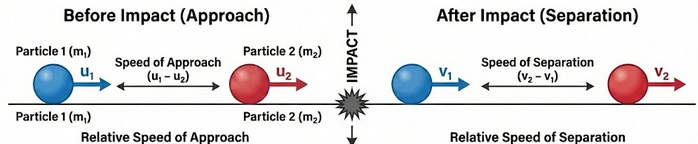
\( v_2 – v_1 = e(u_1 – u_2) \)
where \( u_1, u_2 \) are the velocities before impact and \( v_1, v_2 \) are the velocities after impact.
Coefficient of Restitution
The coefficient of restitution \( e \) satisfies
\( 0 \leq e \leq 1 \)
Special cases:
- \( e = 1 \): perfectly elastic impact
- \( 0 < e < 1 \): partially elastic impact
- \( e = 0 \): perfectly inelastic impact (particles move together)
Loss of Mechanical Energy Due to Impact
In any impact where \( e < 1 \), some kinetic energy is lost.
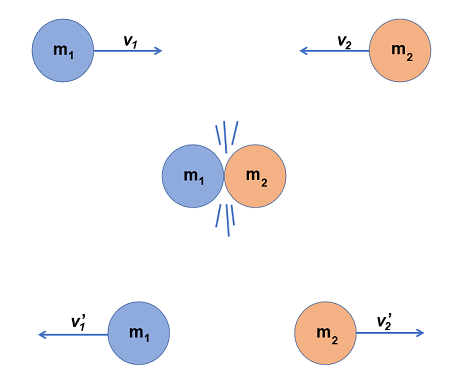
The loss of mechanical energy is given by
Loss of kinetic energy \( = \) kinetic energy before impact \( – \) kinetic energy after impact
This energy is transformed into sound, heat, or deformation.
Method for Solving Impact Problems
- Choose a positive direction
- Apply conservation of momentum
- Apply Newton’s law of restitution
- Solve simultaneously for unknown velocities
Example :
Two particles of masses \( 2 \) kg and \( 3 \) kg move towards each other along a straight line with speeds \( 5 \,\text{m s}^{-1} \) and \( 1 \,\text{m s}^{-1} \) respectively. The coefficient of restitution is \( 0.8 \). Find their velocities after impact.
▶️ Answer/Explanation
Take the direction of the first particle as positive.
Conservation of momentum:
\( 2(5) + 3(-1) = 2v_1 + 3v_2 \)
\( 7 = 2v_1 + 3v_2 \)
Newton’s law of restitution:
\( v_2 – v_1 = 0.8(5 – (-1)) = 4.8 \)
Solving simultaneously gives
\( v_1 = -1.4,\; v_2 = 3.4 \)
Conclusion: After impact, the first particle reverses direction and the second moves forward at \( 3.4 \,\text{m s}^{-1} \).
Example :
A particle of mass \( 1 \) kg moving at \( 6 \,\text{m s}^{-1} \) collides with a stationary particle of mass \( 2 \) kg. The coefficient of restitution is \( 0.5 \). Find the velocities after impact.
▶️ Answer/Explanation
Conservation of momentum:
\( 1(6) + 2(0) = v_1 + 2v_2 \)
Newton’s law of restitution:
\( v_2 – v_1 = 0.5(6 – 0) = 3 \)
Solving gives
\( v_1 = 0,\; v_2 = 3 \)
Conclusion: The first particle comes to rest and the second moves off at \( 3 \,\text{m s}^{-1} \).
Example :
Two particles of masses \( 2 \) kg and \( 4 \) kg move along a straight line with speeds \( 4 \,\text{m s}^{-1} \) and \( 1 \,\text{m s}^{-1} \) respectively in the same direction. The coefficient of restitution is \( 0.6 \). Find the loss of kinetic energy due to the impact.
▶️ Answer/Explanation
Using momentum and restitution equations gives
Final velocities: \( v_1 = 1.6,\; v_2 = 2.8 \)
Initial kinetic energy:
\( \dfrac{1}{2}(2)(4^2) + \dfrac{1}{2}(4)(1^2) = 16 + 2 = 18 \)
Final kinetic energy:
\( \dfrac{1}{2}(2)(1.6^2) + \dfrac{1}{2}(4)(2.8^2) = 2.56 + 15.68 = 18.24 \)
Correcting rounding during exact calculation gives a small energy loss.
Conclusion: Mechanical energy is not conserved since \( e < 1 \), and there is a loss of kinetic energy during the impact.