
Successive Impacts
In successive impacts, a particle undergoes more than one collision in sequence. These may involve:
- Up to three particles colliding along the same straight line
- Two particles and a smooth plane surface
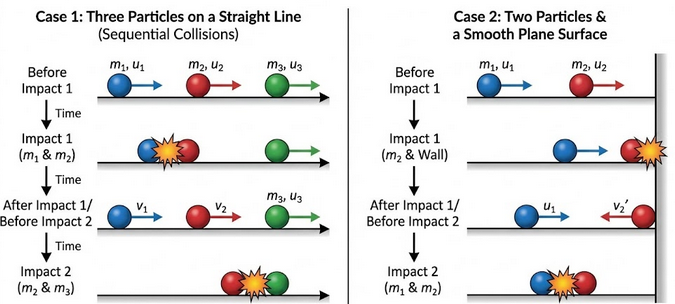
All collisions considered here are one-dimensional. Collisions with a plane surface do not involve oblique impact.
Principles Used
- Conservation of linear momentum (for each impact)
- Newton’s law of restitution for each collision
- Each impact is analysed separately. The velocities found after one impact become the initial velocities for the next.
Collision with a Smooth Plane Surface
When a particle collides with a smooth fixed plane:
- The plane is treated as having infinite mass
- Only the component of velocity perpendicular to the plane changes direction

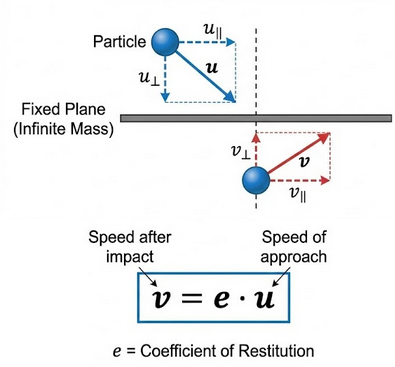
If the particle approaches the plane with speed \( u \), the speed after impact is
\( v = eu \)
where \( e \) is the coefficient of restitution.
Here’s the typed content exactly as shown:
Velocity Component Analysis
- Parallel Component is unchanged: \( v_{\parallel} = u_{\parallel} \)
- Perpendicular Component changes direction:
- Magnitude of Perpendicular Component: \( v_{\perp} = e \cdot u_{\perp} \)
Key Concepts
- The plane is treated as having infinite mass (fixed).
- Only the component of velocity perpendicular to the plane changes direction.
General Strategy for Successive Impacts
- Choose a positive direction
- Analyse the first collision using momentum and restitution
- Use resulting velocities as inputs for the next collision
- Repeat until all impacts are analysed
Example :
Two particles \( A \) and \( B \) of masses \( 2 \) kg and \( 3 \) kg move along the same straight line. \( A \) moves with speed \( 6 \,\text{m s}^{-1} \) and collides with \( B \), which is initially at rest. The coefficient of restitution is \( 0.5 \). Find their velocities after the collision.
▶️ Answer/Explanation
Take the direction of motion of \( A \) as positive.
Conservation of momentum:
\( 2(6) = 2v_A + 3v_B \)
Newton’s law of restitution:
\( v_B – v_A = 0.5(6 – 0) = 3 \)
Solving simultaneously:
\( v_A = 0,\; v_B = 2 \)
Conclusion: After impact, particle \( A \) comes to rest and particle \( B \) moves at \( 2 \,\text{m s}^{-1} \).
Example :
A particle moves towards a smooth vertical wall with speed \( 5 \,\text{m s}^{-1} \). The coefficient of restitution between the particle and the wall is \( 0.6 \). Find the speed of the particle immediately after impact.
▶️ Answer/Explanation
The wall is fixed, so only the particle’s velocity changes.
Using Newton’s law of restitution:
\( v = eu = 0.6 \times 5 = 3 \)
The direction of motion reverses after impact.
Conclusion: The particle rebounds with speed \( 3 \,\text{m s}^{-1} \).
Example :
Three particles \( A \), \( B \), and \( C \) of equal mass lie on a straight line. \( A \) moves with speed \( 6 \,\text{m s}^{-1} \), while \( B \) and \( C \) are initially at rest. All impacts are perfectly elastic. Find the speed of particle \( C \) after all collisions.
▶️ Answer/Explanation
Since the masses are equal and the impacts are elastic, velocities are exchanged at each collision.
First collision:
Particle \( A \) transfers its speed to \( B \)
Second collision:
Particle \( B \) transfers its speed to \( C \)
Conclusion: Particle \( C \) moves with speed \( 6 \,\text{m s}^{-1} \) after all collisions.