
Equilibrium of Rigid Bodies
A rigid body is a body whose shape and size do not change when forces are applied. In mechanics, a rigid body is in equilibrium when it remains completely at rest.
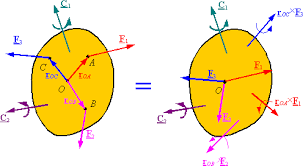
For a rigid body to be in equilibrium under coplanar forces, two conditions must be satisfied:
- The resultant force acting on the body is zero
- The resultant moment about any point is zero
Mathematical Conditions for Equilibrium
For coplanar forces:
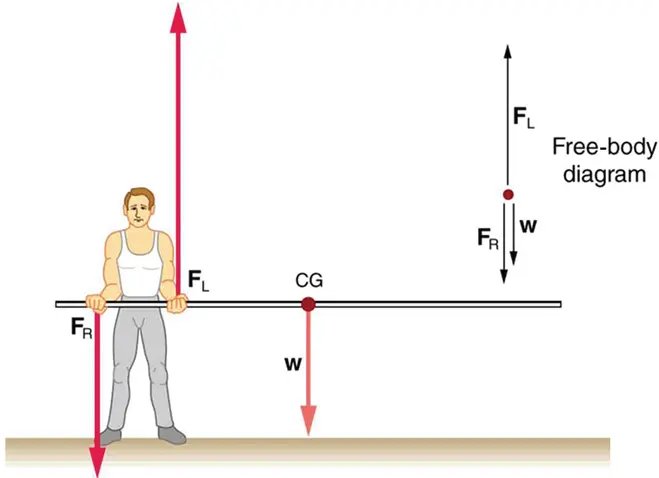
- Sum of horizontal forces \( = 0 \)
- Sum of vertical forces \( = 0 \)
- Sum of moments about any point \( = 0 \)
Parallel Coplanar Forces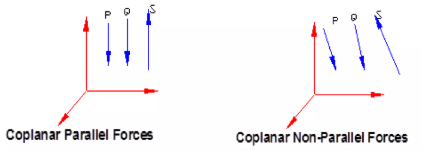
When all forces acting on a rigid body are parallel, equilibrium problems are usually solved by:
- Balancing vertical forces
- Applying the principle of moments
Non-Parallel Coplanar Forces
When forces act in different directions, they must be resolved into horizontal and vertical components before applying the equilibrium conditions.
Rods and Ladders in Equilibrium
Typical problems involve rods or ladders:
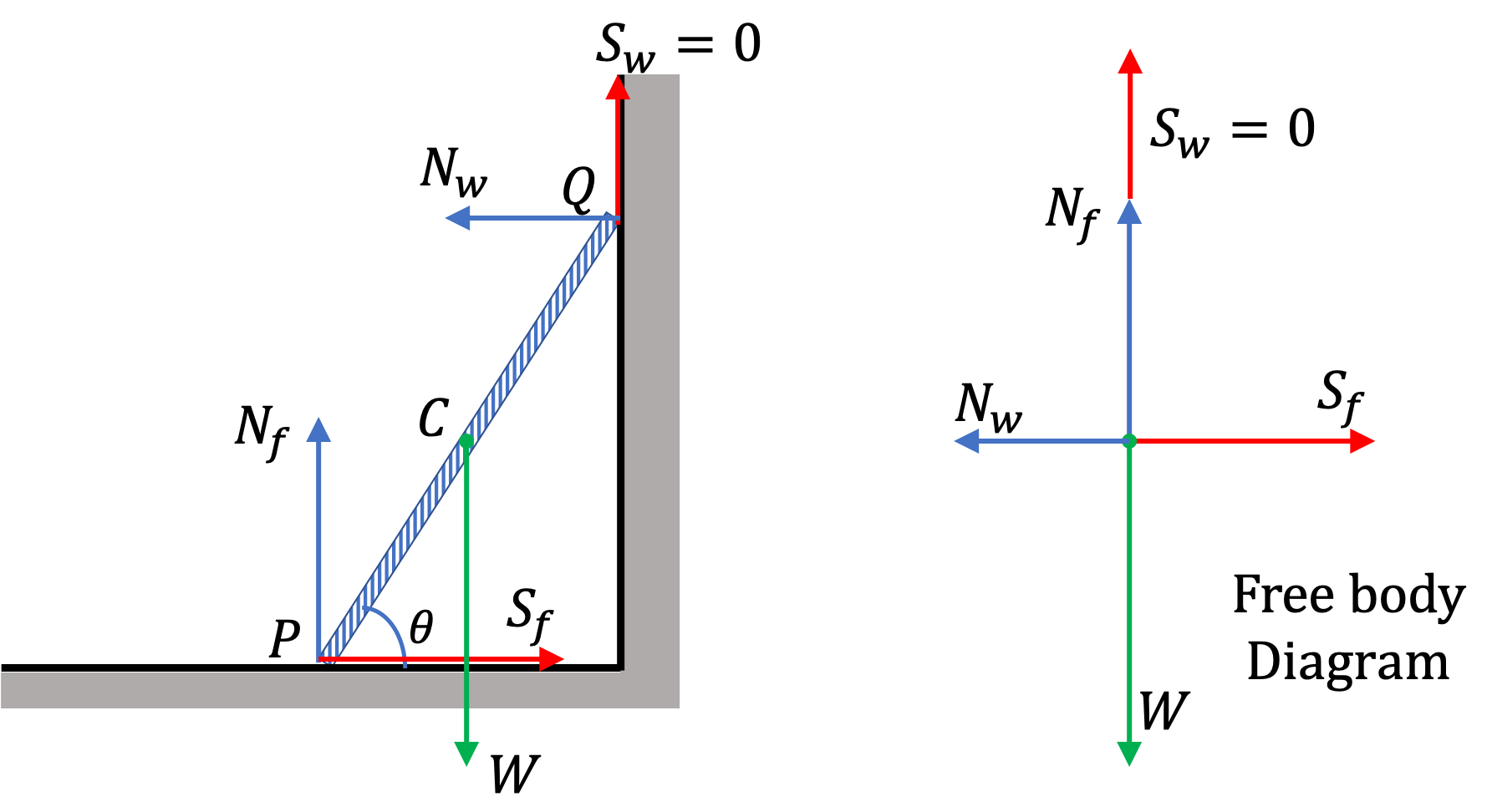
- Resting against a smooth or rough vertical wall
- Resting on smooth or rough horizontal ground
Key forces that may act include:
- Weight acting at the centre of mass
- Normal reactions from the wall or ground
- Frictional forces where surfaces are rough
Smooth surfaces provide normal reactions only, while rough surfaces provide both normal reaction and friction.
Example :
A uniform rod of length \( 6 \) m and weight \( 30 \) N rests horizontally on two supports at its ends.
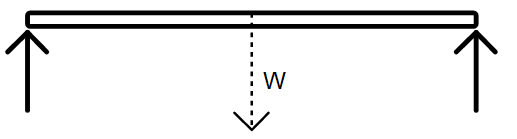
Find the reaction at each support.
▶️ Answer/Explanation
The weight acts at the centre of the rod, \( 3 \) m from each end.
Let the reactions at the supports be \( R_1 \) and \( R_2 \).
Vertical equilibrium:
\( R_1 + R_2 = 30 \)
Taking moments about the left support:
\( R_2 \times 6 = 30 \times 3 \)
\( R_2 = 15 \)
So \( R_1 = 15 \).
Conclusion: Each support provides a reaction of \( 15 \) N.
Example :
A uniform ladder of length \( 5 \) m and weight \( 200 \) N rests against a smooth vertical wall and on rough horizontal ground.The ladder makes an angle of \( 60^\circ \) with the ground.
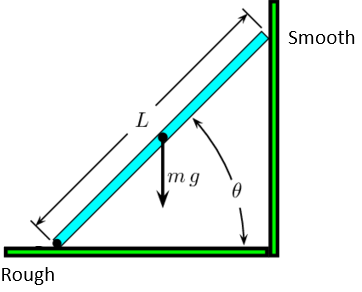
Find the normal reaction at the wall.
▶️ Answer/Explanation
The wall is smooth, so the reaction at the wall is horizontal.
The weight acts at the midpoint of the ladder.
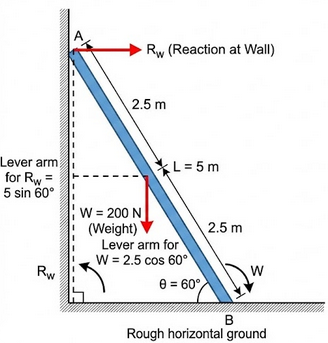
Taking moments about the point where the ladder touches the ground:
Reaction at wall \( \times 5\sin 60^\circ = 200 \times \dfrac{5}{2}\cos 60^\circ \)
Reaction at wall \( = \dfrac{200 \times 2.5 \times 0.5}{5 \times \sin 60^\circ} \)
Reaction at wall \( = \dfrac{250}{5 \times \sin 60^\circ} \)
Conclusion: The normal reaction at the wall is \( \dfrac{50}{\sin 60^\circ} \) N.
Example :
A uniform rod of length \( 4 \) m and weight \( 40 \) N rests in equilibrium with one end against a rough vertical wall and the other on rough horizontal ground. Describe the forces that must be considered when setting up the equilibrium equations.
▶️ Answer/Explanation
The forces acting on the rod are:
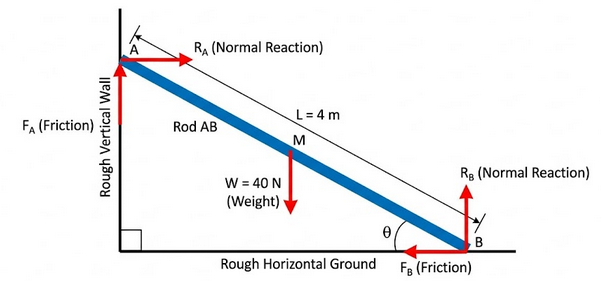
- Weight acting vertically downward at the centre of the rod
- Normal reaction from the ground acting vertically upward
- Frictional force at the ground acting horizontally
- Normal reaction from the wall acting horizontally
- Frictional force at the wall acting vertically
Conclusion: Equilibrium is analysed by resolving forces horizontally and vertically and applying the principle of moments.