
Kinematics with Variable Acceleration
In some kinematics problems, the acceleration of a particle is not constant but varies with either the displacement \( x \) or the time \( t \).
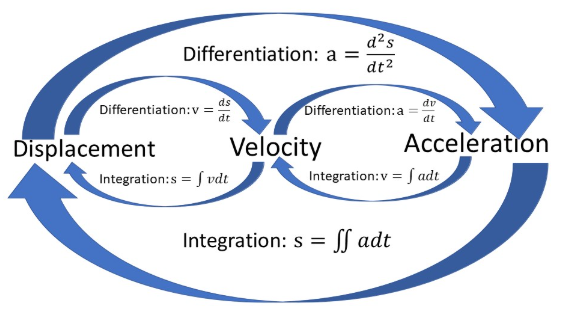
The motion is always along a straight line.
Velocity and Acceleration Relations
The following fundamental relationships are used:
Velocity: \( v = \dfrac{dx}{dt} \)
Acceleration: \( a = \dfrac{dv}{dt} = \dfrac{d^2x}{dt^2} \)
Acceleration as a Function of Time
If acceleration is given as a function of time,
\( \dfrac{dv}{dt} = f(t) \)
Integrating with respect to \( t \) gives the velocity:
\( v = \displaystyle \int f(t)\,dt \)
A further integration gives the displacement.
Acceleration as a Function of Displacement
If acceleration is given as a function of displacement,
\( a = f(x) \)
Using the chain rule, acceleration can be written as
\( a = v\dfrac{dv}{dx} \)
So the governing equation becomes
\( v\dfrac{dv}{dx} = f(x) \)
Integrating with respect to \( x \) gives an expression for \( v \) in terms of \( x \).
Alternative Forms
The syllabus also allows equations of the form:
\( \dfrac{d^2x}{dt^2} = f(x) \)
\( \dfrac{dx}{dt} = f(t) \)
These are solved using direct integration and initial conditions.
Problem-Solving Steps
- Identify whether acceleration depends on \( x \) or \( t \)
- Choose the appropriate differential equation
- Integrate and apply initial conditions
Example :
A particle moves in a straight line with acceleration \( a = 6t \,\text{m s}^{-2} \). It starts from rest at \( t = 0 \). Find its velocity at time \( t \).
▶️ Answer/Explanation
Given
\( \dfrac{dv}{dt} = 6t \)
Integrating:
\( v = 3t^2 + C \)
Using \( v = 0 \) when \( t = 0 \), \( C = 0 \).
Conclusion: The velocity is \( v = 3t^2 \,\text{m s}^{-1} \).
Example :
The acceleration of a particle is given by \( a = 4x \,\text{m s}^{-2} \). When \( x = 0 \), the speed of the particle is \( 2 \,\text{m s}^{-1} \). Find the speed when \( x = 3 \).
▶️ Answer/Explanation
Use
\( v\dfrac{dv}{dx} = 4x \)
Integrating:
\( \dfrac{1}{2}v^2 = 2x^2 + C \)
Using \( v = 2 \) when \( x = 0 \):
\( 2 = C \)
So
\( \dfrac{1}{2}v^2 = 2x^2 + 2 \)
At \( x = 3 \):
\( v^2 = 40 \Rightarrow v = \sqrt{40} \)
Conclusion: The speed is \( \sqrt{40} \,\text{m s}^{-1} \).
Example :
A particle moves so that \( \dfrac{dx}{dt} = 2t + 1 \). Given that \( x = 3 \) when \( t = 0 \), find \( x \) in terms of \( t \).
▶️ Answer/Explanation
Integrate with respect to \( t \):
\( x = t^2 + t + C \)
Using \( x = 3 \) when \( t = 0 \):
\( C = 3 \)
Conclusion: The displacement is \( x = t^2 + t + 3 \).