
Elastic Strings and Springs
Elastic strings and springs are used to model forces that depend on extension. In this syllabus, motion and equilibrium involving elastic strings and light springs are analysed using simple linear force laws.
Elastic Strings
An elastic string is assumed to be:
- Light, so its mass is negligible
- Perfectly elastic
- Inextensible until it reaches its natural length
An elastic string has a natural length \( l \). If its length is less than or equal to \( l \), the string is slack and exerts no force.
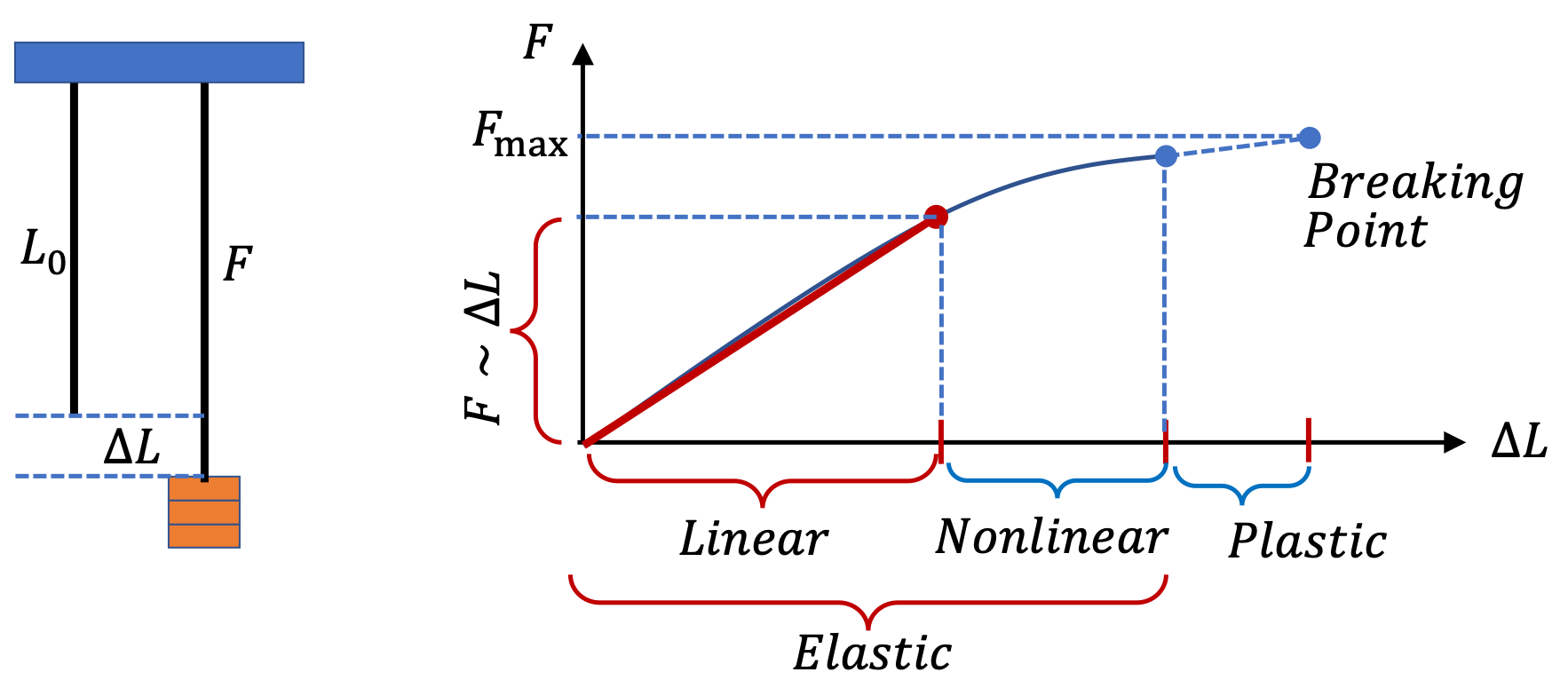
If the string is stretched to length \( x \), where \( x > l \), the tension is given by
\( T = \dfrac{\lambda}{l}(x – l) \)
where \( \lambda \) is the modulus of elasticity of the string.
Springs (Hooke’s Law)
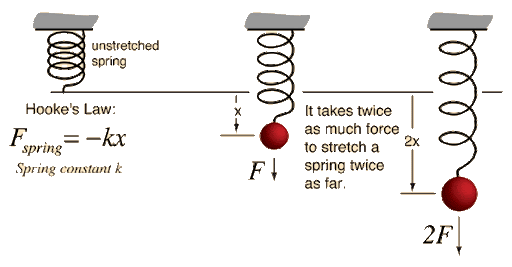
A light spring obeys Hooke’s law, provided it is not stretched beyond its elastic limit.
If the extension of the spring is \( e \), the force exerted by the spring is
\( F = ke \)
where \( k \) is the spring constant.
Comparison of Elastic Strings and Springs
- An elastic string produces tension only when stretched beyond its natural length
- A spring produces a force for any extension or compression
Energy Stored
The elastic potential energy stored is:
For a spring: \( \dfrac{1}{2}ke^2 \)
For an elastic string: \( \dfrac{\lambda}{2l}(x – l)^2 \)
Typical Applications
- Particles hanging in equilibrium
- Vertical motion under gravity
- Use of energy methods to find speed or extension
Example :
A particle of mass \( 2 \) kg hangs at rest from a vertical elastic string of natural length \( 1 \) m and modulus of elasticity \( 20 \) N. Find the extension of the string.
▶️ Answer/Explanation
Let the extension be \( e \).
Tension in the string:
\( T = \dfrac{20}{1}e = 20e \)
In equilibrium, tension equals weight:
\( 20e = 2g \)
\( e = \dfrac{g}{10} \)
Conclusion: The extension of the string is \( \dfrac{g}{10} \) m.
Example :
A spring with spring constant \( 400 \,\text{N m}^{-1} \) is stretched by a force of \( 20 \) N. Find the extension of the spring.
▶️ Answer/Explanation
Using Hooke’s law:
\( F = ke \)
\( 20 = 400e \)
\( e = 0.05 \)
Conclusion: The extension of the spring is \( 0.05 \) m.
Example :
A particle of mass \( 1 \) kg is attached to a vertical spring of spring constant \( 200 \,\text{N m}^{-1} \). It is released from rest when the spring is unstretched. Find the maximum extension of the spring.
▶️ Answer/Explanation
At maximum extension, the particle is momentarily at rest.
Loss of gravitational potential energy:
\( mgx \)
Elastic potential energy stored:
\( \dfrac{1}{2}kx^2 \)
Using energy conservation:
\( mgx = \dfrac{1}{2}kx^2 \)
\( x = \dfrac{2mg}{k} \)
\( x = \dfrac{2g}{200} = \dfrac{g}{100} \)
Conclusion: The maximum extension of the spring is \( \dfrac{g}{100} \) m.
Hooke’s Law
Hooke’s law describes how the force exerted by a spring (or elastic system) depends on its extension or compression. It applies only when the material behaves elastically and is not stretched beyond its elastic limit.
Statement of Hooke’s Law
Hooke’s law states that the force exerted by a spring is directly proportional to its extension or compression, provided the elastic limit is not exceeded.
\( F = ke \)
where
\( F \) is the force exerted by the spring
\( e \) is the extension or compression
\( k \) is the spring constant
The spring constant \( k \) measures the stiffness of the spring. A larger value of \( k \) indicates a stiffer spring.
Direction of the Force
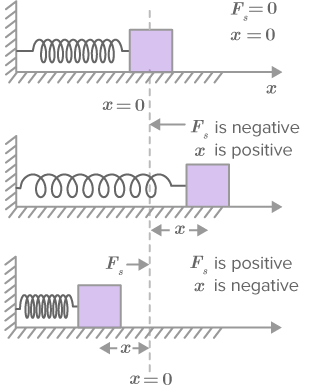
The force due to a spring always acts in the direction that tends to restore the spring to its natural length.
Energy Stored in a Spring
When a spring is stretched or compressed, it stores elastic potential energy given by

\( \dfrac{1}{2}ke^2 \)
Conditions of Validity
- The spring must be light
- The elastic limit must not be exceeded
- The force–extension relationship must be linear
Example :
A spring has spring constant \( 300 \,\text{N m}^{-1} \). Find the force required to stretch the spring by \( 0.04 \) m.
▶️ Answer/Explanation
Using Hooke’s law:
\( F = ke = 300 \times 0.04 \)
\( F = 12 \)
Conclusion: The force required is \( 12 \) N.
Example :
A mass of \( 2 \) kg hangs at rest from a vertical spring. The spring extends by \( 0.05 \) m. Find the spring constant.
▶️ Answer/Explanation
At equilibrium, spring force equals weight:
\( ke = mg \)
\( k(0.05) = 2g \)
\( k = \dfrac{2g}{0.05} = 40g \)
Conclusion: The spring constant is \( 40g \,\text{N m}^{-1} \).
Example :
A particle of mass \( 1.5 \) kg is attached to a vertical spring of spring constant \( 250 \,\text{N m}^{-1} \). It is released from rest when the spring is unstretched. Find the maximum extension of the spring.
▶️ Answer/Explanation
At maximum extension, the particle is momentarily at rest.
Loss of gravitational potential energy:
\( mgx \)
Elastic potential energy stored:
\( \dfrac{1}{2}kx^2 \)
Using energy conservation:
\( mgx = \dfrac{1}{2}kx^2 \)
\( x = \dfrac{2mg}{k} \)
\( x = \dfrac{2 \times 1.5g}{250} = \dfrac{3g}{250} \)
Conclusion: The maximum extension of the spring is \( \dfrac{3g}{250} \) m.