
Newton’s Laws of Motion with Variable Force
Newton’s laws of motion apply equally when the force acting on a particle is variable. In this topic, motion is restricted to one dimension, and calculus methods are used.
Newton’s Second Law (General Form)
Newton’s second law states that the resultant force acting on a particle is equal to the rate of change of its momentum.
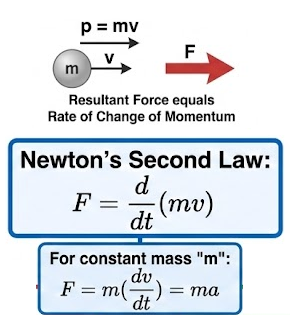
\( \mathbf{F} = \dfrac{d}{dt}(m\mathbf{v}) \)
For motion in one dimension with constant mass \( m \), this becomes
\( F = m\dfrac{dv}{dt} \)
When the force is variable, \( F \) may depend on time \( t \), displacement \( x \), or velocity \( v \).
Variable Force Depending on Time
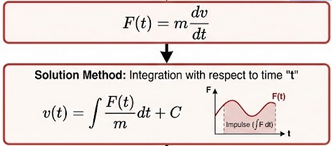
If the force depends on time,
\( F(t) = m\dfrac{dv}{dt} \)
This equation is solved by integrating with respect to \( t \).
Variable Force Depending on Displacement
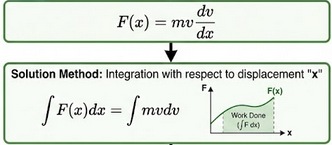
If the force depends on displacement, \( F = f(x) \), then using
\( \dfrac{dv}{dt} = v\dfrac{dv}{dx} \)
Newton’s second law becomes
\( F(x) = mv\dfrac{dv}{dx} \)
This form is particularly useful when the force varies with position.
The Law of Gravitation (Inverse Square Law)
The gravitational force between two particles of masses \( m \) and \( M \), separated by distance \( r \), is given by
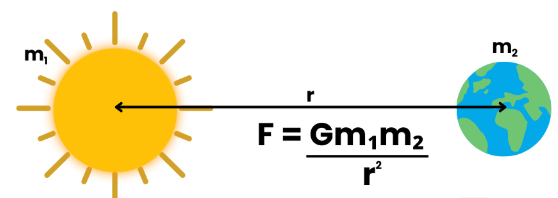
\( F = \dfrac{GMm}{r^2} \)
This is an example of an inverse square law, where the force decreases with the square of the distance.
General Method for Solving Problems
- Choose a positive direction
- Write down Newton’s second law using the given force
- Select the appropriate calculus form
- Integrate and apply initial conditions
Example :
A particle of mass \( 2 \) kg moves in a straight line under a force \( F = 6t \) N. The particle is initially at rest. Find its velocity at time \( t \).
▶️ Answer/Explanation
Using Newton’s second law:
\( 6t = 2\dfrac{dv}{dt} \)
\( \dfrac{dv}{dt} = 3t \)
Integrating:
\( v = \dfrac{3}{2}t^2 + C \)
Since the particle starts from rest, \( C = 0 \).
Conclusion: The velocity is \( v = \dfrac{3}{2}t^2 \,\text{m s}^{-1} \).
Example :
A particle of mass \( 1 \) kg moves along a line under a force \( F = 4x \) N. When \( x = 0 \), the speed of the particle is \( 2 \,\text{m s}^{-1} \). Find the speed when \( x = 3 \).
▶️ Answer/Explanation
Using Newton’s second law:
\( 4x = v\dfrac{dv}{dx} \)
Integrating:
\( \dfrac{1}{2}v^2 = 2x^2 + C \)
Using \( v = 2 \) when \( x = 0 \):
\( C = 2 \)
At \( x = 3 \):
\( v^2 = 40 \Rightarrow v = \sqrt{40} \)
Conclusion: The speed is \( \sqrt{40} \,\text{m s}^{-1} \).
Example :
A particle of mass \( m \) moves towards a fixed mass \( M \) under the gravitational force \( F = \dfrac{GMm}{x^2} \). Show that the acceleration varies inversely as the square of the distance.
▶️ Answer/Explanation
Using Newton’s second law:
\( m\dfrac{dv}{dt} = \dfrac{GMm}{x^2} \)
Dividing both sides by \( m \):
\( \dfrac{dv}{dt} = \dfrac{GM}{x^2} \)
Conclusion: The acceleration is proportional to \( \dfrac{1}{x^2} \), confirming the inverse square law.