
Oscillations of a Particle Attached to an Elastic String or Spring
A particle attached to the end of an elastic string or a spring may execute oscillatory motion about an equilibrium position. In this syllabus, oscillations are confined to the direction of the string or spring only.
Such motion is analysed using Newton’s laws and is shown to be simple harmonic motion (SHM) for small oscillations.
Equilibrium Position
The equilibrium position is the position where the resultant force on the particle is zero.
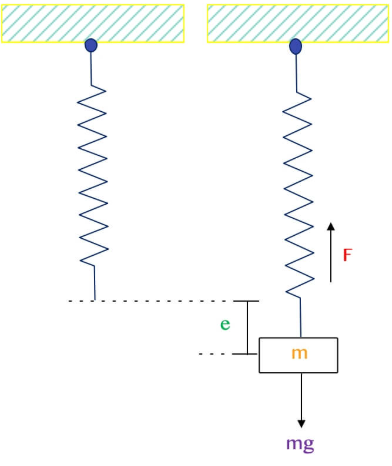
For a vertical system:
- Weight acts downward
- Elastic tension or spring force acts upward
Oscillations take place about this equilibrium position, not about the natural length.
Particle Attached to a Spring
For a light spring with spring constant \( k \), the restoring force when the particle is displaced a distance \( x \) from equilibrium is

\( F = -kx \)
Applying Newton’s second law:
\( m\ddot{x} = -kx \)
So
\( \ddot{x} = -\dfrac{k}{m}x \)
This is the defining equation of SHM with
\( \omega = \sqrt{\dfrac{k}{m}} \)
Particle Attached to an Elastic String
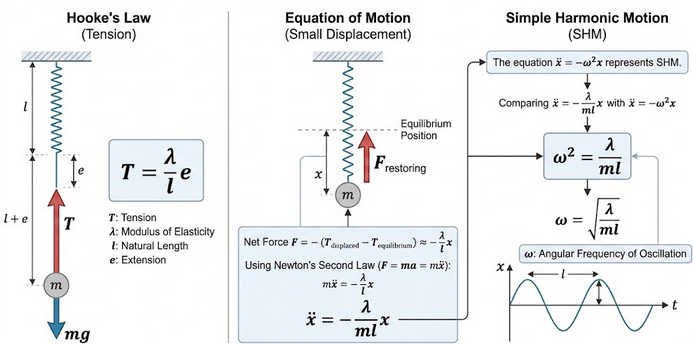
For an elastic string of natural length \( l \) and modulus of elasticity \( \lambda \), the tension when stretched by \( e \) is
\( T = \dfrac{\lambda}{l}e \)
When the particle is displaced a small distance \( x \) from equilibrium, the restoring force is proportional to \( x \), leading to
\( \ddot{x} = -\dfrac{\lambda}{ml}x \)
Thus the motion is SHM with
\( \omega = \sqrt{\dfrac{\lambda}{ml}} \)
Periods of Oscillation
For SHM, the period is given by
\( T = \dfrac{2\pi}{\omega} \)
Hence:
Spring–mass system: \( T = 2\pi\sqrt{\dfrac{m}{k}} \)
Elastic string system: \( T = 2\pi\sqrt{\dfrac{ml}{\lambda}} \)
Example :
A particle of mass \( 0.5 \) kg is attached to a horizontal spring of spring constant \( 8 \,\text{N m}^{-1} \). Show that the particle executes SHM and find the period of oscillation.
▶️ Answer/Explanation
Using Newton’s second law:
\( m\ddot{x} = -kx \)
\( \ddot{x} = -\dfrac{8}{0.5}x = -16x \)
This is SHM with \( \omega^2 = 16 \), so \( \omega = 4 \).
The period is
\( T = \dfrac{2\pi}{4} = \dfrac{\pi}{2} \)
Conclusion: The motion is SHM with period \( \dfrac{\pi}{2} \) s.
Example :
A particle of mass \( 2 \) kg hangs from a vertical elastic string of natural length \( 1 \) m and modulus of elasticity \( 18 \) N. Find the period of small oscillations.
▶️ Answer/Explanation
For an elastic string, the angular speed is
\( \omega = \sqrt{\dfrac{\lambda}{ml}} \)
\( \omega = \sqrt{\dfrac{18}{2 \times 1}} = 3 \)
The period is
\( T = \dfrac{2\pi}{3} \)
Conclusion: The period of oscillation is \( \dfrac{2\pi}{3} \) s.
Example :
A particle attached to a vertical spring executes SHM with angular speed \( 6 \,\text{rad s}^{-1} \). Find the spring constant in terms of the mass \( m \) of the particle.
▶️ Answer/Explanation
For a spring–mass system:
\( \omega = \sqrt{\dfrac{k}{m}} \)
So
\( k = m\omega^2 \)
\( k = 36m \)
Conclusion: The spring constant is \( 36m \,\text{N m}^{-1} \).