
Uniform Motion in a Horizontal Circle
A particle moves with uniform circular motion if it travels at constant speed in a horizontal circular path. Although the speed is constant, the velocity is continually changing in direction, so the particle has an acceleration towards the centre of the circle.
This inward acceleration is the radial (centripetal) acceleration.
Radial Acceleration and Force
For a particle of mass \( m \) moving in a horizontal circle of radius \( r \) with speed \( v \) and angular speed \( \omega \):
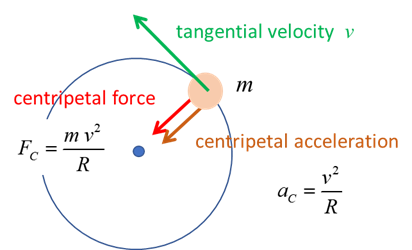
Radial acceleration: \( a = \dfrac{v^2}{r} = r\omega^2 \)
Radial force: \( F = \dfrac{mv^2}{r} = mr\omega^2 \)
The resultant horizontal force acting towards the centre must provide this radial force.
Conical Pendulum
A conical pendulum consists of a particle attached to a light inextensible string of length \( l \), moving in a horizontal circle so that the string makes a constant angle \( \theta \) with the vertical.
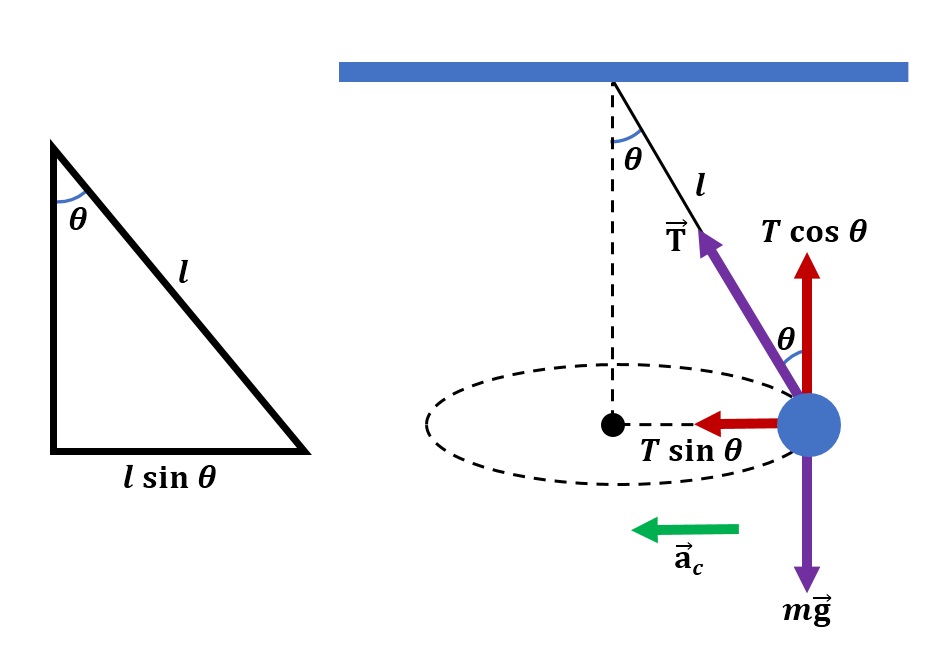
Forces acting on the particle:
Weight \( mg \) acting vertically downward
Tension \( T \) in the string acting along the string
Resolving forces:
Vertical: \( T\cos\theta = mg \)
Horizontal: \( T\sin\theta = \dfrac{mv^2}{r} \)
Elastic String in Circular Motion
If a particle moves in a horizontal circle attached to an elastic string:
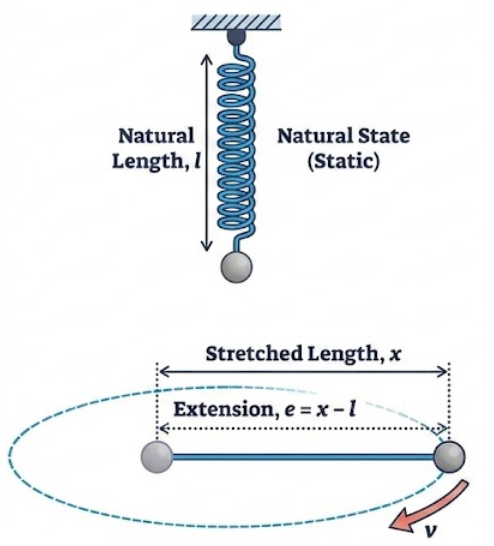
- The tension in the string provides the centripetal force
- The tension depends on the extension of the string
If the natural length is \( l \), the stretched length is \( x \), and the modulus of elasticity is \( \lambda \):
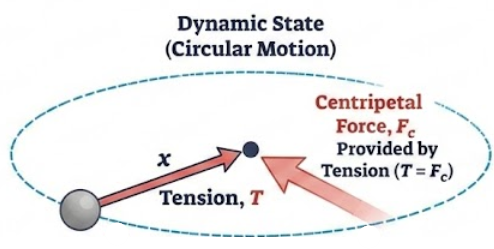
\( T = \dfrac{\lambda}{l}(x – l) \)
Motion on a Banked Surface
When a particle moves in a horizontal circle on a smooth banked surface inclined at angle \( \theta \) to the horizontal:
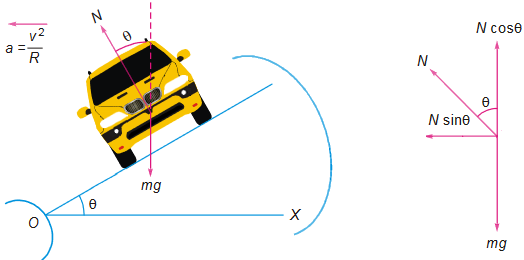
The normal reaction provides the centripetal force
Resolving the normal reaction \( N \):
Vertical: \( N\cos\theta = mg \)
Horizontal: \( N\sin\theta = \dfrac{mv^2}{r} \)
Example :
A particle of mass \( 0.4 \) kg moves in a horizontal circle of radius \( 2 \) m with speed \( 5 \,\text{m s}^{-1} \). Find the magnitude of the centripetal force.
▶️ Answer/Explanation
\( F = \dfrac{mv^2}{r} = \dfrac{0.4 \times 25}{2} = 5 \)
Conclusion: The centripetal force is \( 5 \) N.
Example :
A particle of mass \( 0.5 \) kg is attached to a string of length \( 1.2 \) m and moves as a conical pendulum making an angle of \( 30^\circ \) with the vertical. Find the speed of the particle.
▶️ Answer/Explanation
Radius of the horizontal circle:
\( r = 1.2\sin30^\circ = 0.6 \)
From force resolution:
\( \tan\theta = \dfrac{v^2}{rg} \)
\( \tan30^\circ = \dfrac{v^2}{0.6g} \)
\( v^2 = 0.6g\tan30^\circ \)
Conclusion: The speed is \( \sqrt{0.6g\tan30^\circ} \,\text{m s}^{-1} \).
Example :
A car of mass \( 900 \) kg travels round a smooth circular track of radius \( 50 \) m banked at an angle of \( 20^\circ \). Find the speed at which the car can travel without slipping.
▶️ Answer/Explanation
For a smooth banked surface:
\( \tan\theta = \dfrac{v^2}{rg} \)
\( \tan20^\circ = \dfrac{v^2}{50g} \)
\( v^2 = 50g\tan20^\circ \)
Conclusion: The speed is \( \sqrt{50g\tan20^\circ} \,\text{m s}^{-1} \).