
Motion of a Particle in a Vertical Circle
When a particle moves in a vertical circle, its motion is influenced by both the constraint force (such as tension or reaction) and gravity. Unlike horizontal circular motion, the speed is generally not constant because the particle gains and loses gravitational potential energy.

Problems of this type are solved using a combination of:
- Radial (centripetal) acceleration
- Newton’s second law in the radial direction
- Conservation of mechanical energy
Radial Acceleration
At any point on the vertical circle, the radial acceleration is directed towards the centre and has magnitude
\( a = \dfrac{v^2}{r} \)
Forces Acting on the Particle
Depending on the system, the forces may include:
- Weight \( mg \), acting vertically downward
- Tension in a string, or normal reaction from a track, acting towards the centre
Newton’s second law is applied radially, taking the direction towards the centre as positive.
Key Positions on the Vertical Circle
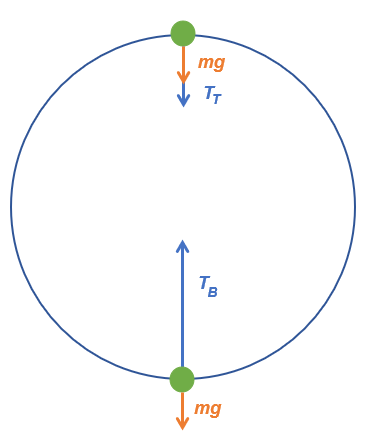
At different points, the radial force balance changes:
- Lowest point: weight acts away from the centre
- Highest point: weight acts towards the centre
Energy Considerations
If air resistance is neglected, mechanical energy is conserved:
$\text{Kinetic energy + gravitational potential energy = constant}$
This allows the speed at different points of the circle to be related.
Condition for Complete Vertical Motion
For a particle attached to a light string, the string must remain taut throughout the motion.
At the top of the circle, the minimum condition is
\( T \geq 0 \)
The limiting case occurs when the tension is zero at the highest point.
Additional Conditions in Motion in a Vertical Circle
In problems involving a particle attached to a light string moving in a vertical circle, two important results are frequently required:
- The minimum speed at the lowest point for complete circular motion
- The difference between the maximum and minimum tension in the string
Minimum Speed at the Lowest Point
For the particle to complete a full vertical circle, the string must remain taut at all times.
At the highest point, the limiting condition occurs when the tension is zero:
\( mg = \dfrac{mv^2}{r} \)
Hence the minimum speed at the highest point is
\( v_{\text{top}} = \sqrt{gr} \)
Using conservation of energy between the lowest and highest points:
\( \dfrac{1}{2}mu^2 = \dfrac{1}{2}mv_{\text{top}}^2 + 2mgr \)
Substituting \( v_{\text{top}}^2 = gr \):
\( u^2 = 5gr \)
Therefore, the minimum speed at the lowest point is
\( \boxed{u = \sqrt{5gr}} \)
Tension at the Highest and Lowest Points
Let \( T_{\max} \) be the tension at the lowest point and \( T_{\min} \) the tension at the highest point.
At the lowest point
\( T_{\max} – mg = \dfrac{mv_{\text{bottom}}^2}{r} \)
At the highest point
\( T_{\min} + mg = \dfrac{mv_{\text{top}}^2}{r} \)
Using energy conservation:
\( v_{\text{bottom}}^2 = v_{\text{top}}^2 + 4gr \)
Difference between Maximum and Minimum Tension
Subtracting the two tension equations gives
\( T_{\max} – T_{\min} = 2mg + \dfrac{m(v_{\text{bottom}}^2 – v_{\text{top}}^2)}{r} \)
Substituting \( v_{\text{bottom}}^2 – v_{\text{top}}^2 = 4gr \):
\( T_{\max} – T_{\min} = 2mg + 4mg \)
\( \boxed{T_{\max} – T_{\min} = 6mg} \)
Example :
A particle of mass \( m \) is attached to a light string of length \( r \) and moves in a vertical circle. Find the minimum speed at the highest point for the string to remain taut.
▶️ Answer/Explanation
At the highest point, both tension and weight act towards the centre.
In the limiting case, tension \( T = 0 \).
\( mg = \dfrac{mv^2}{r} \)
\( v^2 = gr \)
Conclusion: The minimum speed at the highest point is \( \sqrt{gr} \).
Example :
A particle of mass \( m \) is projected at speed \( u \) from the lowest point of a vertical circle of radius \( r \). Find the speed at the highest point, assuming the string remains taut.
▶️ Answer/Explanation
Using conservation of energy:
Initial energy at lowest point:
\( \dfrac{1}{2}mu^2 \)
Gain in potential energy to the top:
\( mg(2r) \)
Energy at highest point:
\( \dfrac{1}{2}mv^2 \)
Equating energies:
\( \dfrac{1}{2}mu^2 = \dfrac{1}{2}mv^2 + 2mgr \)
\( v^2 = u^2 – 4gr \)
Conclusion: The speed at the highest point is \( \sqrt{u^2 – 4gr} \).
Example :
A particle of mass \( 0.6 \) kg moves in a vertical circle of radius \( 1.5 \) m. At the lowest point, its speed is \( 6 \,\text{m s}^{-1} \). Find the tension in the string at the lowest point.
▶️ Answer/Explanation
At the lowest point, the tension acts towards the centre and weight acts away from the centre.
Applying Newton’s second law radially:
\( T – mg = \dfrac{mv^2}{r} \)
\( T = \dfrac{mv^2}{r} + mg \)
\( T = \dfrac{0.6 \times 36}{1.5} + 0.6g \)
\( T = 14.4 + 0.6g \)
Conclusion: The tension at the lowest point is \( (14.4 + 0.6g) \) N.