
Centre of Mass of Uniform Rigid Bodies and Simple Composite Bodies
The centre of mass of a body is the point at which its entire mass may be considered to be concentrated for the purposes of analysing motion and equilibrium.
For a uniform rigid body, the mass is distributed evenly throughout the body. The centre of mass therefore depends only on the geometry of the body.
Centre of Mass and Symmetry
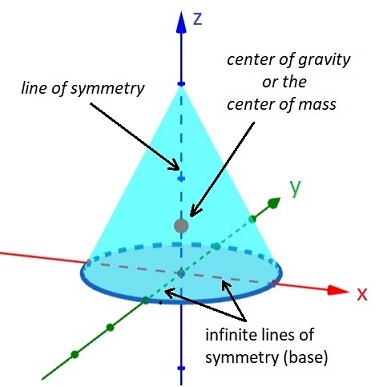
- If a uniform body has one or more axes of symmetry, the centre of mass must lie on each axis of symmetry.
- For many standard shapes, the centre of mass is known and may be quoted directly.
Centre of Mass Using Integration
If symmetry alone is insufficient, the centre of mass may be found using integration.
For a lamina of uniform density, the \( x \)-coordinate of the centre of mass is given by
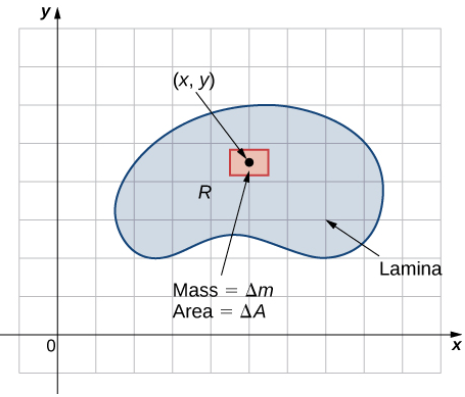
\( \bar{x} = \dfrac{\displaystyle \int x \, dm}{\displaystyle \int dm} \)
Since the density is uniform, \( dm \) may be replaced by an expression involving area or length.
Centre of Mass of Composite Bodies
A composite body is formed by combining two or more simple bodies.
The centre of mass of a composite body is found by treating each part separately and using
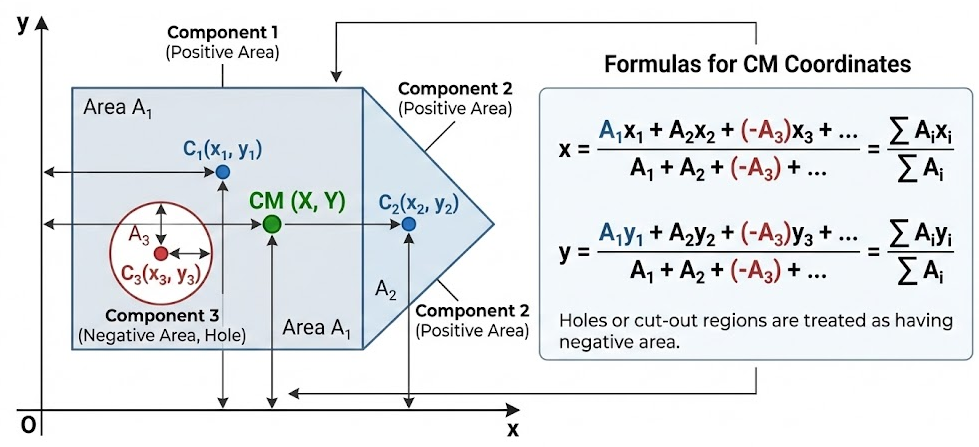
\( \bar{x} = \dfrac{\sum m_ix_i}{\sum m_i} \)
where \( m_i \) is the mass of each component and \( x_i \) is the position of its centre of mass.
Example :
Find the centre of mass of a uniform rod of length \( 2a \).
▶️ Answer/Explanation
The rod is uniform and symmetric about its midpoint.
Therefore, the centre of mass lies halfway along the rod.
Centre of mass is at distance \( a \) from either end.
Conclusion: The centre of mass is at the midpoint of the rod.
Example :
Find the centre of mass of a uniform triangular lamina of base \( b \) and height \( h \).
▶️ Answer/Explanation
The triangular lamina has a line of symmetry through the midpoint of the base.
The centre of mass lies on this line.
It is a standard result that the centre of mass of a triangle lies at the intersection of the medians.
Distance from the base \( = \dfrac{h}{3} \)
Conclusion: The centre of mass is \( \dfrac{h}{3} \) from the base along the median.
Example :
A composite lamina consists of a square of side \( 4a \) with a smaller square of side \( 2a \) removed from one corner. Find the position of the centre of mass.
▶️ Answer/Explanation
Let the origin be at the corner of the large square where the small square is removed.
Area of large square:
\( A_1 = 16a^2 \), centre at \( (2a, 2a) \)
Area of removed square:
\( A_2 = 4a^2 \), centre at \( (a, a) \)
Using the centre of mass formula:
\( \bar{x} = \dfrac{16a^2(2a) – 4a^2(a)}{16a^2 – 4a^2} = \dfrac{28a^3}{12a^2} = \dfrac{7a}{3} \)
\( \bar{y} = \dfrac{16a^2(2a) – 4a^2(a)}{12a^2} = \dfrac{7a}{3} \)
Conclusion: The centre of mass is at \( \left( \dfrac{7a}{3}, \dfrac{7a}{3} \right) \).
Centre of Mass Using Integration
When a uniform body does not have sufficient symmetry, or when its shape varies continuously, the centre of mass must be found using integration.
For a uniform lamina, mass is proportional to area, so the centre of mass can be determined using area elements.
General Formula
If a lamina lies between \( x = a \) and \( x = b \), then the \( x \)-coordinate of the centre of mass is
\( \bar{x} = \dfrac{\displaystyle \int x \, dA}{\displaystyle \int dA} \)
where \( dA \) is a small element of area.
Example:
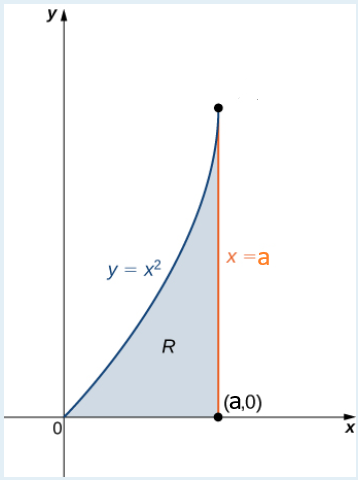
Find the centre of mass of a uniform lamina bounded by the curve \( y = x^2 \), the \( x \)-axis, and the lines \( x = 0 \) and \( x = a \).
▶️ Answer/Explanation
Consider a vertical strip at position \( x \) of width \( dx \).
Area of the strip:
\( dA = y \, dx = x^2 \, dx \)
Total area of the lamina:
\( A = \displaystyle \int_0^a x^2 \, dx = \dfrac{a^3}{3} \)
Moment of the area about the \( y \)-axis:
\( \displaystyle \int_0^a x \, dA = \int_0^a x(x^2)\,dx = \int_0^a x^3 \, dx = \dfrac{a^4}{4} \)
Hence, the \( x \)-coordinate of the centre of mass is
\( \bar{x} = \dfrac{\dfrac{a^4}{4}}{\dfrac{a^3}{3}} = \dfrac{3a}{4} \)
By symmetry about the \( x \)-axis, the centre of mass lies above the axis.
The \( y \)-coordinate is given by
\( \bar{y} = \dfrac{1}{A}\displaystyle \int \dfrac{y}{2}\, dA = \dfrac{1}{A}\int_0^a \dfrac{x^2}{2}(x^2)\,dx \)
\( \bar{y} = \dfrac{1}{\dfrac{a^3}{3}} \cdot \dfrac{1}{2}\int_0^a x^4 \, dx = \dfrac{1}{\dfrac{a^3}{3}} \cdot \dfrac{a^5}{10} = \dfrac{3a^2}{10} \)
Conclusion: The centre of mass of the lamina is at
\( \left( \dfrac{3a}{4}, \dfrac{3a^2}{10} \right) \).