
Laws of Indices for All Rational Exponents
Indices (exponents) can be extended from integers to rational numbers. For any positive real number \( a \) and integers \( m, n \), the exponent rules apply consistently even when the exponents are fractions or negative values.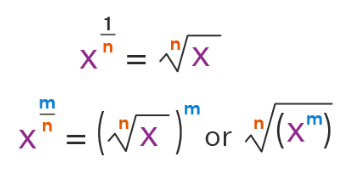
A rational exponent \( \dfrac{m}{n} \) represents both a power and a root:
\( a^{\dfrac{m}{n}} = \left(\sqrt[n]{a}\right)^m = \sqrt[n]{a^m} \)
Laws of Indices
| Law | Expression |
| Multiplication | \( a^m \cdot a^n = a^{\,m+n} \) |
| Division | \( \dfrac{a^m}{a^n} = a^{\,m-n} \) |
| Power of a Power | \( (a^m)^n = a^{mn} \) |
| Power of a Product | \( (ab)^n = a^n b^n \) |
| Power of a Quotient | \( \left(\dfrac{a}{b}\right)^n = \dfrac{a^n}{b^n} \) |
| Zero Index | \( a^0 = 1 \) |
| Negative Index | \( a^{-n} = \dfrac{1}{a^n} \) |
| Rational Index | \( a^{\dfrac{m}{n}} = \sqrt[n]{a^m} \) |
Notes
- All laws remain valid for rational (fractional) and negative indices.
- For \( a^{1/n} \), the number \( a \) must be positive.
- Rational exponents help rewrite roots as powers.
Example
Simplify \( 8^{\,\dfrac{2}{3}} \).
▶️ Answer / Explanation
\( 8^{\dfrac{2}{3}} = (\sqrt[3]{8})^2 = 2^2 = 4 \)
Example
Simplify \( \dfrac{27^{\,\dfrac13}}{3^{-1}} \).
▶️ Answer / Explanation
\( 27^{1/3} = 3 \)
\( 3^{-1} = \dfrac{1}{3} \)
\( \dfrac{3}{1/3} = 9 \)
Example
Simplify completely: \( (16^{\,\dfrac34} \cdot 4^{-\dfrac12}) \div 2^{-1} \).
▶️ Answer / Explanation
\( 16 = 2^4 \Rightarrow 16^{3/4} = (2^4)^{3/4} = 2^3 = 8 \)
\( 4 = 2^2 \Rightarrow 4^{-1/2} = (2^2)^{-1/2} = 2^{-1} = \dfrac12 \)
So product \( = 8 \cdot \dfrac12 = 4 \)
Divide by \( 2^{-1} = \dfrac12 \):
\( \dfrac{4}{1/2} = 8 \)