
Use and Manipulation of Surds
A surd is an irrational root that cannot be expressed as a rational number, such as \( \sqrt{2},\ \sqrt{5},\ \sqrt[3]{7} \). Expressions involving surds can often be simplified by using index laws or by rationalising denominators.
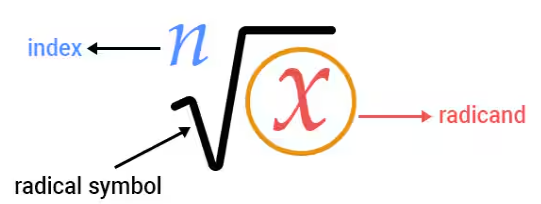
Key Surd Rules
| Rule | Expression |
| Multiplying surds | \( \sqrt{a}\sqrt{b} = \sqrt{ab} \) |
| Dividing surds | \( \dfrac{\sqrt{a}}{\sqrt{b}} = \sqrt{\dfrac{a}{b}} \) |
| Indices with surds | \( \sqrt{a} = a^{1/2},\quad \sqrt[n]{a} = a^{1/n} \) |
| Simplifying | \( \sqrt{ab} = b\sqrt{a} \) if \( b^2 = a \) |
| Conjugate Pair | Conjugate of \( a + \sqrt{b} \) is \( a – \sqrt{b} \) |
Rationalising Denominators
Case 1: Denominator of the form \( \sqrt{a} \)
Multiply top and bottom by \( \sqrt{a} \):
\( \dfrac{1}{\sqrt{a}} = \dfrac{\sqrt{a}}{a} \)
Case 2: Denominator of the form \( a + \sqrt{b} \)
Multiply by its conjugate:
\( \dfrac{1}{a+\sqrt{b}} = \dfrac{a-\sqrt{b}}{a^2 – b} \)
Case 3: General expression with two surds
Multiply by conjugate of the denominator:
\( \dfrac{x}{\sqrt{a}-\sqrt{b}} = \dfrac{x(\sqrt{a}+\sqrt{b})}{a – b} \)
Example
Simplify \( \sqrt{18} \).
▶️ Answer / Explanation
\( 18 = 9 \cdot 2 \)
\( \sqrt{18} = \sqrt{9}\sqrt{2} = 3\sqrt{2} \)
Example
Rationalise the denominator: \( \dfrac{5}{\sqrt{3}} \).
▶️ Answer / Explanation
Multiply by \( \sqrt{3} \):
\( \dfrac{5}{\sqrt{3}} \cdot \dfrac{\sqrt{3}}{\sqrt{3}} = \dfrac{5\sqrt{3}}{3} \)
Example
Rationalise the denominator: \( \dfrac{7}{2 + \sqrt{5}} \).
▶️ Answer / Explanation
Multiply by conjugate \( 2 – \sqrt{5} \):
\( \dfrac{7}{2+\sqrt{5}} \cdot \dfrac{2-\sqrt{5}}{2-\sqrt{5}} = \dfrac{7(2-\sqrt{5})}{4 – 5} \)
\( = \dfrac{7(2 – \sqrt{5})}{-1} = -14 + 7\sqrt{5} \)