
Quadratic Functions and Their Graphs
A quadratic function is a polynomial of degree 2. Its graph is a parabola, which opens upward or downward depending on the sign of its leading coefficient.
The general quadratic function is:

\( f(x) = ax^2 + bx + c \), where \( a \neq 0 \)
Key Properties of Quadratic Graphs
| Feature | Expression | Description |
Shape | Opens upward if \( a > 0 \) Opens downward if \( a < 0 \) |  |
| Axis of symmetry | \( x = -\dfrac{b}{2a} \) |  |
| Vertex (Turning point) | \( \left( -\dfrac{b}{2a},\ f\!\left(-\dfrac{b}{2a}\right) \right) \) |  |
| Roots (solutions) | Given by the quadratic formula \( x = \dfrac{-b \pm \sqrt{b^2 – 4ac}}{2a} \) | 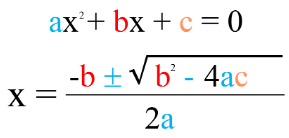 |
| Discriminant | \( \Delta = b^2 – 4ac \) If \( \Delta > 0 \): two real roots If \( \Delta = 0 \): one real repeated root If \( \Delta < 0 \): no real roots | 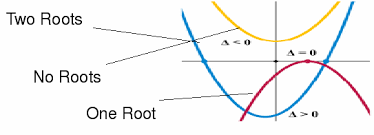 |
| Vertex form | \( f(x) = a(x-h)^2 + k \), vertex at \( (h,k) \) |  |
Graph Behaviour
- The parabola is symmetric about the line \( x = -\dfrac{b}{2a} \).
- The vertex is the minimum point if \( a > 0 \) and maximum point if \( a < 0 \).
- The y-intercept occurs at \( (0,c) \).
- The x-intercepts (if they exist) are the roots of the quadratic equation.
Example
For the quadratic function \( f(x) = x^2 + 6x + 5 \), find:
(i) the axis of symmetry
(ii) the vertex
▶️ Answer / Explanation
Axis of symmetry:
\( x = -\dfrac{b}{2a} = -\dfrac{6}{2} = -3 \)
Vertex:
Find \( f(-3) = (-3)^2 + 6(-3) + 5 = 9 – 18 + 5 = -4 \)
Vertex is \( (-3,\ -4) \)
Example
Given the quadratic \( f(x) = 2x^2 – 5x – 3 \):
Determine the nature of the roots using the discriminant.
▶️ Answer / Explanation
Compute the discriminant:
\( \Delta = b^2 – 4ac = (-5)^2 – 4(2)(-3) \)
\( \Delta = 25 + 24 = 49 \)
Since \( \Delta > 0 \), the quadratic has:
Two real and distinct roots
Example
The quadratic function \( f(x) = -3x^2 + 12x – 9 \) opens downward.
Find:
(i) the coordinates of the vertex
(ii) the maximum value of the function
▶️ Answer / Explanation
(i) Vertex
Axis of symmetry:
\( x = -\dfrac{b}{2a} = -\dfrac{12}{2(-3)} = 2 \)
Find \( f(2) = -3(2)^2 + 12(2) – 9 \)
\( f(2) = -12 + 24 – 9 = 3 \)
Vertex: \( (2,\ 3) \)
(ii) Maximum value
Since the parabola opens downward (\( a < 0 \)), the vertex gives the maximum value:
Maximum value = \( 3 \)