
The Discriminant of a Quadratic Function
For a quadratic function
\( f(x) = ax^2 + bx + c \), where \( a \neq 0 \)
the quadratic equation \( ax^2 + bx + c = 0 \) has solutions given by the formula
\( x = \dfrac{-b \pm \sqrt{b^2 – 4ac}}{2a} \)
The expression inside the square root,
\( \Delta = b^2 – 4ac \)
is called the discriminant. It determines the nature of the roots of the quadratic equation.
Meaning of the Discriminant
| Condition on \( \Delta \) | Nature of Roots |
| \( \Delta > 0 \) | Two distinct real roots Graph cuts the x-axis at two points |
| \( \Delta = 0 \) | One real repeated root Graph touches the x-axis at one point (tangent) |
| \( \Delta < 0 \) | No real roots Graph does not intersect the x-axis |
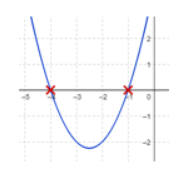
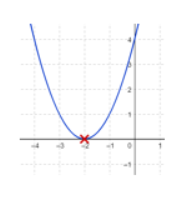
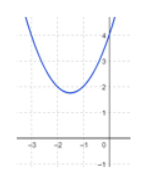
Graph Interpretation
- The discriminant tells you how many times the parabola crosses the x-axis.
- It does not tell you whether the vertex is a maximum or minimum; that depends on \( a \).
- It is useful for determining the number of solutions to quadratic equations without solving them.
Example
Find the discriminant of \( x^2 – 6x + 8 \). State the nature of the roots.
▶️ Answer / Explanation
\( a = 1,\ b = -6,\ c = 8 \)
\( \Delta = (-6)^2 – 4(1)(8) = 36 – 32 = 4 \)
Since \( \Delta > 0 \), the quadratic has two distinct real roots.
Example
Determine, in terms of \( k \), the condition for the quadratic \( 2x^2 + kx + 9 = 0 \) to have no real roots.
▶️ Answer / Explanation
No real roots when \( \Delta < 0 \):
\( \Delta = k^2 – 4(2)(9) \)
\( \Delta = k^2 – 72 \)
\( k^2 – 72 < 0 \Rightarrow k^2 < 72 \)
Thus: \( -\sqrt{72} < k < \sqrt{72} \).
Example
Find the value of \( p \) for which the quadratic \( 3x^2 + px + 12 = 0 \) has exactly one real root.
▶️ Answer / Explanation
One real repeated root when \( \Delta = 0 \).
\( \Delta = p^2 – 4(3)(12) = p^2 – 144 \)
Set equal to 0:
\( p^2 – 144 = 0 \)
\( p^2 = 144 \Rightarrow p = \pm 12 \)