
Completing the Square & Solving Quadratic Equations
A quadratic equation has the form
\( ax^2 + bx + c = 0 \), where \( a \neq 0 \)
Quadratics can be solved using several methods: factorisation, quadratic formula, calculator, or completing the square.
Completing the Square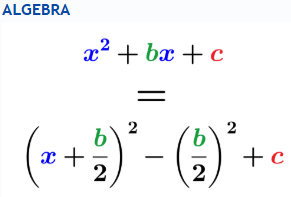
Completing the square rewrites a quadratic in the form:
\( ax^2 + bx + c = a(x – h)^2 + k \)
For a monic quadratic \( x^2 + bx + c \):
\( x^2 + bx = \left(x + \dfrac{b}{2}\right)^2 – \left(\dfrac{b}{2}\right)^2 \)
This form allows:
- easy identification of the vertex
- solving by taking square roots
- converting to vertex form for graphing
Summary of Quadratic Solution Methods
| Method | Description / Formula |
| Factorisation | Rewrite into factors: \( ax^2 + bx + c = (px + q)(rx + s) = 0 \) |
| Quadratic Formula | \( x = \dfrac{-b \pm \sqrt{b^2 – 4ac}}{2a} \) |
| Completing the Square | Rewrite as \( a(x – h)^2 + k = 0 \) then solve by square roots |
| Calculator Method | Use quadratic-solve mode to compute exact or decimal roots |
Notes
- Factorisation works only if the quadratic is factorable.
- The quadratic formula works for every quadratic.
- Completing the square is essential for vertex form and solving by roots.
- The discriminant \( b^2 – 4ac \) determines the nature of the roots.
Example
Solve the quadratic equation \( x^2 – 5x + 6 = 0 \) by factorisation.
▶️ Answer / Explanation
\( x^2 – 5x + 6 = (x – 2)(x – 3) = 0 \)
So roots are:
\( x = 2,\quad x = 3 \)
Example
Solve the equation \( 3x^2 + 4x – 2 = 0 \) using the quadratic formula.
▶️ Answer / Explanation
\( a = 3,\ b = 4,\ c = -2 \)
\( x = \dfrac{-4 \pm \sqrt{4^2 – 4(3)(-2)}}{6} \)
\( = \dfrac{-4 \pm \sqrt{16 + 24}}{6} \)
\( = \dfrac{-4 \pm \sqrt{40}}{6} \)
\( = \dfrac{-4 \pm 2\sqrt{10}}{6} \)
\( = \dfrac{-2 \pm \sqrt{10}}{3} \)
Example
Complete the square for \( 2x^2 – 12x + 7 \) and hence solve the equation.
▶️ Answer / Explanation
Step 1: Factor out \( 2 \):
\( 2x^2 – 12x + 7 = 2(x^2 – 6x) + 7 \)
Step 2: Complete the square inside:
\( x^2 – 6x = (x – 3)^2 – 9 \)
So:
\( 2[(x – 3)^2 – 9] + 7 \)
\( = 2(x – 3)^2 – 18 + 7 \)
\( = 2(x – 3)^2 – 11 \)
Equation becomes:
\( 2(x – 3)^2 – 11 = 0 \)
Solve:
\( 2(x – 3)^2 = 11 \)
\( (x – 3)^2 = \dfrac{11}{2} \)
\( x – 3 = \pm \sqrt{\dfrac{11}{2}} \)
\( x = 3 \pm \sqrt{\dfrac{11}{2}} \)