
Solving Simultaneous Equations by Substitution
Simultaneous equations involve finding values of variables that satisfy all equations at the same time. The substitution method is useful when one of the equations is already written in terms of a single variable, or can be rearranged easily.
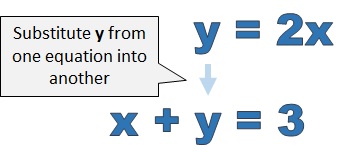
General Procedure
| Step | Description |
| 1. Rearrangement | Rearrange one equation to express one variable in terms of the other(s). |
| 2. Substitution | Substitute this expression into the other equation. |
| 3. Solve | Solve the resulting single-variable equation. |
| 4. Back-substitute | Substitute back to find the remaining variable. |
| 5. Check (optional) | Verify the solution in both equations. |
Example
Solve the system:
\( y = 2x + 1 \)
\( x + y = 7 \)
▶️ Answer / Explanation
Substitute \( y = 2x + 1 \) into the second equation:
\( x + (2x + 1) = 7 \)
\( 3x + 1 = 7 \Rightarrow 3x = 6 \Rightarrow x = 2 \)
Back-substitute:
\( y = 2(2) + 1 = 5 \)
Solution: \( (x, y) = (2, 5) \)
Example
Solve the simultaneous equations:
\( 3x – y = 4 \)
\( 2x + y = 11 \)
▶️ Answer / Explanation
Rearrange the second equation:
\( y = 11 – 2x \)
Substitute into the first:
\( 3x – (11 – 2x) = 4 \)
\( 3x – 11 + 2x = 4 \)
\( 5x = 15 \Rightarrow x = 3 \)
Back-substitute:
\( y = 11 – 2(3) = 5 \)
Solution: \( (x, y) = (3, 5) \)
Example
Solve the system involving a quadratic:
\( y = x^2 – 3x + 2 \)
\( 2x + y = 10 \)
▶️ Answer / Explanation
Substitute \( y = x^2 – 3x + 2 \) into the second equation:
\( 2x + (x^2 – 3x + 2) = 10 \)
\( x^2 – x + 2 = 10 \)
\( x^2 – x – 8 = 0 \)
Solve the quadratic:
\( x^2 – x – 8 = 0 \)
\( (x – 4)(x + 2) = 0 \)
So \( x = 4 \) or \( x = -2 \)
Find corresponding \( y \):
If \( x = 4 \): \( y = 4^2 – 3(4) + 2 = 6 \)
If \( x = -2 \): \( y = (-2)^2 + 6 + 2 = 12 \)
Solutions:
\( (4,\ 6) \),
\( (-2,\ 12) \)