
Equation of a Straight Line
A straight line represents a set of points that maintain a constant rate of change between the \( x \) and \( y \) coordinates. In coordinate geometry, a line is defined by its slope and the position of any one point (or by its intercepts or by its normal form).
Common Forms of the Straight-Line Equation
| Form | Equation |
| Point–slope form | \( y – y_1 = m(x – x_1) \) |
| General form | \( ax + by + c = 0 \) |
| Slope–intercept form | \( y = mx + c \) |
| Two–point form | \( y – y_1 = \dfrac{y_2 – y_1}{\,x_2 – x_1\,}(x – x_1) \) |
| Intercept form | \( \dfrac{x}{a} + \dfrac{y}{b} = 1 \) |
(i) Equation of a Line Through Two Given Points
Let the points be:
\( P(x_1, y_1),\ Q(x_2, y_2) \)
Slope:
\( m = \dfrac{y_2 – y_1}{x_2 – x_1} \)
Equation of line PQ:
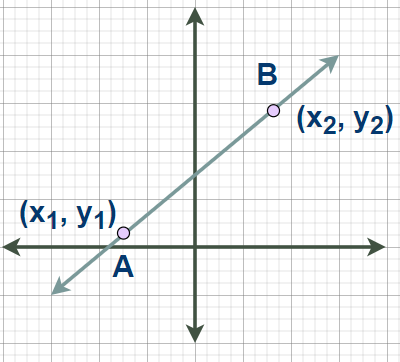
\( y – y_1 = \dfrac{y_2 – y_1}{\,x_2 – x_1\,}(x – x_1) \)
(ii) General Form of a Straight Line
Any straight-line equation can be rearranged into:
\( ax + by + c = 0 \)
Where:
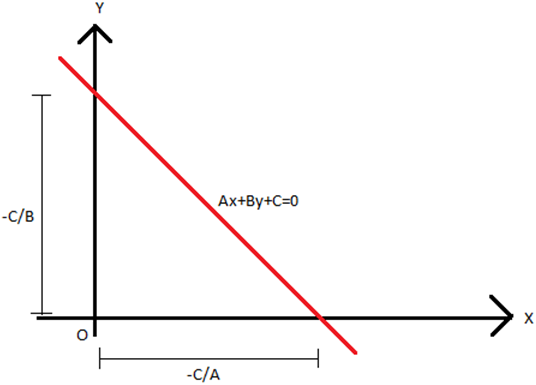
\( a,\ b,\ c \) are real constants and at least one of \( a,\ b \) is nonzero.
This form is useful for:
- Finding the normal vector \( (a, b) \)
- Calculating perpendicular distance from a point to the line
- Comparing lines quickly
(iii) Equation of a Line Parallel or Perpendicular to a Given Line
Given line:
\( ax + by + c = 0 \)
Parallel line: same slope
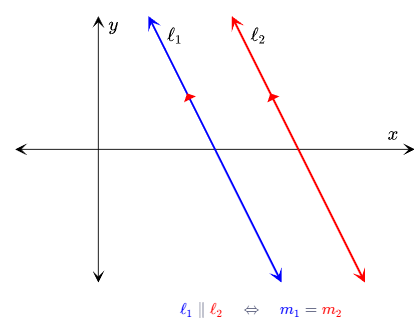
Slope of given line:
\( m = -\dfrac{a}{b} \)
Equation of required parallel line through \( (x_1, y_1) \):
\( y – y_1 = -\dfrac{a}{b}(x – x_1) \)
Perpendicular line: slope is the negative reciprocal
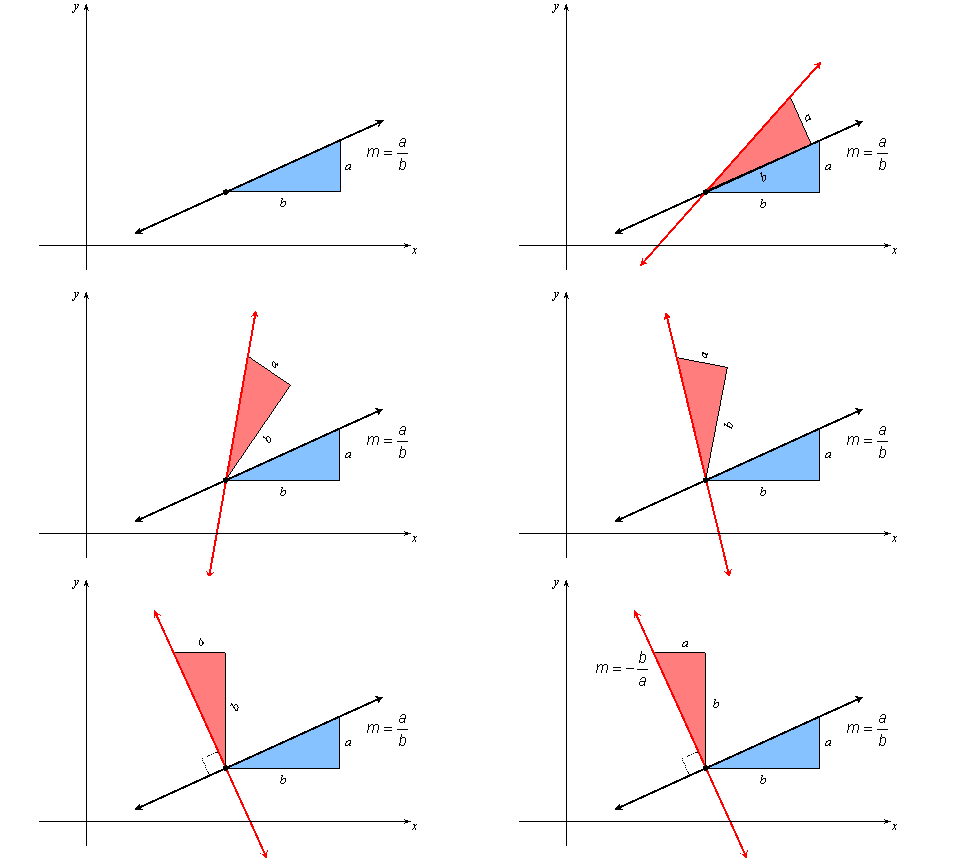
If given slope is \( m \), perpendicular slope is \( -\dfrac{1}{m} \).
Example
Find the equation of the line joining the points \( (1,2) \) and \( (4,5) \).
▶️ Answer / Explanation
Slope:
\( m = \dfrac{5 – 2}{4 – 1} = 1 \)
Equation:
\( y – 2 = 1(x – 1) \Rightarrow y = x + 1 \)
Example
Find the equation of the line parallel to \( 5x – 2y + 7 = 0 \) passing through \( (3, -1) \).
▶️ Answer / Explanation
Slope of given line:
\( 5x – 2y + 7 = 0 \Rightarrow -2y = -5x – 7 \Rightarrow y = \dfrac{5}{2}x + \dfrac{7}{2} \)
So slope is \( \dfrac{5}{2} \).
Parallel line through \( (3,-1) \):
\( y + 1 = \dfrac{5}{2}(x – 3) \)
Example
A line perpendicular to \( 7x + y – 9 = 0 \) passes through the point \( (4,6) \). Find its equation.
▶️ Answer / Explanation
Rewrite the line:
\( y = -7x + 9 \Rightarrow m = -7 \)
Perpendicular slope:
\( m_{\perp} = -\dfrac{1}{-7} = \dfrac{1}{7} \)
Equation:
\( y – 6 = \dfrac{1}{7}(x – 4) \)