
Sine Rule
The sine rule relates the ratios of the sides of a triangle to the sines of their opposite angles. It applies to all triangles whether acute, obtuse or scalene.
In \( \triangle ABC \):
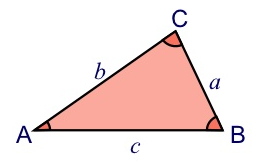
Side \( a \) is opposite angle \( A \)
Side \( b \) is opposite angle \( B \)
Side \( c \) is opposite angle \( C \)
Formula
| Form | Equation |
| Sine Rule | \( \dfrac{a}{\sin A} = \dfrac{b}{\sin B} = \dfrac{c}{\sin C} \) |
| Alternative | \( \dfrac{\sin A}{a} = \dfrac{\sin B}{b} = \dfrac{\sin C}{c} \) |
When to Use the Sine Rule
- Two angles and one side are known (AAS / ASA)
- Two sides and a non-included angle are known (SSA)
- To find unknown angles given sides
Example
In \( \triangle ABC \), \( a = 8 \), \( A = 35^\circ \), \( C = 70^\circ \). Find side \( c \).
▶️ Answer / Explanation
Use the sine rule:
\( \dfrac{a}{\sin A} = \dfrac{c}{\sin C} \)
\( \dfrac{8}{\sin 35^\circ} = \dfrac{c}{\sin 70^\circ} \)
\( c = \dfrac{8\sin 70^\circ}{\sin 35^\circ} \)
Example
In a triangle, \( b = 12 \), \( c = 15 \) and \( B = 50^\circ \). Find angle \( C \).
▶️ Answer / Explanation
Apply the sine rule:
\( \dfrac{\sin C}{c} = \dfrac{\sin B}{b} \)
\( \dfrac{\sin C}{15} = \dfrac{\sin 50^\circ}{12} \)
\( \sin C = 15 \cdot \dfrac{\sin 50^\circ}{12} \)
Then evaluate to find \( C \).
Example
Triangle \( ABC \) has sides \( a = 9 \), \( b = 11 \). Angle \( A = 30^\circ \). Find angle \( B \). (This may produce an ambiguous case.)
▶️ Answer / Explanation
Using sine rule:
\( \dfrac{\sin B}{b} = \dfrac{\sin A}{a} \)
\( \dfrac{\sin B}{11} = \dfrac{\sin 30^\circ}{9} \)
\( \sin B = 11 \cdot \dfrac{1/2}{9} \)
\( \sin B = \dfrac{11}{18} \)
This gives two possible values for \( B \): \( B_1 = \sin^{-1}\left(\dfrac{11}{18}\right) \), \( B_2 = 180^\circ – B_1 \).
Cosine Rule
The cosine rule relates the three sides of a triangle with the cosine of one of its angles. It is especially useful when the triangle is not right-angled.
In \( \triangle ABC \):
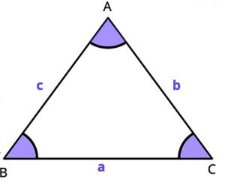
Side \( a \) is opposite angle \( A \)
Side \( b \) is opposite angle \( B \)
Side \( c \) is opposite angle \( C \)
Formula
| Form | Equation |
| Cosine Rule (Side) | \( a^2 = b^2 + c^2 – 2bc\cos A \) \( b^2 = c^2 + a^2 – 2ca\cos B \) \( c^2 = a^2 + b^2 – 2ab\cos C \) |
| Cosine Rule (Angle) | \( \cos A = \dfrac{b^2 + c^2 – a^2}{2bc} \) \( \cos B = \dfrac{c^2 + a^2 – b^2}{2ca} \) \( \cos C = \dfrac{a^2 + b^2 – c^2}{2ab} \) |
When to Use the Cosine Rule
- When two sides and the included angle are known (SAS)
- When all three sides are known and an angle must be found (SSS)
- When the sine rule cannot be applied directly
Example
In \( \triangle ABC \), \( b = 5 \), \( c = 7 \) and \( A = 40^\circ \). Find side \( a \).
▶️ Answer / Explanation
Use the cosine rule:
\( a^2 = b^2 + c^2 – 2bc\cos A \)
\( a^2 = 5^2 + 7^2 – 2(5)(7)\cos 40^\circ \)
\( a = \sqrt{25 + 49 – 70\cos 40^\circ} \)
Example
In a triangle, sides are \( a = 12 \), \( b = 8 \), \( c = 14 \). Find angle \( A \).
▶️ Answer / Explanation
Use angle form:
\( \cos A = \dfrac{b^2 + c^2 – a^2}{2bc} \)
\( \cos A = \dfrac{8^2 + 14^2 – 12^2}{2(8)(14)} \)
\( \cos A = \dfrac{64 + 196 – 144}{224} = \dfrac{116}{224} \)
Then compute \( A = \cos^{-1}\left( \dfrac{116}{224} \right) \).
Example
Triangle has sides \( a = 9 \), \( b = 11 \), \( c = 17 \). Determine whether the triangle is acute, right-angled or obtuse.
▶️ Answer / Explanation
Check largest side \( c = 17 \). Use cosine rule on angle \( C \):
\( \cos C = \dfrac{a^2 + b^2 – c^2}{2ab} \)
\( \cos C = \dfrac{9^2 + 11^2 – 17^2}{2(9)(11)} \)
\( \cos C = \dfrac{81 + 121 – 289}{198} \)
\( \cos C = \dfrac{-87}{198} \) (negative)
Since \( \cos C < 0 \), the angle \( C \) is obtuse ⇒ the triangle is obtuse.
Area of a Triangle
The area of any triangle can be computed using different formulae depending on the information given. When two sides and the included angle are known, the trigonometric area formula is used.
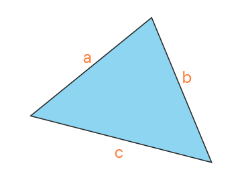
In \( \triangle ABC \):
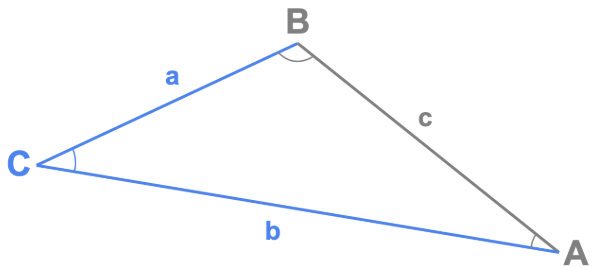
Side \( a \) is opposite angle \( A \)
Side \( b \) is opposite angle \( B \)
Side \( c \) is opposite angle \( C \)
Formulae for Area
| Form | Formula |
Trigonometric Form | \( \text{Area} = \dfrac12 ab\sin C \) \( \text{Area} = \dfrac12 bc\sin A \) \( \text{Area} = \dfrac12 ca\sin B \) |
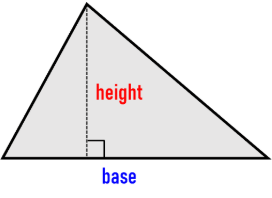
Base–Height Formula | \( \text{Area} = \dfrac12 \times \text{base} \times \text{height} \) |
Heron’s Formula | \( \text{Area} = \sqrt{s(s-a)(s-b)(s-c)} \) where \( s = \dfrac{a + b + c}{2} \) |
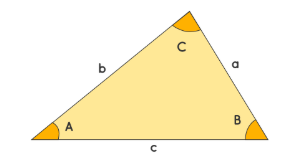
When to Use Each Formula
- \( \dfrac12 ab\sin C \) — when 2 sides and the included angle are known (SAS)
- Base–height — when height is known or easily found
- Heron’s formula — when all 3 sides are known (SSS)
Example
Find the area of a triangle with base \( 10 \) and height \( 6 \).
▶️ Answer / Explanation
Use base–height formula:
\( \text{Area} = \dfrac12 \times 10 \times 6 = 30 \)
Example
In \( \triangle ABC \), \( a = 8 \), \( b = 11 \) and \( C = 52^\circ \). Find the area.
▶️ Answer / Explanation
Use trigonometric area formula:
\( \text{Area} = \dfrac12 ab\sin C \)
\( \text{Area} = \dfrac12 (8)(11)\sin 52^\circ \)
Example
A triangle has sides \( a = 9 \), \( b = 13 \), \( c = 14 \). Find its area using Heron’s formula.
▶️ Answer / Explanation
First compute semiperimeter:
\( s = \dfrac{9 + 13 + 14}{2} = 18 \)
Apply Heron’s formula:
\( \text{Area} = \sqrt{18(18 – 9)(18 – 13)(18 – 14)} \)
\( \text{Area} = \sqrt{18 \cdot 9 \cdot 5 \cdot 4} \)
Ambiguous Case of the Sine Rule
The sine rule sometimes produces two possible triangles for the same given data. This happens in the SSA condition: two sides and an angle that is not the included angle.
Given a triangle with:
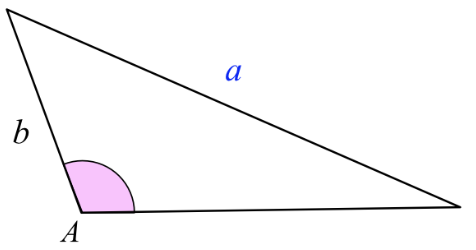
Side \( a \), side \( b \), and angle \( A \)
Using the sine rule:
\( \dfrac{\sin B}{b} = \dfrac{\sin A}{a} \)
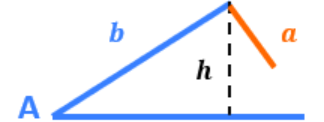
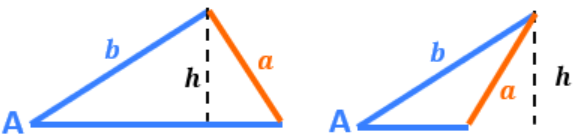
If the value of \( \sin B \) lies between 0 and 1, then two angles may satisfy the equation:
\( B_1 = \sin^{-1}(x) \)
\( B_2 = 180^\circ – B_1 \)
This creates two possible triangle configurations.
Possibilities in the Ambiguous Case (SSA)
| Case | Outcome |
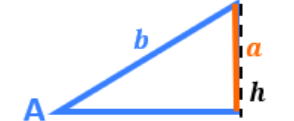
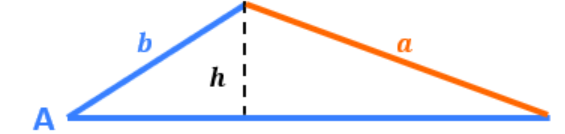
| \( a < b\sin A \) |
No triangle exists |
| \( a = b\sin A \) |
One right triangle |
| \( b\sin A < a < b \) |
Two possible triangles (AMBIGUOUS CASE) |
| \( a \ge b \) |
One triangle |
Why Two Triangles?
- The sine of an angle is the same for two angles: \( \sin \theta = \sin(180^\circ – \theta) \).
- This means the unknown angle may be acute or obtuse.
- Both possibilities can produce valid triangles, hence the ambiguity.
Example
In \( \triangle ABC \), \( a = 7 \), \( b = 10 \), and \( A = 40^\circ \). Find possible values of angle \( B \).
▶️ Answer / Explanation
Using sine rule:
\( \dfrac{\sin B}{10} = \dfrac{\sin 40^\circ}{7} \)
\( \sin B = 10 \cdot \dfrac{\sin 40^\circ}{7} \)
Compute \( x = \sin B \).
Then:
\( B_1 = \sin^{-1}(x) \)
\( B_2 = 180^\circ – B_1 \)
Example
Triangle has \( a = 12 \), \( b = 15 \), and \( A = 30^\circ \). Determine whether 0, 1 or 2 triangles exist.
▶️ Answer / Explanation
Compare with condition:
\( b\sin A = 15\sin 30^\circ = 15 \cdot \dfrac12 = 7.5 \)
\( a = 12 \)
Since \( a > b \), one triangle exists.
Example
Given \( a = 9 \), \( b = 14 \), and \( A = 42^\circ \), determine all possible values of angle \( B \), then find angle \( C \) for each triangle.
▶️ Answer / Explanation
Using sine rule:
\( \dfrac{\sin B}{14} = \dfrac{\sin 42^\circ}{9} \)
\( \sin B = 14 \cdot \dfrac{\sin 42^\circ}{9} \)
Compute:
\( B_1 = \sin^{-1}(x) \)
\( B_2 = 180^\circ – B_1 \)
For each angle:
\( C = 180^\circ – A – B \)