
Sine Function
The sine function is a periodic trigonometric function defined for all real values of \( x \). It models many natural oscillations such as waves, circular motion and alternating signals.
Definition
\( y = \sin x \)
The input \( x \) is measured in radians. The sine function produces a repeating wave pattern.
Key Properties of the Sine Function
| Property | Value |
| Domain | All real numbers |
| Range | \( -1 \le y \le 1 \) |
| Period | \( 2\pi \) |
| Amplitude | 1 |
| Symmetry | Odd function (symmetric about origin): \( \sin(-x) = -\sin x \) |
| Maximum | \( 1 \) at \( x = \dfrac{\pi}{2} + 2k\pi \) |
| Minimum | \( -1 \) at \( x = \dfrac{3\pi}{2} + 2k\pi \) |
Graph Features

- Wave-like curve starting at \( (0,0) \)
- Reaches maximum at \( \dfrac{\pi}{2} \), minimum at \( \dfrac{3\pi}{2} \)
- Repeats every \( 2\pi \) units
- Crosses the x-axis at multiples of \( \pi \)
- Odd symmetry: rotational symmetry about the origin
Example
Find the value of \( \sin 0 \).
▶️ Answer / Explanation
\( \sin 0 = 0 \)
Example
Find all solutions to \( \sin x = \dfrac12 \) in the interval \( [0, 2\pi] \).
▶️ Answer / Explanation
Sine is \( \dfrac12 \) at:
\( x = \dfrac{\pi}{6},\ \dfrac{5\pi}{6} \)
Example
Solve \( \sin x = -\dfrac{\sqrt{2}}{2} \) for all real \( x \).
▶️ Answer / Explanation
Reference angle: \( \dfrac{\pi}{4} \)
Sine is negative in quadrants III and IV.
Solutions:
\( x = \dfrac{5\pi}{4} + 2k\pi \)
\( x = \dfrac{7\pi}{4} + 2k\pi \)
Example:
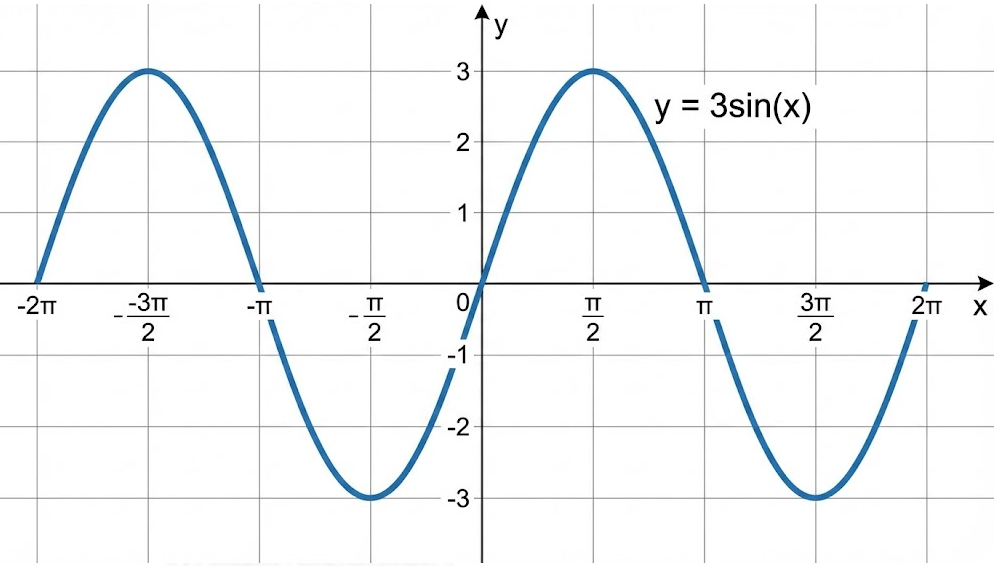
Consider the graph of \( y = 3\sin x \). Draw the graph and explain it.
▶️ Answer / Explanation
Amplitude: becomes 3 (instead of 1)
Period: unchanged at \( 2\pi \)
Key points:
- Maximum becomes \( y = 3 \)
- Minimum becomes \( y = -3 \)
- Crossings at same x-values as \( \sin x \)
Example:
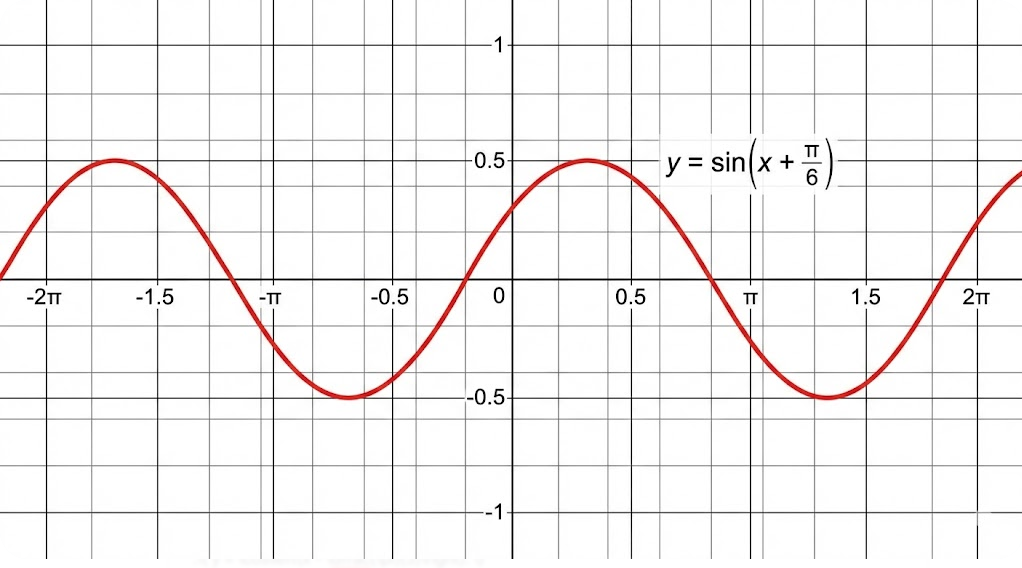
Consider \( y = \sin\left(x + \dfrac{\pi}{6}\right). \). Draw the graph and explain it.
▶️ Answer / Explanation
This is a shift to the left by \( \dfrac{\pi}{6} \).
Amplitude: 1 (unchanged)
Period: \( 2\pi \) (unchanged)
Effect: every point on \( \sin x \) moves left \( \dfrac{\pi}{6} \)
New maximum: occurs at \( x = \dfrac{\pi}{2} – \dfrac{\pi}{6} = \dfrac{\pi}{3} \)
Example:
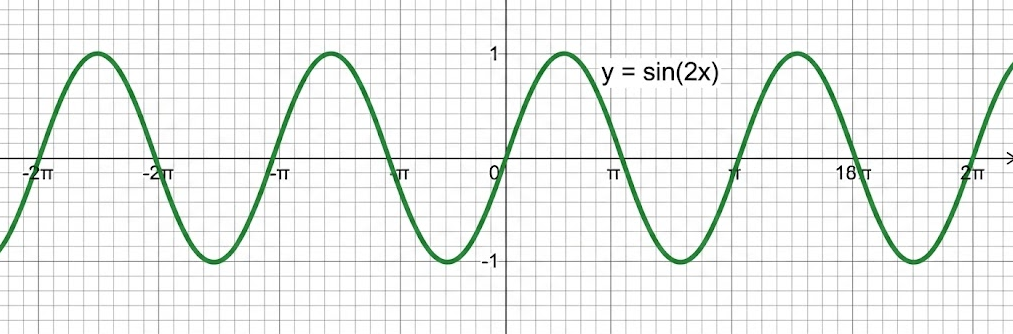
Consider \( y = \sin 2x. \). Draw the graph and explain it.
▶️ Answer / Explanation
Period becomes:
\( \dfrac{2\pi}{2} = \pi \)
The graph completes one full cycle twice as fast.
- Zeroes now at \( 0, \dfrac{\pi}{2}, \pi, \ldots \)
- Maximum at \( \dfrac{\pi}{4} \)
- Minimum at \( \dfrac{3\pi}{4} \)
Cosine Function
The cosine function is a periodic trigonometric function defined for all real values of \( x \). It models many natural oscillations and is closely related to circular motion and wave phenomena.
Definition
\( y = \cos x \)
The cosine function produces a smooth wave similar to the sine graph but shifted horizontally.
Key Properties of the Cosine Function
| Property | Value |
| Domain | All real numbers |
| Range | \( -1 \le y \le 1 \) |
| Period | \( 2\pi \) |
| Amplitude | 1 |
| Symmetry | Even function (symmetric about the y-axis): \( \cos(-x) = \cos x \) |
| Maximum | \( 1 \) at \( x = 2k\pi \) |
| Minimum | \( -1 \) at \( x = \pi + 2k\pi \) |
Graph Features
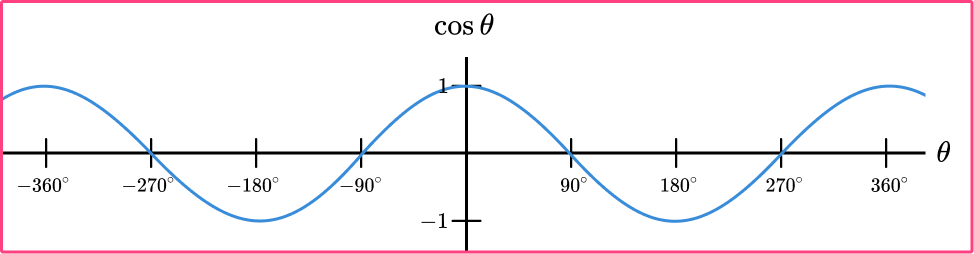
- The cosine graph begins at maximum: \( (0,1) \).
- It reaches zero at \( \dfrac{\pi}{2} \), minimum at \( \pi \), then repeats.
- It completes one cycle every \( 2\pi \) units.
- Graph is symmetric about the y-axis since it is an even function.
Example
Find the value of \( \cos 0 \).
▶️ Answer / Explanation
\( \cos 0 = 1 \)
Example
Find all solutions to \( \cos x = -\dfrac12 \) in the interval \( [0, 2\pi] \).
▶️ Answer / Explanation
Cosine is \( -\dfrac12 \) at:
\( x = \dfrac{2\pi}{3},\ \dfrac{4\pi}{3} \)
Example
Solve \( \cos x = \dfrac{\sqrt{2}}{2} \) for all real values of \( x \).
▶️ Answer / Explanation
Reference angle: \( \dfrac{\pi}{4} \)
Cosine is positive in quadrants I and IV.
General solutions:
\( x = \dfrac{\pi}{4} + 2k\pi \)
\( x = \dfrac{7\pi}{4} + 2k\pi \)
Example:
Sketch the graph of \( y = 4\cos x \).
▶️ Answer / Explanation
Amplitude: becomes 4 (instead of 1)
Period: unchanged at \( 2\pi \)
Key points:
- Maximum becomes \( y = 4 \) (at \( x = 2k\pi \))
- Minimum becomes \( y = -4 \)
- Shape remains the same (vertical scaling only)
Example:
Sketch \( y = \cos\left(x – \dfrac{\pi}{3}\right). \) and explain.
▶️ Answer / Explanation
This is a shift to the right by \( \dfrac{\pi}{3} \).
Amplitude: 1 (unchanged)
Period: \( 2\pi \) (unchanged)
Effect: every point on \( \cos x \) moves right \( \dfrac{\pi}{3} \)
New maximum: now at \( x = \dfrac{\pi}{3} \) instead of \( x=0 \)
Example:
Sketch the \( y = \cos 3x. \)
▶️ Answer / Explanation
Period becomes:
\( \dfrac{2\pi}{3} \)
The graph completes one cycle 3 times as fast.
- Maximum at \( x = 0,\ \dfrac{2\pi}{3},\ \dfrac{4\pi}{3}, \ldots \)
- Minimum at \( x = \dfrac{\pi}{3},\ \pi, \ldots \)
- More oscillations in the same interval.
Tangent Function
The tangent function is defined as the ratio of sine to cosine. It is periodic, unbounded, and has vertical asymptotes where cosine equals zero.
Definition
\( y = \tan x = \dfrac{\sin x}{\cos x} \)
The tangent function repeats every \( \pi \) units and is undefined whenever \( \cos x = 0 \).
Key Properties of the Tangent Function
| Property | Value |
| Domain | All real \( x \) except \( x = \dfrac{\pi}{2} + k\pi \) |
| Range | All real numbers |
| Period | \( \pi \) |
| Asymptotes | Vertical asymptotes at \( x = \dfrac{\pi}{2} + k\pi \) |
| Symmetry | Odd function: \( \tan(-x) = -\tan x \) |
Graph Features
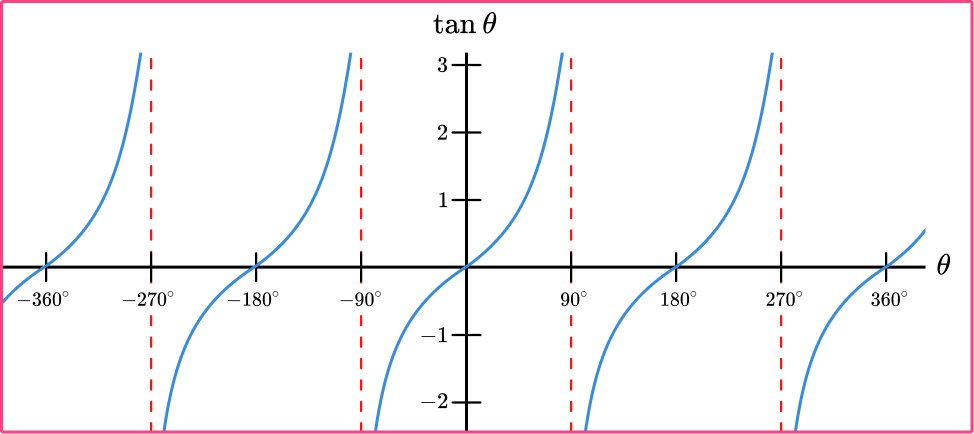
- Tangent graph passes through the origin.
- It increases steeply and has no maximum or minimum.
- Vertical asymptotes occur where cosine is zero.
- One complete cycle spans \( \pi \) units.
- Graph has rotational symmetry about the origin.
Example
Find \( \tan 0 \).
▶️ Answer / Explanation
\( \tan 0 = \dfrac{\sin 0}{\cos 0} = 0 \)
Example
Solve \( \tan x = 1 \) in the interval \( [0, 2\pi] \).
▶️ Answer / Explanation
Reference angle: \( \dfrac{\pi}{4} \)
Tangent is positive in quadrants I and III.
Solutions:
\( x = \dfrac{\pi}{4},\ \dfrac{5\pi}{4} \)
Example
Solve \( \tan x = -\sqrt{3} \) for all real values of \( x \).
▶️ Answer / Explanation
Reference angle: \( \dfrac{\pi}{3} \)
Tangent is negative in quadrants II and IV.
General solutions:
\( x = \dfrac{2\pi}{3} + k\pi \)
\( x = \dfrac{5\pi}{3} + k\pi \)
Example:
Sketch the graph of \( y = 3\tan x \).
▶️ Answer / Explanation
Tangent has no true amplitude, but the graph becomes steeper.
Period: unchanged at \( \pi \)
Asymptotes: unchanged at \( x = \dfrac{\pi}{2} + k\pi \)
- Graph rises faster and falls faster.
- The x-intercepts remain at \( k\pi \).
Example:
Explain the Phase Shift \( y = \tan\left( x – \dfrac{\pi}{4} \right). \)
▶️ Answer / Explanation
This is a shift to the right by \( \dfrac{\pi}{4} \).
Period: \( \pi \) (unchanged)
Asymptotes move to:
\( x = \dfrac{\pi}{2} + \dfrac{\pi}{4} + k\pi = \dfrac{3\pi}{4} + k\pi \)
Zero crossing: now at \( x = \dfrac{\pi}{4} \) instead of \( x = 0 \).
Example:
Sktech and explain \( y = \tan 2x. \)
▶️ Answer / Explanation
Period becomes:
\( \dfrac{\pi}{2} \)
The tangent curve completes one full cycle twice as quickly.
- x-intercepts at \( x = 0,\ \dfrac{\pi}{2},\ \pi, \ldots \)
- Asymptotes now at \( x = \dfrac{\pi}{4} + k\dfrac{\pi}{2} \)
- Graph oscillates more frequently across any interval.