
Derivative as the Gradient of the Tangent
The derivative of a function at a point gives the gradient of the tangent line to the curve at that point. If a curve is given by \( y = f(x) \), then the derivative \( f'(x) \) tells us how steep the curve is at any value of \( x \).
Geometric Meaning
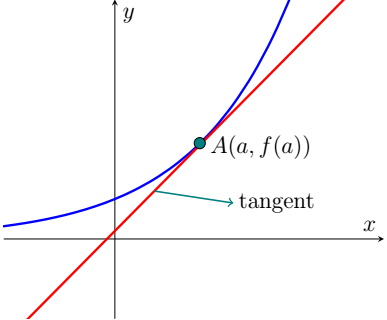
The derivative \( f'(a) \) is the gradient of the tangent to the curve \( y = f(x) \) at the point \( x = a \).
Algebraic Definition
\( f'(a) = \text{gradient of tangent at } x=a \)
Interpretation
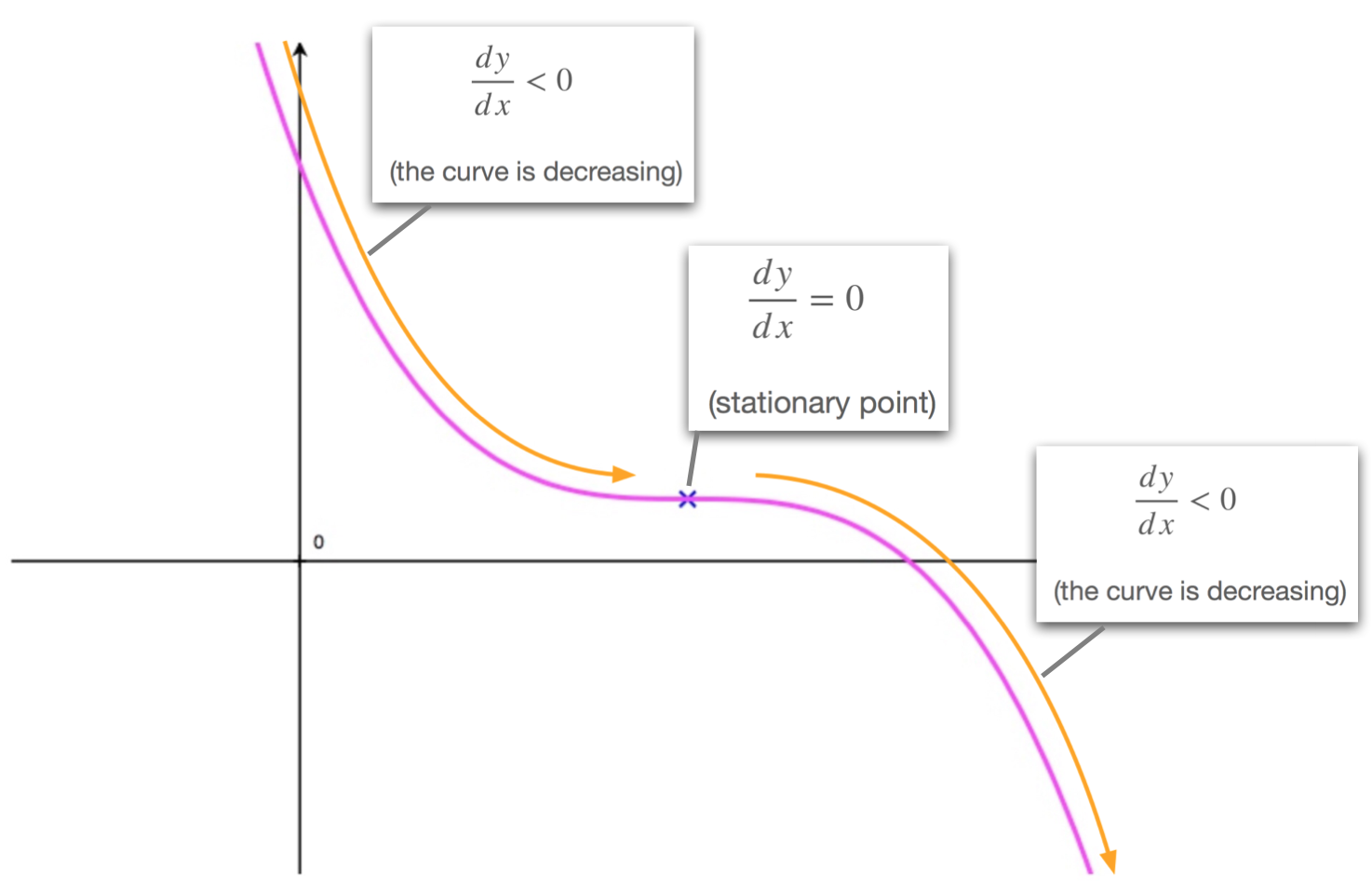
- If \( f'(x) > 0 \): curve is increasing at \( x \)
- If \( f'(x) < 0 \): curve is decreasing at \( x \)
- If \( f'(x) = 0 \): possible stationary point (maximum, minimum or point of inflection)
Example
Find the gradient of the curve \( y = x^2 \) at \( x = 3 \).
▶️ Answer / Explanation
Derivative:
\( f'(x) = 2x \)
At \( x = 3 \):
\( f'(3) = 6 \)
The tangent has gradient \( 6 \).
Example
Find the equation of the tangent to \( y = 5x^3 \) at \( x = 1 \).
▶️ Answer / Explanation
\( f'(x) = 15x^2 \)
At \( x = 1 \): \( f'(1) = 15 \)
Point on curve: \( (1, 5) \)
Equation:
\( y – 5 = 15(x – 1) \)
Example
The tangent to the curve \( y = \sqrt{x} \) at \( x = a \) has gradient \( 2 \). Find the value of \( a \).
▶️ Answer / Explanation
\( f(x) = x^{1/2} \)
\( f'(x) = \dfrac{1}{2\sqrt{x}} \)
Set gradient equal to 2:
\( \dfrac{1}{2\sqrt{a}} = 2 \)
\( 1 = 4\sqrt{a} \)
\( \sqrt{a} = \dfrac{1}{4} \)
\( a = \dfrac{1}{16} \)
Derivative as a Limit
The derivative of a function can be defined using limits. It represents the limiting value of the gradient of a secant line as the two points on the curve move infinitely close.
Definition (First Principles):
\( f'(x) = \displaystyle \lim_{h \to 0} \dfrac{f(x+h)-f(x)}{h} \)
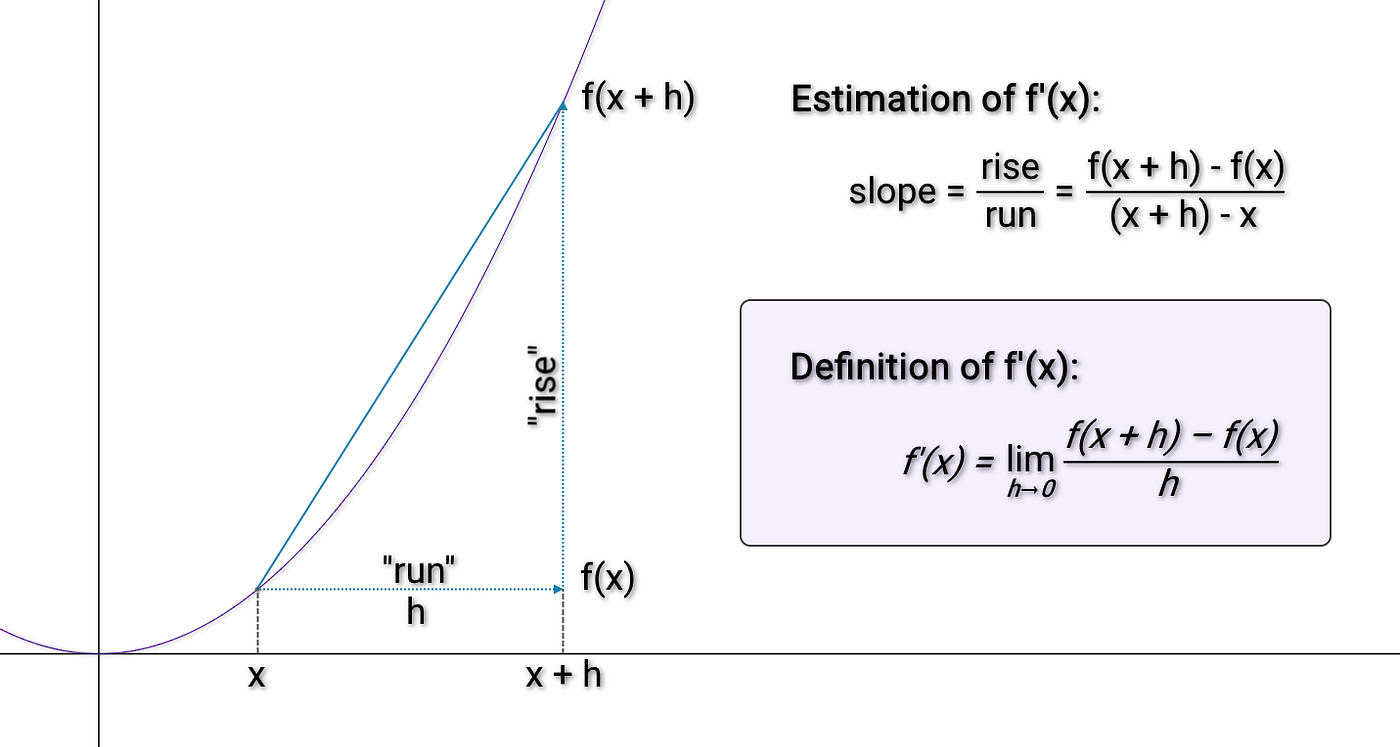
This measures the gradient between points \( x \) and \( x+h \) on the curve and then lets \( h \) shrink to zero.
Idea Behind the Limit
| Concept | Meaning |
| Secant Gradient | \( \dfrac{f(x+h)-f(x)}{h} \) Gradient between two points on the curve |
| Tangent Gradient | The limit of the secant gradient as \( h \to 0 \) This becomes \( f'(x) \) |
Interpretation
- The derivative is obtained by shrinking the secant interval.
- This method is called differentiation from first principles.
- All standard derivative rules (power rule, chain rule, etc.) come from this limit definition.
Example
Use first principles to differentiate \( f(x) = x^2 \).
▶️ Answer / Explanation
\( f(x+h) = (x+h)^2 = x^2 + 2xh + h^2 \)
\( f(x+h)-f(x) = 2xh + h^2 \)
Gradient:
\( \dfrac{2xh + h^2}{h} = 2x + h \)
Limit as \( h \to 0 \):
\( f'(x) = 2x \)
Example
Differentiate \( f(x) = 3x + 1 \) using limits.
▶️ Answer / Explanation
\( f(x+h) = 3(x+h) + 1 = 3x + 3h + 1 \)
\( f(x+h)-f(x) = 3h \)
Gradient:
\( \dfrac{3h}{h} = 3 \)
Limit:
\( f'(x) = 3 \)
Example
Find the derivative of \( f(x) = \sqrt{x} \) using first principles.
▶️ Answer / Explanation
\( f(x+h) = \sqrt{x+h} \)
\( f(x+h)-f(x) = \sqrt{x+h} – \sqrt{x} \)
Multiply numerator & denominator by the conjugate:
\( \dfrac{\sqrt{x+h} – \sqrt{x}}{h} \cdot \dfrac{\sqrt{x+h} + \sqrt{x}}{\sqrt{x+h} + \sqrt{x}} \)
Becomes:
\( \dfrac{h}{h(\sqrt{x+h} + \sqrt{x})} = \dfrac{1}{\sqrt{x+h} + \sqrt{x}} \)
Limit as \( h \to 0 \):
\( f'(x) = \dfrac{1}{2\sqrt{x}} \)
Derivative as a Rate of Change
The derivative represents how fast one quantity changes with respect to another. If \( y = f(x) \), then the derivative \( f'(x) \) describes the instantaneous rate of change of \( y \) with respect to \( x \).
Interpretation
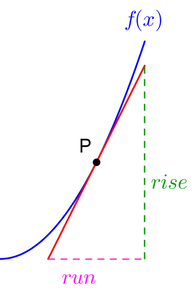
\( f'(x) = \text{rate of change of } y \text{ per unit change in } x \)
This concept is used widely in physics, economics, biology, and more.
Meaning of the Sign
| If \( f'(x) \) | Interpretation |
| \( f'(x) > 0 \) | Quantity is increasing |
| \( f'(x) < 0 \) | Quantity is decreasing |
| \( f'(x) = 0 \) | Rate of change is zero (possible turning point) |
Common Applications
- Velocity: rate of change of displacement
- Acceleration: rate of change of velocity
- Growth rate: rate of change of population
- Marginal cost/revenue: rate of change in economics
Example
A particle moves so that its displacement is given by \( s(t) = t^2 + 3t \). Find the velocity at \( t = 4 \).
▶️ Answer / Explanation
Velocity is the rate of change of displacement:
\( v(t) = s'(t) = 2t + 3 \)
At \( t = 4 \):
\( v(4) = 2(4) + 3 = 11 \)
Example
The area of a growing circle is \( A(t) = 5t^2 \) square cm. Find the rate at which the area is increasing when \( t = 3 \).
▶️ Answer / Explanation
Rate of change:
\( A'(t) = 10t \)
At \( t=3 \):
\( A'(3) = 30 \)
The area increases at \( 30 \text{ cm}^2/\text{s} \).
Example
The temperature of a cooling object is \( T(t) = 80e^{-0.2t} + 20 \). Find the rate of change of temperature at \( t = 5 \).
▶️ Answer / Explanation
\( T'(t) = -16e^{-0.2t} \) (differentiate exponential)
At \( t = 5 \):
\( T'(5) = -16e^{-1} \)
The object is cooling at rate \( -16e^{-1} \approx -5.88^\circ \text{C per unit time} \).
Second Order Derivatives
The second derivative of a function measures how the rate of change itself is changing. If \( y = f(x) \), then:
\( f”(x) = \dfrac{d}{dx}(f'(x)) \)
This tells us whether the graph is curving upwards or downwards and how fast the gradient changes.
Geometric Interpretation
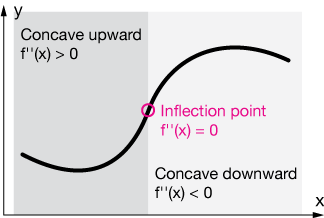
- If \( f”(x) > 0 \): the curve is concave up → Minimum point.
- If \( f”(x) < 0 \): the curve is concave down → Maximum point.
- If \( f”(x) = 0 \): possible point of inflection
Physical Interpretation
- If \( s(t) \) is displacement: \( s'(t) = \) velocity, \( s”(t) = \) acceleration
- Second derivative tells how fast a rate is changing
Summary Table
| Derivative | Meaning |
| \( f'(x) \) | Rate of change, gradient of tangent |
| \( f”(x) \) | Rate of change of gradient; curvature |
| Sign of \( f”(x) \) | Concave up ↔ \( f”(x)>0 \) Concave down ↔ \( f”(x)<0 \) |
Example
Find the second derivative of \( y = x^3 \).
▶️ Answer / Explanation
First derivative:
\( y’ = 3x^2 \)
Second derivative:
\( y” = 6x \)
Example
For the function \( s(t) = 4t^3 – 5t \): Find velocity and acceleration at \( t = 2 \).
▶️ Answer / Explanation
Velocity:
\( s'(t) = 12t^2 – 5 \)
At \( t=2 \): \( s'(2) = 48 – 5 = 43 \)
Acceleration:
\( s”(t) = 24t \)
At \( t=2 \): \( s”(2) = 48 \)
Example
A curve has equation \( y = e^{2x}\sin x \). Find \( y” \).
▶️ Answer / Explanation
First derivative using product rule:
\( y’ = e^{2x}(2\sin x + \cos x) \)
Differentiate again:
\( y” = e^{2x}(4\sin x + 4\cos x – \sin x) \)
Simplify:
\( y” = e^{2x}(3\sin x + 4\cos x) \)