
Gradients on Curves Using Differentiation
For a curve given by \( y = f(x) \), differentiation allows us to find the gradient at any point. The derivative \( f'(x) \) gives the gradient of the curve at a general \( x \), meaning how steep the curve is at that location.
Key Idea

The gradient of the curve at \( x = a \) is \( f'(a) \).
Instead of using two points (as with straight lines), differentiation gives an instantaneous gradient.
Gradient Behaviour

| If \( f'(x) \) | Curve Behaviour |
| Positive | Curve is rising (increasing) |
| Negative | Curve is falling (decreasing) |
| Zero | Possible stationary point (max/min/inflection) |
General Procedure
- Differentiate \( f(x) \) to obtain \( f'(x) \)
- Substitute the required \( x \)-value into \( f'(x) \)
- The result is the gradient at that point
Example
Find the gradient of the curve \( y = 3x^2 – 2x \) at \( x = 2 \).
▶️ Answer / Explanation
Differentiate:
\( y’ = 6x – 2 \)
At \( x = 2 \):
\( y'(2) = 12 – 2 = 10 \)
Example
For the curve \( y = 4\sqrt{x} \), find the gradient at \( x = 9 \).
▶️ Answer / Explanation
\( y = 4x^{1/2} \)
\( y’ = 4 \cdot \dfrac12 x^{-1/2} = 2x^{-1/2} \)
At \( x = 9 \):
\( y'(9) = 2 \cdot \dfrac{1}{3} = \dfrac{2}{3} \)
Example
Find the gradient of the curve \( y = \dfrac{1}{x^2 + 1} \) at \( x = 1 \).
▶️ Answer / Explanation
Use quotient or chain rule:
\( y = (x^2 + 1)^{-1} \)
\( y’ = -1(x^2+1)^{-2}(2x) = \dfrac{-2x}{(x^2+1)^2} \)
At \( x = 1 \):
\( y'(1) = \dfrac{-2}{4} = -\dfrac12 \)
Tangents to a Curve
A tangent to a curve at a point is a straight line that just touches the curve at that point and has the same gradient as the curve there. Differentiation gives this gradient directly.
Key Idea
If \( y = f(x) \), then the tangent at \( x = a \) has gradient \( f'(a) \).
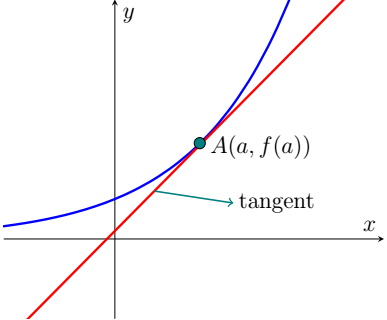
Once the gradient and the point on the curve are known, the tangent line equation can be found using point–slope form.
Equation of tangent: \( y – f(a) = f'(a)(x – a) \)
Steps to Find a Tangent
| Step | Action |
| 1 | Differentiate \( f(x) \) to find \( f'(x) \) |
| 2 | Evaluate gradient: \( f'(a) \) |
| 3 | Find the point on curve: \( (a, f(a)) \) |
| 4 | Substitute into \( y – f(a) = f'(a)(x – a) \) |
Example
Find the equation of the tangent to the curve \( y = x^2 + 1 \) at \( x = 2 \).
▶️ Answer / Explanation
Differentiate: \( y’ = 2x \)
Gradient at \( x = 2 \): \( y'(2) = 4 \)
Point on curve: \( (2, 2^2 + 1) = (2, 5) \)
Tangent:
\( y – 5 = 4(x – 2) \)
Example
Find the tangent to the curve \( y = 3\sqrt{x} \) at \( x = 4 \).
▶️ Answer / Explanation
Rewrite: \( y = 3x^{1/2} \)
Derivative: \( y’ = \dfrac{3}{2}x^{-1/2} \)
Gradient at \( x = 4 \):
\( y'(4) = \dfrac32 \cdot \dfrac14 = \dfrac{3}{8} \)
Point on curve: \( (4, 3\cdot 2) = (4, 6) \)
Tangent:
\( y – 6 = \dfrac{3}{8}(x – 4) \)
Example
Find the equation of the tangent to \( y = \dfrac{x}{x+1} \) at \( x = 1 \).
▶️ Answer / Explanation
Use quotient rule:
\( y = \dfrac{x}{x+1} \)
\( y’ = \dfrac{(x+1)\cdot1 – x\cdot1}{(x+1)^2} = \dfrac{1}{(x+1)^2} \)
Gradient at \( x = 1 \): \( y'(1) = \dfrac{1}{4} \)
Point on curve: \( (1,\ \dfrac{1}{2}) \)
Tangent:
\( y – \dfrac12 = \dfrac14(x – 1) \)
Normals to a Curve
The normal to a curve at a point is the straight line that is perpendicular to the tangent at that point. If the tangent has gradient \( m \), then the normal has gradient \( -\dfrac{1}{m} \).
Key Idea
If the tangent at \( x = a \) has gradient \( f'(a) \), then the normal has gradient \( m_{\text{normal}} = -\dfrac{1}{f'(a)} \).
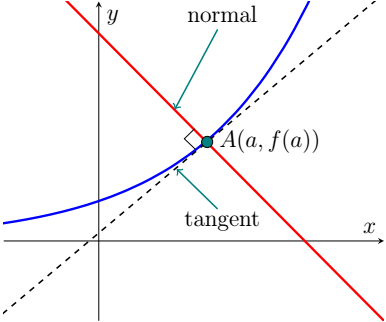
The normal line passes through the same point \((a,\ f(a))\).
Equation of normal: \( y – f(a) = -\dfrac{1}{f'(a)}(x – a) \)
Steps to Find a Normal
| Step | Action |
| 1 | Differentiate \( f(x) \) to find \( f'(x) \) |
| 2 | Evaluate gradient at \( x = a \): \( f'(a) \) |
| 3 | Find the normal gradient \( m_n = -\dfrac{1}{f'(a)} \) |
| 4 | Use point \( (a,\ f(a)) \) and write the line \( y – f(a) = m_n(x – a) \) |
Example
Find the normal to the curve \( y = x^2 \) at \( x = 1 \).
▶️ Answer / Explanation
\( y’ = 2x \)
At \( x = 1 \): \( y'(1) = 2 \)
Normal gradient:
\( m_n = -\dfrac{1}{2} \)
Point on curve: \( (1,1) \)
Normal:
\( y – 1 = -\dfrac{1}{2}(x – 1) \)
Example
Find the normal to \( y = \sqrt{x} \) at \( x = 4 \).
▶️ Answer / Explanation
Rewrite: \( y = x^{1/2} \)
\( y’ = \dfrac{1}{2}x^{-1/2} \)
At \( x = 4 \): \( y'(4) = \dfrac{1}{4} \)
Normal gradient:
\( m_n = -4 \)
Point on curve: \( (4,2) \)
Equation:
\( y – 2 = -4(x – 4) \)
Example
Find the normal to \( y = \dfrac{1}{x} \) at \( x = 2 \).
▶️ Answer / Explanation
Rewrite: \( y = x^{-1} \)
\( y’ = -x^{-2} = -\dfrac{1}{x^2} \)
At \( x = 2 \): \( y'(2) = -\dfrac{1}{4} \)
Normal gradient:
\( m_n = -\dfrac{1}{-1/4} = 4 \)
Point on curve: \( (2,\ \dfrac{1}{2}) \)
Normal equation:
\( y – \dfrac12 = 4(x – 2) \)
Example
For the curve \( y = x^3 – 3x + 2 \), find the equations of the tangent and the normal at \( x = 1 \).
▶️ Answer / Explanation
Step 1: Differentiate
\( y’ = 3x^2 – 3 \)
Step 2: Find tangent gradient at \( x = 1 \)
\( y'(1) = 3(1)^2 – 3 = 3 – 3 = 0 \)
So the tangent has gradient \( 0 \) → it is horizontal.
Step 3: Find the point on the curve
\( y(1) = 1^3 – 3(1) + 2 = 0 \)
Point: \( (1, 0) \)
Tangent Equation
Gradient = 0 → horizontal line
\( y = 0 \)
Step 4: Normal Gradient
Tangent gradient = 0 ⇒ Normal gradient = undefined (vertical line)
So the normal is:
\( x = 1 \)
Final Answers:
- Tangent: \( y = 0 \)
- Normal: \( x = 1 \)