
Structure of Mathematical Proof
A mathematical proof is a logical argument that shows a statement is always true. It proceeds from given assumptions through a sequence of correct logical steps to reach a clear conclusion.
At IAL level, proofs are usually algebraic or logical and must be written clearly, using correct mathematical reasoning.
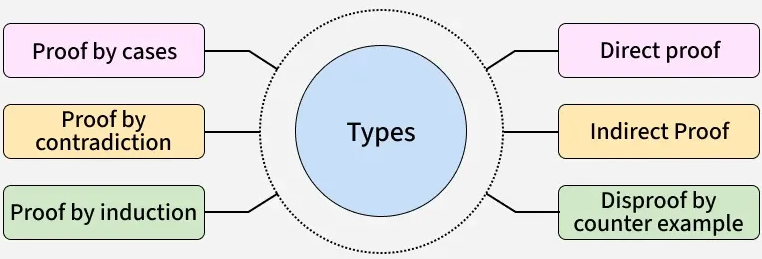
Basic Structure of a Proof
| Stage | What to Do |
| Given | State all assumptions and known information clearly. |
| Working | Use algebraic manipulation or logical reasoning step by step. |
| Justification | Each step must follow logically from the previous one. |
| Conclusion | State clearly what has been proven, often using “Hence” or “Therefore”. |
Common Proof Methods at IAL Level
- Direct proof: start from given assumptions and derive the result.
- Algebraic proof: use algebraic identities and manipulation.
- Proof using inequalities: compare expressions logically.
- Counterexample (to disprove): a single example showing a statement is false.
Language and Notation Used in Proofs
- “Assume that…” — introduces given conditions.
- “Let…” — defines variables.
- “Then…” — shows logical progression.
- “Hence” or “Therefore” — introduces the conclusion.
Example
Prove that the sum of two even integers is even.
▶️ Answer / Explanation
Let the two even integers be \( 2m \) and \( 2n \), where \( m \) and \( n \) are integers.
Their sum is:
\( 2m + 2n = 2(m + n) \)
Since \( m + n \) is an integer, the sum is divisible by 2.
Therefore, the sum of two even integers is even.
Example
Prove that if \( x \) is an odd integer, then \( x^2 \) is also odd.
▶️ Answer / Explanation
Assume \( x \) is an odd integer.
Then \( x = 2k + 1 \) for some integer \( k \).
Squaring:
\( x^2 = (2k + 1)^2 = 4k^2 + 4k + 1 \)
\( x^2 = 2(2k^2 + 2k) + 1 \)
This is of the form \( 2n + 1 \), which is odd.
Hence, if \( x \) is odd, then \( x^2 \) is odd.
Example
Prove that for all real numbers \( x \),
\( x^2 + 1 \ge 2x \).
▶️ Answer / Explanation
Start with the left-hand side:
\( x^2 + 1 – 2x = x^2 – 2x + 1 \)
Factorise:
\( x^2 – 2x + 1 = (x – 1)^2 \)
Since the square of any real number is non-negative,
\( (x – 1)^2 \ge 0 \)
Thus:
\( x^2 + 1 \ge 2x \)
Therefore, the inequality holds for all real \( x \).