
Disproof by Counterexample
A statement that claims something is true for all values can be disproved by finding just one example for which the statement is false. This method is called a disproof by counterexample.
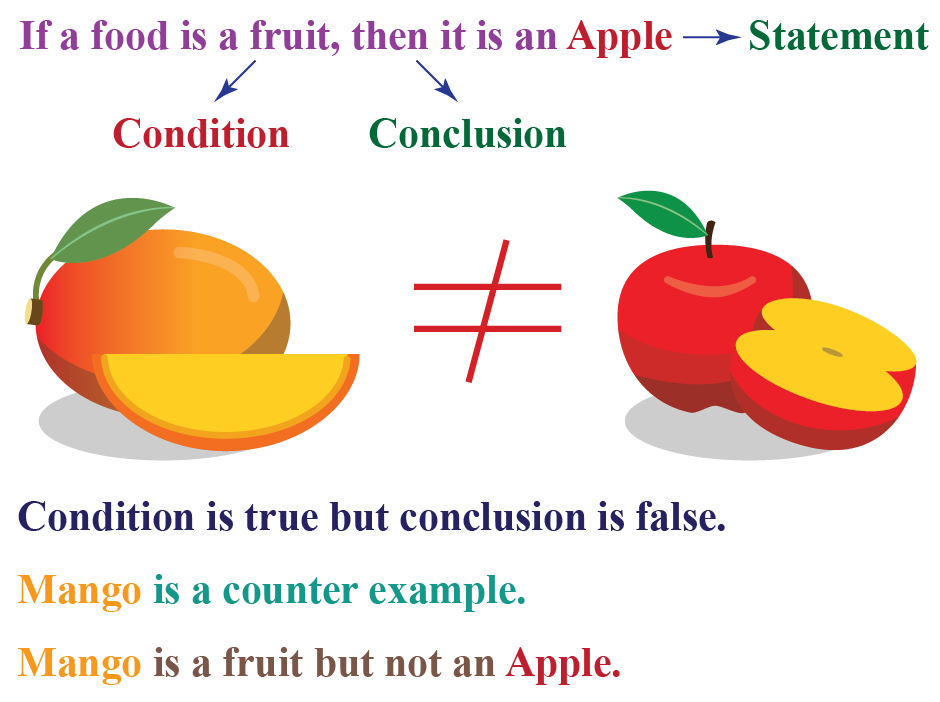
Unlike a proof, which must work for every case, a disproof requires only a single contradiction.
Structure of a Disproof by Counterexample
| Step | What to Do |
| State the claim | Clearly write the statement being tested. |
| Find a counterexample | Choose a value that contradicts the claim. |
| Verify | Substitute the value and show the result is false. |
| Conclude | State clearly that the statement is untrue. |
Example
Show that the statement “Every odd number is a prime number” is untrue.
▶️ Answer / Explanation
Take the odd number \( 9 \).
\( 9 = 3 \times 3 \)
Since 9 has factors other than 1 and itself, it is not a prime number.
Conclusion: The statement is false because 9 is an odd number that is not prime.
Example
Show that the statement “\( n^2 + n \) is odd for all integers \( n \)” is untrue.
▶️ Answer / Explanation
Let \( n = 2 \).
\( n^2 + n = 2^2 + 2 = 4 + 2 = 6 \)
Since 6 is even, the expression is not odd.
Conclusion: The statement is false because \( n^2 + n \) can be even.
Example
Show that the statement “\( n^2 – n + 1 \) is a prime number for all values of \( n \)” is untrue.
▶️ Answer / Explanation
Take \( n = 8 \).
\( n^2 – n + 1 = 8^2 – 8 + 1 \)
\( = 64 – 8 + 1 = 57 \)
\( 57 = 3 \times 19 \), so it is not a prime number.
Conclusion: The statement is false because when \( n = 8 \), the expression is not prime.